This page was translated automatically from German. View the original
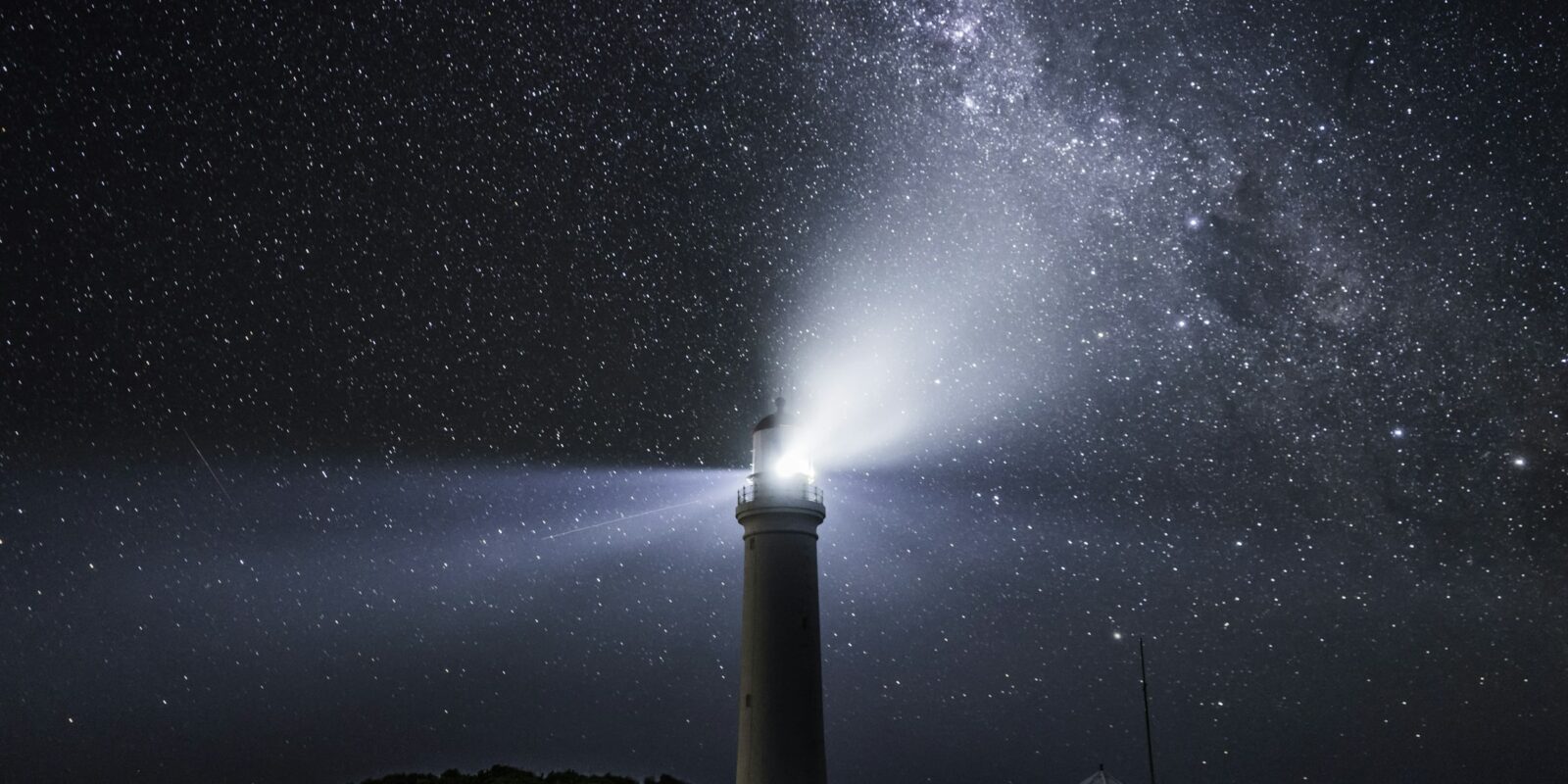
Every lighthouse has its own characteristic: a fixed rhythm of light and dark, a colour and a period in seconds. This light characteristic is given in the Seekarte and in the list of lights, and it tells you at night which lighthouse lies ahead of you.
The essentials at a glance
- On the chart, the characteristic appears in abbreviated form, for example Fl(3)WR.10s: three flashes, white and red, every 10 seconds. The colours are W white, R red, G green and Y yellow.
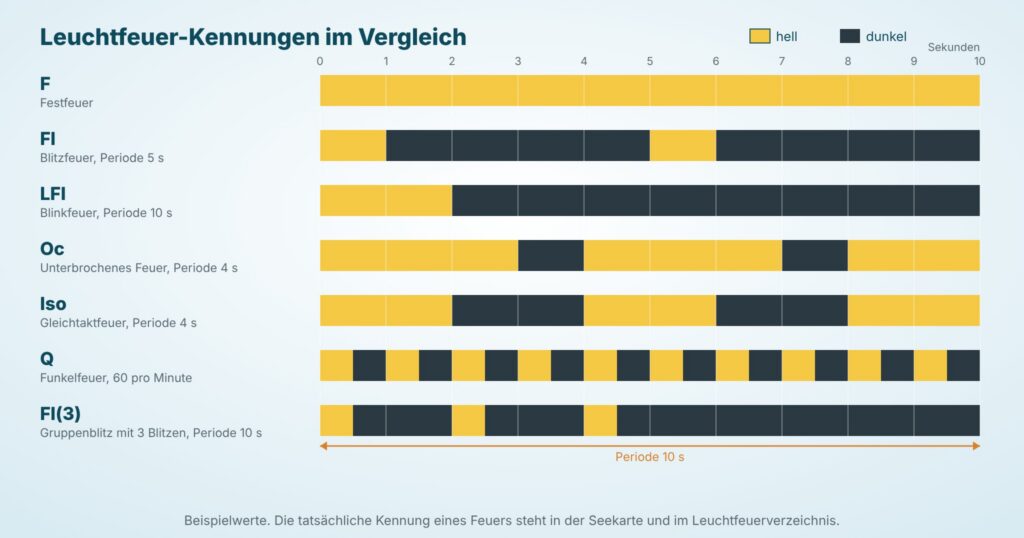
- Flashing light (Fl): The light is on for less time than it is off. Occulting light (Oc): The light is on for longer than it is off. Isophase light (Iso): Light and dark are of equal length.
- Quick lights (Q) flash 50 to 79 times per minute, and 60 times in German waters. Very quick lights (VQ) flash 80 to 159 times, and 100 to 120 times in German waters (as of November 2026).
- After the characteristic, the chart shows the light's height in metres (m) and its range in nautical miles (M).
- On board, you time the period with a stopwatch and compare it with the chart.
What does the characteristic of a light mean?
The characteristic is the fixed light rhythm by which you can unmistakably identify a light. It is chosen so that you can tell neighbouring lights apart and find each light again on the chart.
The types of characteristic are internationally agreed, and the abbreviations on charts are almost the same everywhere. The period is the time until the complete sequence repeats, for example a group of three flashes including all the pauses. On a given bearing, a light always shows the same characteristic.
Which light characteristics are there? Fl, Oc, Iso, Q at a glance
There are only a handful of basic types. The table shows them with their name, international abbreviation and the German short form, which you will find in the German regulations on navigational signs even today.
| Description | International | German short form | What It Looks Like |
|---|---|---|---|
| Festfeuer | F | F. | Constant light without interruption |
| Flashing light | Fl | Blz. | short flashes, dark period at least three times as long |
| Long-flashing light | LFl | Blk. | long flash of about 2 seconds or longer |
| Occulting light | Oc | Ubr. | long light, briefly interrupted |
| Isophase light | Iso | Glt. | Light and dark of equal duration |
| Quick flashing light | Q | Fkl. | 50 to 79 flashes per minute |
| Very quick flashing light | VQ | SFkl. | 80 to 159 flashes per minute |
| Morse code light | Mo(A) | – | Morse code made up of short and long lights, here “A” = short, long |
| Alternating light | Al | – | changes colour, for example Al.WR = alternating white and red |
A number in brackets means a group: Fl(3) is three flashes, then a long pause. Oc(2) is two occultations in a row. Fl(2+1) is a group of two flashes followed by a single flash.
Flashing or occulting light: how do you tell them apart?
Pay attention to which phase predominates. With a flashing light it is mostly dark and the light flashes up briefly. With an occulting light it is mostly bright and the light goes out briefly. With an isophase light you can count light and dark in the same rhythm, and the period is at least 2 seconds.
Quick flashing lights: what do Q, VQ and Q(6)+LFl mean?
A quick flashing light (Q) flashes about once a second, a very quick flashing light (VQ) about twice as fast. With groups, you count the flashes up to the pause.
White quick flashing lights are found mainly on cardinal marks: continuous quick flashing stands for north, groups of 3 for east and groups of 9 for west. Q(6)+LFl means six quick flashes followed by one long flash, which is the characteristic for south. How the marks look and how to pass them is explained in the article on buoyage and navigational marks.
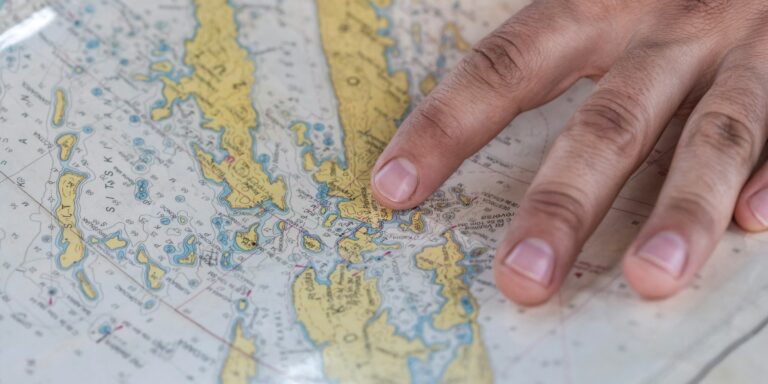
How do you read a light characteristic on the chart?
The details always appear in the same order: rhythm, colour, period, height of the light, range. An invented example to practise with is Fl(3)WR.10s 32m 15M.
- Fl(3): group flashing light with three flashes.
- WR: white and red light. If more than one colour is given without “Al”, it is as a rule a sector light.
- 10s: The group of three starts again every 10 seconds.
- 32m: The light is 32 metres above chart datum.
- 15M: The range is 15 nautical miles.
If no colour is given, the light is white. If the colours have different ranges, the chart shows, for example, 15/12M. You can find out how long a nautical mile is in the article on nautical mile.
What are sector lights, directional lights and leading lights?
All three show you, through the colour or position of the light, where you are in relation to a safe course. A sector light shows a different colour depending on the direction you view it from, and this tells you which area around the light you are in.
The sector boundaries are marked on the chart. They are given as true bearings from seaward, that is, relative to geographic north and as you would take them from the vessel. If the colour changes, you have crossed a sector boundary. A sector can mark a safe channel or a danger area; the chart shows which one it is.
A directional light is a single light with a narrow leading sector that marks the line of the fairway. Leading lights consist of two lights, one behind the other: the lower front light and the higher rear light behind it. If you see both vertically aligned, you are on the leading line.
Range and height of light: how far away can a lighthouse be seen?
The range tells you how far the light's intensity reaches. The height of the light determines whether, because of the curvature of the earth, it rises above the visible horizon at all. You only see the light when both conditions are met: it must be within range and above the horizon.
The range on German charts is based on a visibility of 10 nautical miles. In haze or rain you will see the light considerably later, and in very clear air it may be visible from further away. A powerful but low light, on the other hand, only appears above the horizon late, even in the best visibility. The higher your eye level on board, the earlier you will see it. The List of Lights contains tables showing when a light comes into view over the horizon.
How do you recognise a lighthouse at night? Using a stopwatch in practice
You observe the light, count the flashes in a group and time the period. Then you compare both with the chart.
- Beforehand, pick out on the chart the lights that should come into view on your course, and note down their characteristics.
- Observe the light for a while without a watch first: is light or dark dominant, are there groups, does the colour change?
- Start the stopwatch at the beginning of a group (first flash or first eclipse) and stop it at the beginning of the next.
- Time three periods in a row and divide by three. This evens out reaction errors.
- Dim the display of your watch or phone so that your eyes stay adapted to the dark.
If the rhythm, colour and period match the chart, you have identified the light and can take a bearing on it. The lights of other vessels follow their own rules, which the article on Navigation lights at sea explains.
Practise night navigation yourself
The quickest way to learn to recognise lights is on a night passage with an experienced crew. On Törnfinder you will find Sail trainingwhere you practise navigation with a chart and compass, and Mile building with night sailing.
Frequently asked questions
What do Fl, Oc and Iso mean for a lighthouse?
Fl stands for flashing light (short light, long dark), Oc for occulting light (long light, short dark) and Iso for isophase light (light and dark of equal length).
What is the difference between a flash and a long flash on a lighthouse?
A long flash (LFl) is a long period of light lasting about 2 seconds or more. A flashing light (Fl) shows much shorter flashes.
What does the number with “s” on the chart mean?
That is the period in seconds, in other words the time until the whole characteristic repeats. 10s means: the sequence starts again every 10 seconds.
What does “M” after the characteristic mean?
M stands for nautical miles and indicates the range of the light. The figure before it, with a lowercase “m”, is the height of the light in metres.