This page was translated automatically from German. View the original
Calais lies on the Strait of Dover, opposite the English coast. The Port de plaisance de Calais is in Bassin Ouest, a harbour basin between the beach and the town centre. Here you can read how to get to the start of your trip in Calais, where the Port de plaisance is, where to park and shop, what sailing weather and tides to expect, which destinations are nearby, and what skippers should know about the bridge, commercial shipping and marine weather.
The essentials at a glance
- Calais has two railway stations: Calais-Ville is right in the centre opposite the town hall, while the TGV station Calais-Fréthun is about nine kilometres outside the town. All city buses in the greater Calais area are free.
- You can only enter and leave the harbour when the Henri Hénon bridge opens: from two hours before to three hours after high water, once an hour.
- The Plaisance car park is at Bassin Ouest, and parking is free almost everywhere in Calais. The nearest supermarket is about 500 metres from the harbour.
- Calais is a tidal area. On a mean spring tide, the water rises to about 7.3 metres above chart datum at high water and falls to about 0.8 metres at low water.
Where is the Port de plaisance de Calais?
The Port de plaisance de Calais is in Bassin Ouest, the western harbour basin behind the Arrière-port, the inner outer harbour. The beach is only a few minutes' walk away, as is the Calais-Nord district with the Place d’Armes, and from there the town centre.
Map from OpenStreetMap. When the map is displayed, data is transmitted to the provider.
More InformationIn total, the Port de plaisance has around 390 berths, 340 of them on the pontoons in Bassin Ouest. A small number are in Bassin du Paradis, the oldest basin of the medieval harbour, next to the fishing quarter Courgain Maritime. It dries out at low water and is intended for a handful of small boats. Visiting yachts berth in Bassin Ouest.
Arriving at the start of your trip in Calais
From the airport to Calais
From Lille-Lesquin airport, a shuttle bus takes about 20 minutes to reach the railway stations in the centre of Lille. From Lille, the TGV takes about 30 minutes to Calais-Fréthun, and regional trains run to Calais-Ville in the centre. By car, Calais is about an hour from Lille via the A26.
By car, train, bus or ferry
By car, you reach Calais via the A16 from the direction of Belgium or Rouen, and via the A26 from the direction of Lille and Reims. It is about two hours from Brussels and about three from Paris.
By train, you arrive either at Calais-Ville, the station in the centre opposite the town hall, with regional trains to Lille, Dunkerque and Boulogne-sur-Mer, or at Calais-Fréthun, the TGV station about nine kilometres outside the town. From Paris, the TGV takes about an hour and a half to Calais-Fréthun. From Fréthun, the regional train and the free bus line 6 run into the centre.
From England, you can take the ferry from Dover: as things stand (November 2026), three ferry operators sail around the clock, every day of the week, with almost 40 departures a day in total. The crossing takes about 75 minutes. As a foot passenger, without a vehicle, only P&O Ferries takes travellers, and tickets are then only available online. By car, you can also take Le Shuttle through the Channel Tunnel from Folkestone to Coquelles on the edge of town.
In town you can ride the bus for free. The Imag’in network with 13 lines reaches as far as Sangatte, Blériot-Plage, Coquelles and Marck. There is also the small free Balad’in bus, which runs through the centre every 10 to 15 minutes from 9am to 7pm, Monday to Saturday, and also calls at the ferry terminal.
Parking
The Plaisance car park is right by the Bassin Ouest. Another car park on Boulevard de la Résistance is around 200 metres from the harbour, and the one at Place d’Armes in Calais-Nord is around 550 metres away. Parking is free almost everywhere in Calais. In the blue zones you need a parking disc; there you can park for a maximum of one and a half hours, Monday to Saturday, from 9am to 12pm and from 2pm to 7pm.
Showers and sanitary facilities
The sanitary facilities and showers are open around the clock, and you can get the access code from the harbour office. There is a laundry with a washing machine and a tumble dryer.
Shopping for the trip
The nearest supermarket, a Match, is around 500 metres from the harbour. For larger shops it is best to take the car: an Aldi is around 1.4 kilometres away and a Carrefour Market around 1.7 kilometres. Boat supplies are stocked by the chandler Calais Nautic right on the harbour basin.
Doctor, pharmacy and emergency services
A doctor's surgery is around 500 metres from the harbour. The nearest pharmacy is the Pharmacie Calais Côte d’Opale, around 450 metres from the harbour. The Pharmacie Royale and the Pharmacie de la Halle are each around 550 metres away. The emergency department of the Centre hospitalier de Calais on Boulevard des Justes is open around the clock and lies around four kilometres south-east of the harbour. In France you can reach the ambulance service, police and fire brigade free of charge on these numbers:
- 112: European emergency number, from landlines and mobiles
- 15: medical emergency (SAMU), 17: police, 18: fire brigade
- 196: sea rescue, if you are calling from the coast. At sea, call on VHF channel 16; the responsible rescue coordination centre is CROSS Gris-Nez.
What does the Port de plaisance de Calais offer?
The Port de plaisance is a sheltered basin with floating pontoons in which the water stays in even at low tide. It accepts visiting yachts with a draught of up to 3.5 metres all year round.
| Port de plaisance de Calais | Details |
|---|---|
| Location | Bassin Ouest, between the beach and Calais-Nord |
| Berths | around 390, of which 340 at floating pontoons in the Bassin Ouest |
| Tiefgang | up to 3.5 m |
| Access | via the Henri Hénon bridge, from 2 hours before to 3 hours after high water |
| VHF channel | 17 (Calais Port) for the outer harbour and the Arrière-port, 9 for the Bassin Ouest |
| Phone | +33 3 21 34 55 23 |
| Fuel station | Diesel and Super 98, around the clock by card |
| Berth fee per day | 2026 rates, April to September: 10 m 34 euros, 12 m 41 euros; October to March: 10 m 29 euros, 12 m 34 euros (as of November 2026) |
Equipment
Every pontoon has water and electricity at 220 volts and 6 amps. You have free Wi-Fi throughout the harbour, and the access code is available from the harbour office. The fuel station is on the quay near Pontoon D. For craning, there is a slewing crane of up to 2 tonnes and a travel lift for 35 tonnes, plus a space ashore for work on the underwater hull and a grid for drying out. Calais Nautic allocates crane appointments. Waste oil and filters are accepted at a dedicated collection point. The yacht club bar is located above the harbour office.
What is the sailing weather like in Calais?
Météo-France issues a warning for coastal waters as soon as winds of Force 7 on the Beaufort scale are observed or forecast.
Calais is a tidal sailing area. At mean spring tide, high water is at around 7.3 metres and low water at around 0.8 metres above chart datum; at mean neap tide, at around 6 and around 2 metres. You should therefore plan your departure and arrival around the tide and the bridge opening times.
Which sailing destinations are near Calais?
From Calais you sail along the French coast eastwards towards Dunkirk and Belgium, or south-west around Cap Gris-Nez to Boulogne-sur-Mer.
- Gravelines: The small town on the Aa lies on the coast between Calais and Dunkirk.
- Dunkirk: In the middle of the town lie the Bassin du Commerce and the Bassin de la Marine, which you reach through a lock. The Port du Grand Large on the fairway is currently being rebuilt (as of November 2026): all pontoons have been removed since October 2026, and the renewed harbour is due to open in spring 2028. You can read more in the profile of the harbours in Dunkirk.
- Nieuwpoort: The Belgian coast begins east of Dunkirk, and that is where Nieuwpoort lies.
- Boulogne-sur-Mer: South-west, beyond Cap Gris-Nez, lies Boulogne with its marina. The pontoons in the outer harbour are accessible around the clock, 70 berths are reserved for visitors, and you reach the Bassin Napoléon behind it through a lock.
- Dover: Dover Marina lies on the other side of the Strait of Dover, beneath the white cliffs. It has visitor berths and berths both with and without tidal influence. On the way you cross the traffic separation scheme. You can read more about this in the profile of the Dover Marina.
- Ramsgate: Ramsgate, with its Royal Harbour, lies on the Kent coast, also beyond the traffic separation scheme.
For detailed planning, use the nautical chart.
What can you do on a harbour day in Calais?
- Calais Lighthouse: The lighthouse stands in the middle of the town, only a few hundred metres from the Arrière-port. From the top you have a panoramic view over the town, the harbour and the hinterland, and in clear weather as far as the cliffs of Dover.
- Courgain Maritime: The old fishermen's quarter lies right next to the Bassin du Paradis. Early risers can see the fishermen selling their catch directly from the stalls on the Place du Minck.
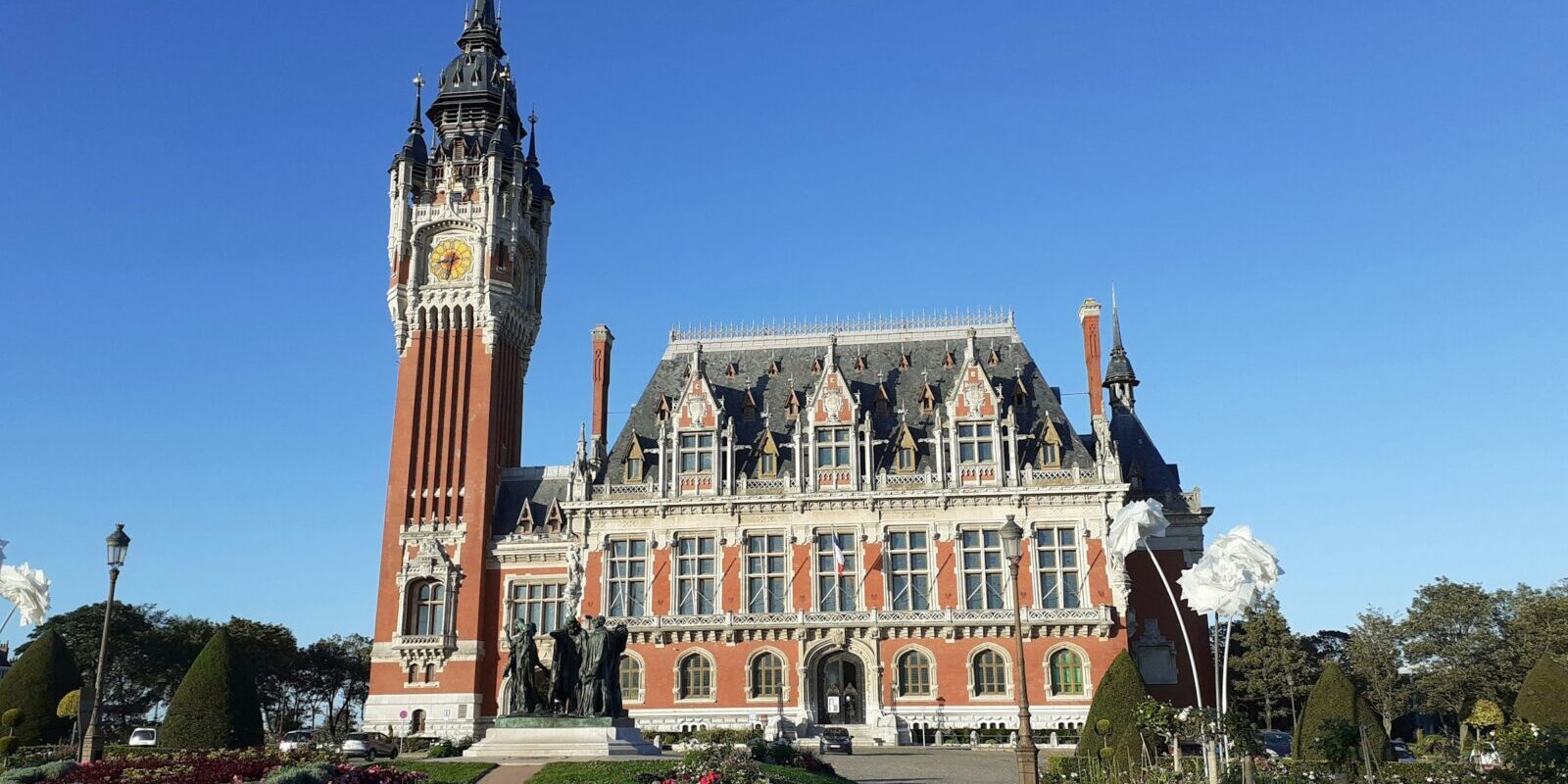
- Town hall and belfry: The town hall's 75-metre-high belfry is a UNESCO World Heritage Site and can be visited. In the garden in front stands Rodin's sculpture “The Burghers of Calais”.
- Seafront promenade and dragon: The promenade along the beach, around 1.3 kilometres long, has been redesigned. A giant mechanical dragon walks along it, and you can ride on its back for a trip of about 45 minutes.
- Cap Blanc-Nez: About eleven kilometres to the west, the cliffs of Cap Blanc-Nez rise up, with walking trails and views across the strait to England. Depending on the season, the free bus line 5 runs to the cape, using an open-top double-decker bus.
For skippers: berthing, bridge and marine weather in Calais
Calais is a large ferry port where commercial shipping has priority in the fairway. Before any movement in the outer harbour and in the Arrière-port, call Calais Port on VHF channel 17; for the Bassin Ouest, call the Port de plaisance on channel 9.
Registration and Berthing
Announce your visit by phone on +33 3 21 34 55 23 or by e-mail, stating your arrival date and boat dimensions. The harbour team will assign you a berth; visitor berths are allocated according to availability. You will be berthed at floating pontoons. Immediately after arrival, register at the harbour office with your boat papers and proof of insurance. If you arrive late, moor at the visitors' pontoon and report to the office as soon as it opens.
The harbour office is staffed from May to September from 9am to 6pm, daily in July and August, otherwise Monday to Saturday. From May to August the team adjusts its hours, between 8am and 8pm, to the bridge openings. From October to April the office is open Monday to Friday from 9am to 4.30pm, with an on-call service at weekends.
Henri Hénon bridge
The Bassin Ouest is a basin with a lock, and the approach leads under the Henri Hénon bridge. The bridge opens at hourly intervals, six times per tide: two hours and one hour before high water, at high water, and one, two and three hours after. The exact times are published every month as a table by the Calais harbour master's office. They are posted on the Quai de la Colonne, at the lock and in the harbour office, and are available on the Port de plaisance website. Individual openings may be cancelled; these are marked as cancelled in the table.
If you are waiting for the next opening, moor at one of the waiting buoys in the Arrière-port. The buoys are intended for boats waiting for the bridge or staying only briefly, for two tides at most, with only one boat per buoy. Anchoring is prohibited in the Arrière-port.
Harbour rules
In the outer harbour the maximum speed is 10 knots, in the inner fairway and in the Arrière-port 8 knots, and in the Bassin Ouest and the Bassin du Paradis 5 knots. In the harbour you proceed under engine; you must not move about there under sail alone. The harbour's light signals and the instructions of the harbour authority apply without exception when entering and leaving. In the Bassin Ouest you moor only at the pontoons, not at the quay walls and not rafted up at the pontoon head. Keep dogs on a lead throughout the harbour. Open fires on land and on the pontoons are prohibited, and so are barbecues on board.
Approach
Off Calais there are two sandbanks parallel to the coast, the Ridens de Calais and, further to the southwest, the shallow bank Ridens de la Rade, where the sea breaks. Both are marked with lit buoys, and you should give them a wide berth. Good landmarks are the lighthouse in the middle of the town, the red-and-white chimney east of the harbour and the signal tower on the east pier. West of the town you can see Cap Blanc-Nez with the Dover Patrol memorial.
Crossing to England
If you are sailing to Dover or Ramsgate, you will cross the traffic separation scheme in the Strait of Dover. Cross the traffic lanes with your bow as close to a right angle to the direction of traffic as possible; what counts is your heading, not your course over ground. As a sailing vessel you must not impede power-driven vessels following the traffic lane; if the wind is not sufficient for this, use the engine. Expect plenty of ferries and fast ferries crossing the traffic lanes.
For arrival in Great Britain, register the boat online with the Pleasure Craft Report with the British border authority. From the 12-nautical-mile limit, fly the yellow Q flag. Anyone who does not hold a British or Irish passport may go ashore only with the permission of the border authority. The details can be found on the UK government's website.
Great Britain is not part of the Schengen Area. Anyone leaving France for Great Britain or returning from there, together with the whole crew, is subject to French border controls, regardless of nationality. The Port de plaisance de Calais takes part in a procedure run by customs and the border police: before departing for Great Britain, you send the harbour office the border control form with the list of all persons on board and the boat details. When you return from Great Britain, you ask the harbour office for permission to enter and send the form at the latest when you leave the British harbour. The form and further details can be found on the French customs website.
Which marine weather forecast applies in Calais?
The Météo-France marine weather forecast is the authoritative source. Calais lies in the coastal zone "De la frontière belge à la baie de Somme", and the coastal forecast applies up to 20 nautical miles off the coast.
The CROSS Gris-Nez rescue coordination centre broadcasts the forecast on VHF channel 79: via the Gris-Nez transmitter at 7:10, 13:10 and 19:10 local time, and via the Dunkerque transmitter at 7:20, 13:20 and 19:20 local time. All stations and broadcast times are listed in the Marine weather guide from Météo-France.
Sailing trips from Calais on Törnfinder
You will find offers on all French coasts at Sailing in France, and all offers with dates and departure harbour at Trips.
Frequently asked questions
How do I get from Calais-Ville station to the Port de plaisance?
On foot or by the free Balad’in bus, which links the station, the tourist office and the harbour. The Port de plaisance lies between Calais-Nord and the beach. From Calais-Fréthun, you take a regional train or bus line 6 into the centre.
Where do I park at the start of my trip in Calais?
In the Plaisance car park right by the Bassin Ouest or on the Boulevard de la Résistance, about 200 metres from the harbour. Parking is free almost everywhere in Calais; in blue zones you need a parking disc during the day.
Where do I shop for provisions in Calais?
The nearest supermarket, a Match, is about 500 metres from the harbour in Calais-Nord. For a big shop, drive to Aldi, about 1.4 kilometres away, or to Carrefour Market, about 1.7 kilometres away.
When can I enter the Port de plaisance?
From two hours before to three hours after high water, when the Henri Hénon bridge opens, once an hour. Until then, you wait at a buoy in the Arrière-port.