This page was translated automatically from German. View the original
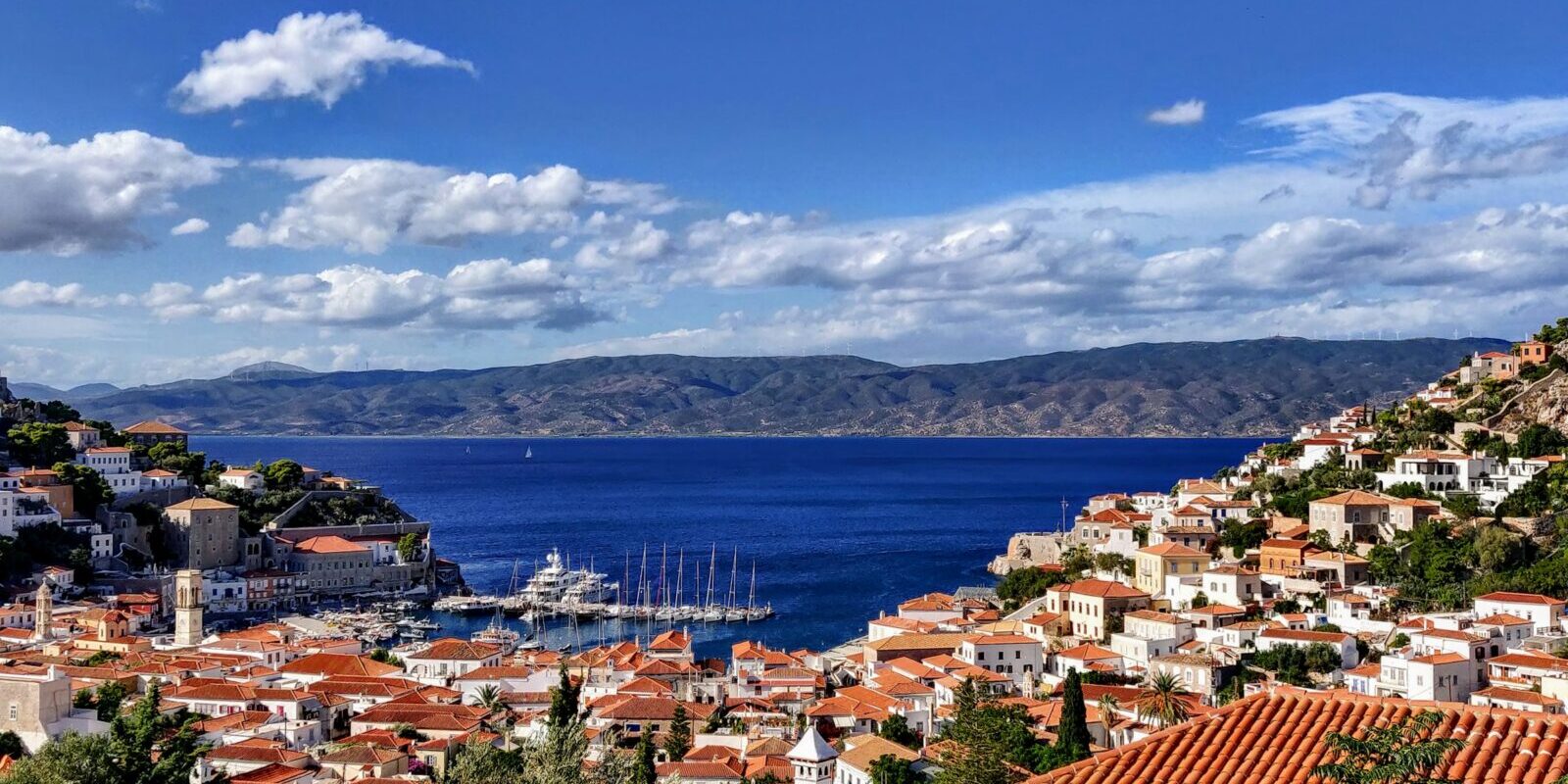
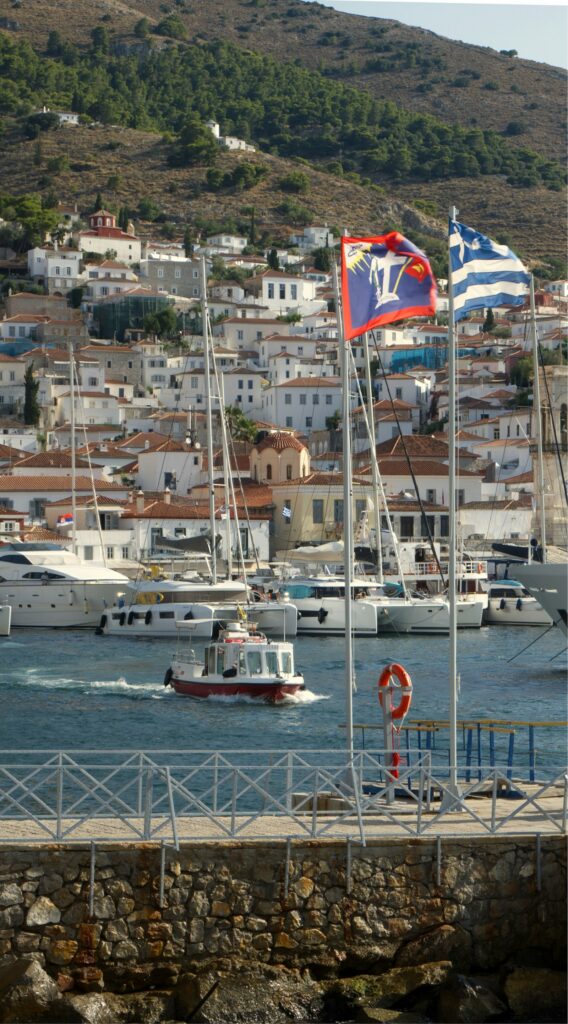
Hydra, Greek Ýdra, is the main town of the island of the same name in the Saronic Gulf. It lies on the island's north coast, opposite the coast of the Peloponnese and about 36 nautical miles southwest of Athens. The town curves around an almost circular harbour basin like an amphitheatre, and there are no private cars on the island. Here you can read how to get to the harbour of Hydra at the start of your trip, where to leave your car and do your shopping, what winds to expect, which destinations between Dokos, Ermioni and Spetses are close by, and what skippers should know about berthing in the often crowded harbour.
The essentials at a glance
- Hydra has no airport. From Athens airport you take the metro to Piraeus, from where high-speed ferries run to Hydra all year round.
- There are no private cars on the island. You drive as far as Metochi on the opposite Peloponnese coast and cross by boat.
- Yachts lie stern-to with stern lines and their own anchor on the quay in the harbour basin, right in the middle of the town.
- Small supermarkets are about 110 to 190 metres from the harbour basin. There are no large supermarkets on the island.
- On Hydra, luggage and shopping are transported by mule, donkey or handcart, and water taxis run around the clock.
Where is the harbour of Hydra?
The harbour of Hydra lies in a small bay on the island's north coast, about four nautical miles from Metochi on the mainland. A narrow entrance leads into an almost circular basin, surrounded by the captains' houses, cafés and tavernas of the town. A breakwater protects the basin to the north.
Map from OpenStreetMap. When the map is displayed, data is transmitted to the provider.
More InformationIn the basin, yachts, ferries, fishing boats and water taxis lie close together. The high-speed ferries from Piraeus and the boats from Metochi berth on the east side of the harbour. To the west is the small bay of Kamini with a fishing harbour, and to the east the bay of Mandraki, the island's former naval harbour.
Arriving in Hydra at the start of your trip
You can only reach Hydra by water. Most guests joining a trip fly to Athens and take the ferry from Piraeus. If you arrive by car, you drive to the Peloponnese and cross from Metochi or Ermioni.
From Athens airport to Hydra
The nearest airport is Athens International Airport. From there, metro line 3 runs directly to the port of Piraeus, currently (as of November 2026) every 36 minutes. The journey takes up to an hour.
The high-speed ferries to Hydra leave from Piraeus. The route is served all year round, exclusively by fast boats and catamarans that carry passengers only. Currently (as of November 2026), around ten to twelve ferries a day run from May to September, and at least two during the rest of the year. Depending on the vessel and any intermediate stops, the crossing takes between just over one and just over two hours. In July and August and at weekends the ferries are often fully booked, so it is best to book your tickets early.
By car and boat via Metochi or Ermioni
By car, you drive from Athens via the Attiki Odos and the motorway to Corinth, then after the Isthmus towards Epidavros and on along the coast via Galatas, opposite Poros, to Metochi. The journey takes about 2 hours and 45 minutes. Metochi is the point on the mainland closest to Hydra.
Passenger boats run daily from the jetty in Metochi to Hydra, and the crossing takes about 12 to 25 minutes depending on the boat. You can buy your ticket at the kiosk in Metochi or on board. Water taxis also run, even at night, and can be booked in advance. On Hydra, the boats arrive on the east side of the harbour, near the high-speed ferry quay.
Alternatively, you can drive to Ermioni in about 2 hours and 30 minutes and take a boat to Hydra from there. Bicycles are not permitted on Hydra.
Parking
You cannot park on Hydra itself, as no private vehicles are permitted on the island. In Metochi there is a large, guarded car park about 170 metres from the jetty. It is staffed around the clock and you do not need to reserve a space. You leave your car there at your own risk.
Shopping for the trip
There are several small supermarkets at the harbour of Hydra. Super K is about 120 metres from the harbour basin, and you will find more small supermarkets about 110 to 190 metres away in the lanes behind the quay. Greengrocers and bakeries are right next door. There are no large supermarkets on the island, so for a big shop, stock up on the mainland beforehand. Because everything comes aboard on foot or by handcart, allow a little extra time for larger quantities.
Doctor, pharmacy and emergency services
In the town, about 210 metres from the harbour basin, is the Kouloureio hospital “Panagia Faneromeni”, telephone +30 22980 53150. It offers basic care in internal medicine, paediatrics, laboratory, X-ray and ultrasound, as well as consultations in various specialities. There is also a health centre, telephone +30 22980 52420.
Hydra has two pharmacies. The Rafalias pharmacy is about 290 metres from the harbour basin, telephone +30 22980 52059, and you can reach the Gavalas pharmacy on +30 22980 53260. At weekends, one of the two is on call. In urgent cases, the Greek emergency numbers apply:
- 112: European emergency number for police, ambulance and fire brigade
- 166: Emergency services, 100: Police, 199: Fire brigade
- 108: Coast Guard, also for emergencies at sea; at sea also VHF channel 16
What does the harbour of Hydra offer?
The harbour of Hydra is a town harbour without marina operations. The harbour office of Hydra is responsible for the berths, and water is supplied by the municipal port fund.
| Feature | Harbour of Hydra |
|---|---|
| Location | Centre of Hydra, north coast of the island, opposite the Peloponnese |
| Position | 37° 21,0′ N, 023° 28,0′ E |
| Berths | on the quay in the south and on the inside of the breakwater, stern-to with stern lines and your own anchor |
| Water depth | about 2 to 4 metres |
| Harbour master's office | Limenarchio Ydras, telephone +30 22980 52279 |
| Water | Municipal port fund, telephone +30 22980 52333 |
| Ferries (as of November 2026) | Piraeus year-round, passenger boats to Metochi |
| Nearest airport | Athens |
Equipment
You can get water at the quay. There is no fuel station for yachts, no showers for visiting boats and no workshop in the harbour, and the shops only sell boating supplies for fishermen. Around the harbour basin, however, you will find supermarkets, bakeries, tavernas, cafés, banks and the post office. The police and the harbour authority have their offices right on the harbour.
What wind can you expect around Hydra?
In summer the Meltemi also dominates the Saronic Gulf, but here it blows less steadily and more gently than in the Cyclades. Around Aegina and Poros it mostly comes from north-northeast to northeast, reaching no more than Force 4 to 6 along the mainland coast. Further towards the Peloponnese the wind often shifts to south or north and becomes noticeably weaker. West of Hydra, towards the small island of Trikeri, it often blows from an easterly direction, and thermal southerly winds frequently spring up towards Poros.
The harbour is well protected against the prevailing summer winds. In strong winds from north to northwest, however, swell runs into the basin, and in strong southerlies it gets choppy. In a strong northeasterly, violent gusts come down from the mountains on the south coast of Hydra. In the early and late season, passing lows also bring strong northerly or southerly winds. Warnings are issued by the Greek weather service EMY.
Which sailing destinations are near Hydra?
Hydra lies between the Saronic Gulf and the Argolic Gulf. The destinations in the Gulf of Hydra are short hops, and you can reach Poros and Athens in a day. For planning, rely on the nautical chart.
- Mandraki (approx. 1 nm): The bay east of the harbour used to be the island's naval harbour. You anchor in 3 to 6 metres of water over sand, seagrass and mud. The bay is open to the north, and water taxis run into the village.
- Molos and the west coast of Hydra (approx. 3 to 6 nm): The bay of Molos is a good alternative in most northerly winds. Further west lie the small bays of Bali and Agios Georgios, as well as the bay of Agios Nikolaos at the southwest tip.
- Dokos (approx. 7 nm): The small island west of Hydra and its waters form an archaeological park. In the bay of Skintos, the Hydra fleet spent the winter of 1821, and off the coast the Dokos wreck dating from around 2700 to 2200 BC was found.
- Ermioni (approx. 10 nm): This quiet village on the Peloponnese lies at the foot of a wooded headland. You anchor near the ancient mole or moor behind the outer mole.
- Poros (approx. 14 nm): Around the eastern tip of the Peloponnese you reach the harbour of Poros, opposite Galatas. More in the profile of the Port of Poros.
- Spetses (approx. 16 nm): The island lies to the southwest, at the entrance to the Argolic Gulf. Berths in the harbour are scarce.
- Athens (approx. 36 nm): Most charter yachts in the sailing area start from Athens, especially from Marina Alimos. More in the profile of the Marina Alimos.
What can you do on a harbour day in Hydra?
The best way to explore Hydra is on foot. There have been no cars on the island since the 1950s, only a few municipal vehicles for emergencies. Cobbled lanes lead from the harbour up to whitewashed houses, small churches and courtyards. The large stone houses date from the 18th and early 19th centuries, when Hydra was an important seafaring island. During the War of Independence from 1821, the Hydriots converted their merchant ships into warships.
- Historical Archive and Museum: The museum stands right on the harbour. It displays items from the Greek Revolution and the wars of the 20th century, and houses the island's library.
- Cathedral of the Assumption of Mary: The church with the tall bell tower stands in the middle of the harbour. The Ecclesiastical and Byzantine Museum is housed in its premises.
- Mansion of Lazaros Kountouriotis: The house above the harbour to the southwest is a branch of the National Historical Museum and displays furniture, paintings and mementos of the family.
- Bastions and bathing spots: To the left and right of the harbour entrance stand the old bastions with their cannons. Below them lie the rocky bathing spots of Spilia and Hydronetta and the pebble beach of Avlaki, a few minutes' walk from the harbour.
- Kamini and Vlychos: Follow the coast westwards to the small fishing harbour of Kamini and on to the village of Vlychos with its pebble beach.
- Profitis Ilias Monastery: At an altitude of around 500 metres on Mount Eros lie the monasteries of Profitis Ilias and Agia Efpraxia. In 1825, Theodoros Kolokotronis and other fighters of the War of Independence were imprisoned here for a time.
In the evening, when the day visitors have left, the harbour grows quieter. The lights of the tavernas are then reflected in the water.
For skippers: mooring, harbour office and marine weather in Hydra
Hydra's harbour is considered one of the most popular and most crowded in the Saronic Gulf. In season the few berths are often taken by early afternoon, and at weekends many yachts arrive from Athens. Channel 16 is the distress and calling channel.
Registration and Berthing
- The harbour office of Hydra, the Limenarchio Ydras, is responsible for berthing. You pay the harbour dues there and should bring the ship's papers with you. Telephone +30 22980 52279.
- Visiting yachts moor stern-to with their own anchor on the south quay or on the inside of the breakwater. The outside of the breakwater is less busy, but it is considerably less sheltered.
- The left-hand part of the quay is reserved for water taxis, the right-hand part for other commercial boats. The east pier belongs to the ferries, and the fishermen also have their own berths.
- In high season, yachts lie in two or three rows, one behind the other. The outer boats then pass their stern lines to the yachts in the first row. This is only for experienced crews and calm weather.
Harbour rules and anchoring
Anchoring freely in the harbour basin is not permitted because of the lack of space. Outside the breakwater, the seabed drops away quickly to more than 20 metres. In the basin, anchors often snag, and the holding is poor in places. A trip line on the anchor is therefore a good idea. Water taxis run around the clock and create wash, and the ferries add to it. If you cannot find a berth, move to the bays of Mandraki or Vlychos and take the dinghy or the water taxi into the village.
Approach
The approach is easy. However, there are several rocks near the northern breakwater. There is a lot of traffic around the harbour and towards the mainland from ferries, water taxis and excursion boats. If you are coming from Poros, watch out for high-speed ferries in the narrows near Cape Skyli, where they appear at great speed.
Formalities in Greece
Recreational boats over seven metres in Greek waters are liable for the TEPAI yacht fee. It is paid monthly and in advance via the platform of the Greek tax authority AADE, and for commercially used yachts it is paid by the owner or operator (as of November 2026). Details can be found in the AADE FAQ on TEPAI (in Greek).
Which marine weather forecast applies around Hydra?
The relevant forecast is the marine weather report of the Greek meteorological service EMY, known in English as HNMS. You can get it on the Meteorological Service website. In the forecasts, the sea area of the Saronic Gulf is called Saronikos.
The stations Iraklio and Limnos broadcast the forecasts for Saronikos via NAVTEX on 518 kHz. Olympia Radio also broadcasts weather reports in Greek and English on VHF, for the Athens area via the Parnitha station on channel 25. Gale warnings are broadcast on channel 16.
Sailing trips from Hydra on Törnfinder
You will find sailing trips in the Saronic Gulf and from other Greek harbours under Sailing in Greece, and offers around the islands under Sailing in the Aegean and all sailing areas in the trip overview.
Frequently asked questions
How do I get from Athens airport to Hydra?
Metro line 3 takes you directly from the airport to the port of Piraeus. From there, high-speed ferries take you to Hydra in a little over one to just over two hours.
Can I drive to Hydra?
No, private vehicles are not allowed on Hydra. You drive to Metochi on the Peloponnese, leave the car in the guarded car park and cross over by passenger boat or water taxi.
Where do I buy supplies for the trip in Hydra?
In the small supermarkets by the harbour, for example Super K, around 120 metres from the harbour basin. There are no large supermarkets on the island, so it is better to do a big shop beforehand on the mainland.
Are there showers in Hydra harbour?
No, there are no showers for visiting yachts in the harbour. You can get water at the quay.
How do I get my luggage to the boat?
On Hydra, everything is transported by mule, donkey or handcart. As the yachts lie at the quay in the middle of the village, the way from the ferry quay is short.
When can I find a berth in Hydra harbour?
Most likely in the shoulder seasons and during the week. In high season, the berths are often taken by early afternoon. Alternative bays are Mandraki and Vlychos, from where water taxis run into the village.