Symbolic image
This page was translated automatically from German. View the original
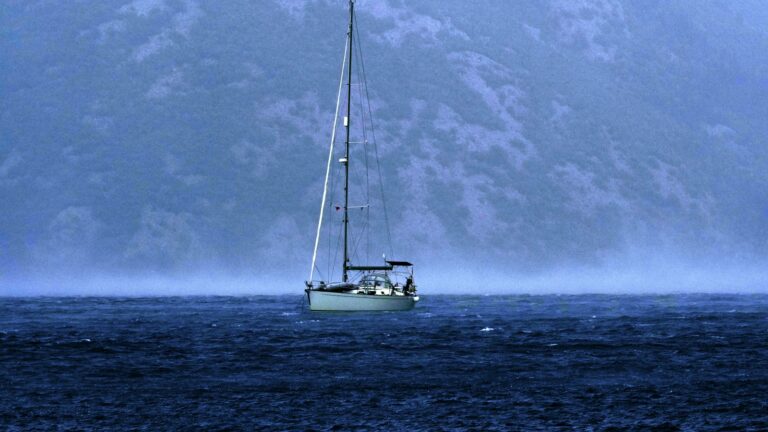
During the night of 17–18 October 2026, volunteer sea rescuers from the Timmendorf station on Poel retrieved a single-handed sailor from his roughly nine-metre yacht in the Salzhaff near Rerik. The anchor had failed to hold in gusts of Force 7 to 8, and the boat was drifting towards shallow water with stones. The case shows what matters when anchoring in strong winds.
The essentials at a glance
- Location: Salzhaff near Rerik, south of the sand island Kieler Ort on the Baltic coast of Mecklenburg-Vorpommern.
- The sailor had sought shelter there because of the increasing wind; after midnight the anchor no longer held.
- Because of the rough sea, the sea rescuers needed around an hour and a half to reach the scene instead of the usual 20 minutes.
- The sailor came ashore in Timmendorf at around 03:30; the stranded yacht was towed free on Sunday.
What happened in the Salzhaff?
A single-handed sailor was on passage from Kirchdorf on Poel to Kühlungsborn when the wind grew stronger over the course of the day. He put into the Salzhaff and anchored south of Kieler Ort, as the Deutsche Gesellschaft zur Rettung Schiffbrüchiger (DGzRS) describes in its incident report.
After midnight, storm-force gusts of Force 7 to 8 set in, corresponding to up to 74 km/h according to the DGzRS. The anchor no longer held and the yacht dragged. Because she was drifting towards stones in shallow water and was in danger of holing, the sailor alerted the maritime rescue coordination centre. The lifeboat from the volunteer station launched at 00:40.
Towing was not possible under these conditions. The crew coordinated by telephone with the sailor and took him aboard in a brief moment when both boats came close enough. Gusts and rain showers repeatedly obscured visibility. In Timmendorf the man was handed over to the water police. On Sunday the sea rescuers helped, at their request, to free the yacht, which had by then run aground, from the Salzhaff. Afterwards the sailor was able to make for a nearby harbour with his yacht.
Anchoring in strong winds: what matters?
The crucial thing is that you make the decision between anchorage and harbour early, whilst the wind still leaves room for manoeuvre. Anyone who only anchors when it is already stormy has scarcely any reserves if the anchor fails to hold.
Monitor weather forecasts and warnings continuously
The Deutscher Wetterdienst (DWD) issues strong wind and gale warnings for the German coast. You can find them on the Binnensee- und Küstenwarnungen des DWDpage, together with the marine weather forecasts via radio and internet. The DGzRS advises checking weather and sea state before every departure and continuing to monitor them whilst under way. If the situation deteriorates, you should break off the trip in good time. Pay particular attention to the forecast gusts, not just the mean wind.
Check holding ground and room to leeward
An anchorage in strong winds should offer good holding ground and above all room to leeward. If there is shallow water, stones or a shore behind you, you have scarcely any time if the anchor drags. The chart and pilot book show you what lies beneath. Also plan how you would leave the anchorage at night.
Rode, swinging room and anchor watch
The more wind is expected, the more generously you should veer the rode, provided the swinging room allows it. How much exactly is sensible depends on water depth, ground tackle, boat and bottom; a fixed figure does not suit every situation. As soon as the anchor is set, take bearings or set an anchor alarm via GPS or app. With strong winds forecast, a proper anchor watch is worthwhile. Single-handed that means: set an alarm, check regularly and record position, wind and barometric pressure in the Logbuch logbook.
Better early into harbour
A sheltered harbour is almost always the calmer choice than an anchorage when a gale warning is in force. The DGzRS recommends staying in harbour in stormy weather and advises identifying alternative harbours during passage planning.
Call for help early
Calling for help is not a defeat. The DGzRS expressly asks you to contact the Maritime Rescue Coordination Centre even when a situation could become dangerous, not just in an acute emergency. The Maritime Rescue Coordination Centre (MRCC Bremen) can be reached on VHF channel 16 and channel 70 (DSC) with the call sign "Bremen Rescue", and around the clock on 0421 53687-0. From German mobile networks it can also be reached on 124 124 near the coast; the DGzRS points out that this is a service number provided by the network operators. Via 112 you can be connected to the Maritime Rescue Coordination Centre. All contact details are on the emergency page of the sea rescuers (as at October 2026).
Anchoring manoeuvres in wind are best practised with experienced people on board. On Törnfinder you will find offers for a Skipper training and trips for Sailing in the Baltic Sea, where anchoring and weather planning are part of everyday life on board.
Frequently asked questions
Where can I get strong wind and gale warnings for the Baltic Sea?
From the Deutscher Wetterdienst. It publishes coastal warnings and marine weather reports online and by radio. Check them before setting off and several times a day underway.
How do I notice at night that my anchor is dragging?
With an anchor alarm via GPS or app and with bearings that you memorise after anchoring. In strong winds, regular checks on deck are also part of the routine.
When should I call the sea rescuers?
Early. The DGzRS asks you to make contact as soon as a situation could become dangerous. The Maritime Rescue Coordination Centre can be reached on VHF channel 16, DSC on channel 70 and by telephone on 0421 53687-0 (as at October 2026).