This page was translated automatically from German. View the original
Whether anchoring overnight in a bay or during a brief swimming stop, the anchor gear helps decide whether a yacht lies quietly or drags across the bottom. This covers the common anchor types, chain, rode and accessories, and how much chain you let out relative to water depth.
The essentials at a glance
- Anchor gear comprises the anchor, shackle, possibly a swivel, chain or chain with rode, the anchor windlass with matching gypsy, a chain stopper and a snubber.
- Every anchor type has its favourite bottom: sand and firm mud usually hold well, weed and rock are difficult for many anchors.
- As a lower limit, about 3:1 between deployed length and depth applies; around 5:1 is usual, in stronger wind 7:1 to 8:1. Measured from the bow roller to the seabed.
- Chain size and windlass gypsy must match. Refer to the windlass manufacturer's table.
What does anchor gear consist of?
Anchor gear is the entire connection from the seabed to the foredeck, not just the anchor. Every part must suit the load, because the weakest link determines what the whole assembly can withstand.
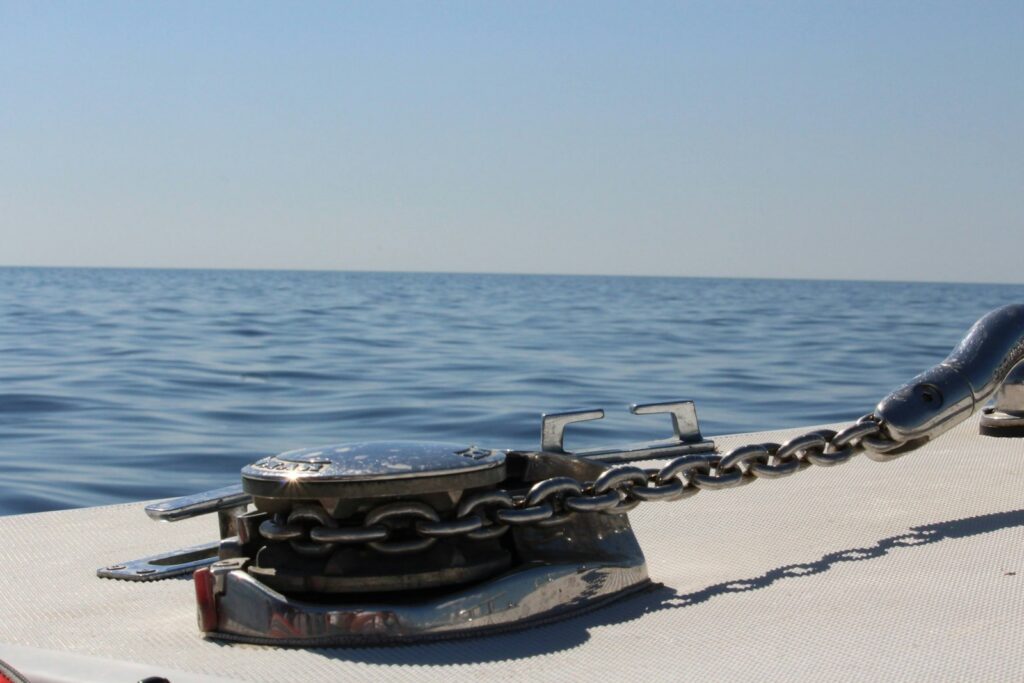
From the bottom upwards come anchor, shackle, possibly a swivel, chain and often a rode, then windlass, chain stopper and, with all-chain, a snubber.
How does an anchor hold?
An anchor holds not by its weight, but because it digs in and pushes bottom material ahead of it. This only works if the pull sets in as flat as possible to the seabed.
If the chain leads steeply upwards, it levers the point out of the bottom. Modern anchors differ chiefly in how reliably they settle into the right attitude and how they react when the wind shifts.
What anchor types are found on sailing yachts?
On cruising yachts you mainly find plough, rollbar and scoop, claw and plate anchors. Fisherman anchors have become rare. Brand names here are given only as examples of the type.
Plough anchor with hinge (CQR type)
The classic plough anchor has a hinged shank and a fluke shaped like a ploughshare that furrows into the bottom as it sets. In sand and mud it can hold well. But it needs the right attitude on the bottom to set, the hinge wears, and in thick weed it does not always set reliably.
Delta anchor with fixed shank
The Delta anchor is a ploughshare with a rigid shank and a weighted point. The low centre of gravity rights it on the bottom and it slides off the bow roller by itself as you pay out.
Rollbar anchors and modern scoop anchors
Rollbar anchors have a curved, scoop-shaped fluke with a sharp point and a roll bar above. The bar rotates the anchor on contact so the point aims downwards. An example of this type is the Rocna. There are also scoop anchors without a bar that right themselves by ballast in the point. According to manufacturers, such anchors suit sand, mud, clay and weed. Rock is not their speciality either, and in sticky mud or thick weed a rollbar can clog.
Claw anchor (Bruce type)
The claw anchor has three broad flukes and no moving parts. It usually copes with sandy and stony ground, less so in soft mud, and generally rights itself after breaking out. Without a suitable bow fitting it is difficult to stow. Relative to its weight it holds rather little and therefore tends to be larger. The original is no longer manufactured, but copies are widespread.
Fluke anchor (Danforth type, also in aluminium)
Fluke anchors have two large, flat flukes that pivot around a cross stock. They hold well in sand and mud and can be stowed flat. On some aluminium versions the fluke angle can be adjusted for soft mud. On weed, hard sand and rock the flukes can slide over the ground, and in strong wind shifts a fluke anchor breaks out easily. Many therefore use it as a second or stern anchor.
Stock anchor (Admiralty anchor)
On a stock anchor a long stock sits across the arms. It tips the anchor so that one arm digs into the seabed. This type is hardly to be found on modern cruising yachts any more.
Which anchor suits which ground?
The overview is a general assessment. How well an anchor holds depends in each case on the ground, weight and setting.
| Anchor type | Good ground | Advantages | Disadvantages |
|---|---|---|---|
| Plough with hinge | Sand, mud | can hold well in these seabeds | needs the right attitude to set, unreliable in thick weed, hinge wears |
| Delta (fixed shank) | Sand, mud | rights itself, runs off the roller by itself, no hinge | – |
| Roll-bar and scoop anchors | Sand, mud, clay, weed | achieves penetrating attitude via roll-bar or ballast | roll-bar can clog in tough mud or weed, not a rock anchor |
| Claw | Sand, stony ground | no moving parts, generally rights itself after breaking out | little holding power per kilogramme, weak in soft mud, difficult to stow without bow fitting |
| Fluke anchor | Sand, mud | holds well in these seabeds, can be stowed flat | slides on weed and rock, breaks out easily in wind shifts |
Chain or chain with line?
Pure chain resists chafing on stones and lies flat on the seabed. Chain with attached line saves weight in the bow and cushions load peaks. The chain lead helps keep the pull on the anchor flat.
No anchor gear should be without chain altogether, as a length of chain protects the rode at the seabed from chafe. Cruising yachts usually have considerably more chain on board; many lie entirely on chain. Nylon is suitable as rode because it stretches considerably.
If you anchor on pure chain, you lose this spring effect. In that case a nylon snubber is needed, which is attached to the chain and made fast to a cleat. At anchor the load should never rest on the windlass alone, but on a chain stopper or a strong cleat.
Does the chain fit the gypsy of the anchor windlass?
Chain size and windlass gypsy must match. Refer to the windlass manufacturer's table.
There it states for each gypsy which chain types it accepts, such as chain designated DIN 766 or ISO 4565, and for some windlasses American grades as well. Both standard designations are nowadays mainly table terms: ISO 4565 for anchor chains of small craft was withdrawn in 2002, and the current edition of DIN 766 describes hoist chains. In the gypsy tables, DIN 766 still refers to the chain according to the earlier edition (as of October 2026). If you buy new chain, take the gypsy specification from the windlass manual with you. If the two do not match, the chain can jump or jam.
Shackles, swivels and anchor buoys
Shackles and swivels are often the weakest link. They should ideally withstand at least as much as the chain.
Schäkel
The largest shackle whose pin still fits through the end link of the chain has proved successful, preferably forged rather than cast. A screw pin is secured against loosening with wire made of stainless steel or Monel.
Swivel
A swivel prevents the chain from twisting, but is susceptible to side loads. If you use one, it should be rated for the breaking load of the chain, not just the working load, and sit a few chain links away from the anchor. Many manage entirely without a swivel.
Anchor buoy
An anchor buoy hangs on a thin line attached to the purpose-built eye on the anchor. If the anchor snags on stones or cables, it can be pulled out backwards using it. The line should be slightly longer than the water depth and should not float, so it doesn't get in the way of any propeller. Mark the buoy clearly so nobody mistakes it for a mooring buoy.
How much chain do you pay out when anchoring?
A minimum of about 3:1 between paid-out length and depth applies; around 5:1 is usual. In more wind and swell, for instance when one of the typical Mediterranean winds picks up, you go to 7:1 to 8:1. Always watch your swinging circle when doing so.
The depth in this calculation is not the number on the echo sounder. It's measured from the seabed to the bow roller. An example: 6 metres water depth plus 1.2 metres height of the bow roller gives 7.2 metres; at 5:1 that's about 36 metres of chain. At the same time, make sure the swinging circle is clear.
In very deep water the required ratio decreases, because the weight of the long chain makes the pull flatter. Markings at fixed intervals or a chain counter show you how much is out.
How does the anchor dig in?
The anchor drops when the boat is stationary or has just begun to drift backwards. Then you pay out the chain steadily, without piling it on top of the anchor.
Next you make the chain fast, motor astern at low revs and increase the load slowly until the chain remains taut and the boat no longer moves back. Too much speed at the start is more likely to make the anchor skip over the seabed. Bearings ashore or the anchor alarm on the plotter then show you whether the yacht stays put. What anchoring in strong winds feels like is described in the report Anchoring in strong winds in Salzhaff.
Practising anchoring and experiencing it on board
Anchoring is best learnt on board, with someone who knows the gear. On Törnfinder you will find Skipper training, where manoeuvres such as anchoring are specifically practised, and Cabin charters, where you get to know anchorages and routines on board.
Frequently asked questions
Which anchor is best for a sailing yacht?
There's no single anchor for every seabed. What matters is the seabed in the sailing area, the weight of the anchor and how it fits on the bow. Fluke anchors work well in sand and mud; hardly any anchor is built for rock.
How much chain do I need in 5 metres of water?
With 5 metres of water depth and 1 metre height of the bow roller, you reckon on 6 metres. At 5:1 that's around 30 metres, more in stronger winds.
Do I need a swivel on the anchor?
Not necessarily. Without a swivel, a sufficiently large, secured shackle is enough.