
This page was translated automatically from German. View the original
Electricity is scarce on board a sailing yacht at sea: everything you charge draws from a 12-volt battery. It is recharged when the engine is running, the sun shines on the solar panels or the yacht is connected to shore power in harbour. Anyone who understands how the ship's system works will charge phone, camera and laptop without stress and leave the power-hungry devices at home in the first place.
The essentials at a glance
- Underway, power comes from the service battery at 12 volts DC; the starter battery is reserved for the engine.
- Recharging is done via the alternator when the engine is running, via solar panels and in harbour via shore power at 230 volts.
- Phone and camera charge without problems via USB or the 12-volt socket. Laptops with a USB-C charging port charge there with a sufficiently powerful 12-volt adapter; other laptops need their power supply at an inverter or shore power.
- Hairdryers, kettles and straightening irons require so much power that they are practically unusable without shore power.
How does the electrical system work on a sailing yacht?
The electrical system on a cruising yacht is essentially a 12-volt direct current network, fed from batteries, as in a motorhome. 230 volts from a socket is only available on shore power or via an inverter.
Starter battery and service battery
A cruising yacht typically has two separate battery circuits. The starter battery has only one job: to start the engine. It is isolated from the rest of the system so that lights, fridge and chargers cannot drain it. All other devices are supplied from the service battery, often also called the house battery or domestic battery. If it runs flat, the lights and fridge go off, but the engine will still start.
Where does the power come from whilst underway?
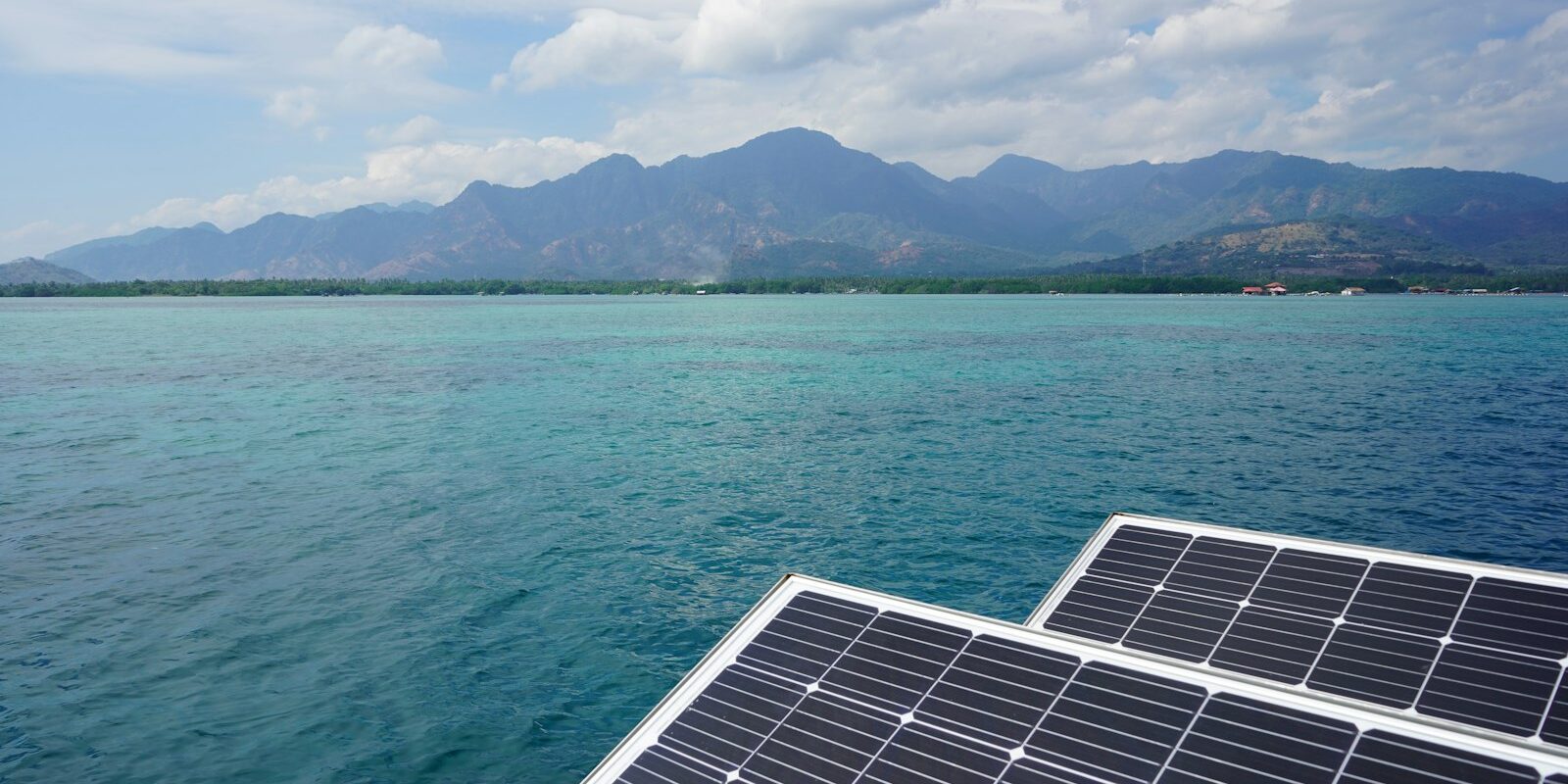
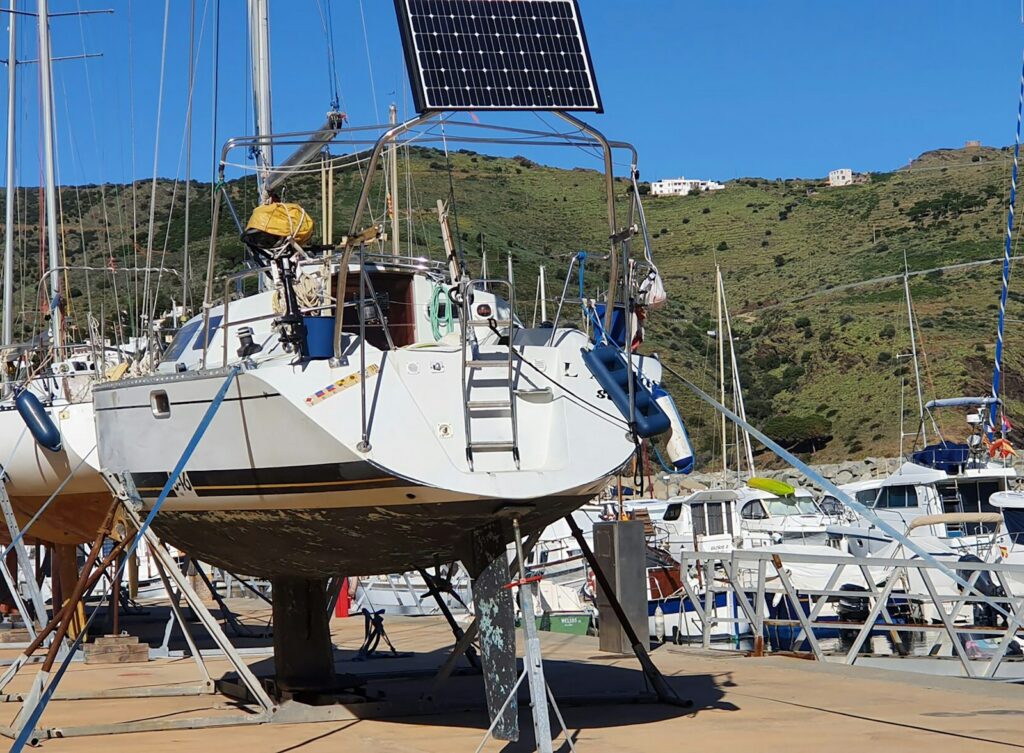
When the engine is running, its alternator charges the starter battery first and then the service battery. Solar panels supply power during the day, but there is little space on deck and the mast, boom and sails cast shadows, so output fluctuates. If you sail at night without the engine and without a wind or towed generator, nothing is charging: the boat then lives off whatever is in the battery.
Shore power in harbour
In harbour the yacht is connected to the socket on the pontoon via a cable. A permanently installed charger then charges the batteries, and if there are 230-volt sockets on board, they work just as they do at home. Shore power is therefore the moment when all batteries are topped up.
What does an inverter do?
An inverter converts the 12 volts from the battery into 230 volts AC. This allows laptop power supplies and mobile phone chargers to run at sea as well. However, the battery delivers every watt-hour itself, plus a proportion that is lost as heat during conversion. For a laptop and mobile phone charger, an inverter with a few hundred watts is sufficient; for appliances that heat, it would need to deliver several times that.
What can you charge on board?
Anything that charges via USB is a trifle for the boat's electrical system: mobile phone, camera batteries, watch, headphones, e-reader. Even a laptop is manageable if you charge it selectively.
Mobile phone, camera and small items
If there are USB sockets on board or a 12-volt socket like in a car, you charge there directly. A car charging adapter with two or more USB ports saves jostling over the one socket at the chart table. Camera batteries that only charge via their own 230-volt charger are charged at the inverter or on shore power.
Laptop and tablet
Laptops that charge via USB-C can be charged at the boat's socket with a suitable 12-volt adapter. Make sure the adapter delivers at least as many watts as your normal power supply, otherwise the computer will only charge at a snail's pace or not at all. Laptops with their own power supply and barrel connector charge via this power supply at the inverter or on shore power; directly on 12 volts only with a charger that is expressly intended for the model.
The best time to charge
Charge when power is coming in anyway: when motoring out of the bay, in sunshine around midday and especially on shore power in harbour. Plugging everything in at once at night at anchor puts a load on the battery precisely when nothing is coming in.
Why do hair dryers, kettles and straighteners usually not work?
Because these appliances draw more energy in a few minutes than the battery budgets for a whole day. A simple calculation with watts and watt-hours shows this.
Watts and watt-hours explained simply
Watts (W) indicate how much power an appliance is currently drawing. Watt-hours (Wh) indicate how much energy is consumed over a certain time: power times hours. An appliance with 60 watts uses 60 Wh in one hour, so 10 Wh in ten minutes. The battery has a fixed stock of watt-hours, and that runs out faster than you might think.
How much power does the boat battery have?
A typical calculation example for a smaller yacht: a service battery with 12 volts and 100 amp-hours stores 1,200 Wh. However, a lead, AGM or gel battery should only be discharged to half, so around 600 Wh are usable. For a smaller boat with lights, navigation instruments and a few chargers, a daily consumption of this magnitude is realistic. Lithium batteries (LiFePO4) can be used to 80 to 100 per cent and are considerably lighter; for the same usable energy you need about double the capacity from a lead battery.
The calculation for hair dryers and kettles
Calculation example: a hair dryer with 2,200 watts consumes around 370 Wh in ten minutes, so more than half of the 600 Wh from the battery example above, not yet including losses in the inverter. A kettle with 2,400 watts that runs for four minutes in the example uses around 160 Wh. There is a second problem on top of this: at 12 volts, 2,200 watts means a calculated current of over 180 amps. The small inverters on board and their cables are not designed for that at all. The same calculation applies to straighteners and curling tongs; the wattage is on the type plate. Coffee and tea are therefore made on the stove on board, hair dries in the air.
And on shore power?
If the yacht is on shore power and has 230-volt sockets, hair dryers and kettles will work in principle. A connection with 16 amps delivers a calculated maximum of around 3,700 watts at 230 volts. The hair dryer and kettle from the example come to 4,600 watts together and are therefore above that, in which case the circuit breaker on the pontoon can trip. So use them one after another instead of together.
How do you save electricity on board?
The biggest saving comes from keeping continuous consumers small, because they run around the clock. Small habits of the whole crew make more difference than any technology.
- Only open the fridge or cool box briefly and know what you are looking for before the lid goes up. Bring drinks on board already chilled if possible and top up whilst shore power is connected.
- Light only where it is needed. LED lights use considerably less than old incandescent bulbs, but ten burning LEDs still add up. A head torch replaces the saloon lighting at night.
- Instruments, plotter and radio that are not needed at the anchorage, switch off. The anchor light stays on at night.
- Don't leave chargers plugged into the inverter permanently and switch the inverter off when nothing is charging; it draws some current even without a load.
- Anyone using internet via satellite on board has an additional consumer that constantly draws power when in operation. More about this in the article on Starlink on sailing boats.
Which plug fits the shore power?
In European harbours, the blue CEE plug with three poles and 16 amperes is the standard shore power connection, designed for 200 to 250 volts. The domestic plug (Schuko) doesn't fit.
The shore power cable is usually part of the yacht's equipment. For harbours with different sockets there are ready-made adapter cables, for instance between CEE and Schuko; larger yachts sometimes have 32-ampere connections and then need suitable cables. A cable drum is always completely unrolled, otherwise it can overheat. Home-made adapters have no place on board, and installation or modifications to the boat's electrical system are work for professionals.
If you're joining as crew: what goes in your luggage?
Pack so you can manage with USB and a power bank. That way you're independent of how well equipped the yacht is.
- A car charging adapter for the 12-volt socket with multiple USB ports; for laptops with USB-C, one with sufficient wattage.
- Suitable charging cables, preferably somewhat longer, as the socket rarely sits next to the bunk.
- A power bank for the night, shore leave and days without shore power.
- Hair dryer, straighteners and travel kettle stay at home.
If you're flying to the trip, the power bank goes in hand luggage, not in checked baggage. How many and what size power banks are permitted and whether you may use them on the aircraft is regulated differently by the airlines.
Power on board and your next trip
How much power is available depends primarily on the trip: anyone putting into a harbour with shore power every evening charges everything there. On nights at anchor and longer overnight passages, such as on a Mile building, every watt-hour counts. On Törnfinder you'll find trips in many sailing areas, from a weekend on the coast to a long delivery voyage, and for example Sailing in the Mediterranean with places for individual crew.
Frequently asked questions
Can I use a hair dryer on board?
Practically not whilst underway: a 2,200-watt hair dryer consumes around 370 Wh in ten minutes. In the example of a lead-acid battery with 100 Ah, that's more than half the usable reserve of around 600 Wh. On shore power it works, provided the yacht has 230-volt sockets.
How long does the ship's battery last?
That depends on size, battery type and consumption. Lead-acid batteries are only usable to half capacity, lithium batteries to 80 to 100 per cent. In the example of a lead-acid battery with 100 Ah and around 600 Wh usable reserve, on a smaller yacht that's enough for about one day without recharging.
Does the battery charge whilst sailing?
Only if solar panels or another charger are on board. The alternator only charges when the engine is running.
Which plug is needed for shore power?
Generally the blue CEE plug with three poles and 16 amperes. For harbours with different sockets there are ready-made adapter cables.