
This page was translated automatically from German. View the original
Anyone spending a week on a yacht with others pays not only the cabin price or their share of the charter. On top comes the ship's kitty: a shared pot for everything that comes up during the trip, from bread and coffee to mooring fees and diesel.
The essentials at a glance
- The ship's kitty covers running costs on board: provisions, drinks for the galley, mooring and harbour fees, diesel, water and gas.
- Restaurant visits, excursions, travel to/from the yacht and personal wishes are usually paid for individually.
- Mooring fees and diesel are charged per boat, not per person. The more people on board, the smaller each share.
- End-of-charter cleaning, bed linen, deposit and charter base fees don't belong in the ship's kitty — they're part of the charter or cabin price.
- Fair settlement means: equal starting amount for everyone, one person as treasurer, keep receipts, settle up openly at the end.
What is a ship's kitty?
The ship's kitty is the crew's shared money for costs that only arise during the trip. At the start, everyone pays in a fixed amount, one person manages the money, and at the end accounts are settled.
The reason for this system is simple. Many expenses can't be calculated precisely before the trip. How often the crew goes into harbour and how often they anchor, how much motoring is done and what ends up in the galley is only decided underway. Instead of splitting every bill individually, the kitty pays, and everyone covers their share at the end.
The ship's kitty exists on cabin charters just as on jointly chartered yachts or when owners take friends along. The rules are similar everywhere; only the question of who pays in is answered differently.
What goes into the ship's kitty?
The ship's kitty covers costs that everyone on board causes together. The usual items are these:
Provisions and drinks
Breakfast, midday snack, dinner on board, coffee, tea, water and soft drinks. This is usually the largest item. Whether beer and wine are also paid from the kitty is a matter of agreement. Some crews buy alcohol together, others separately, because not everyone drinks the same amount.
Berth and harbour fees
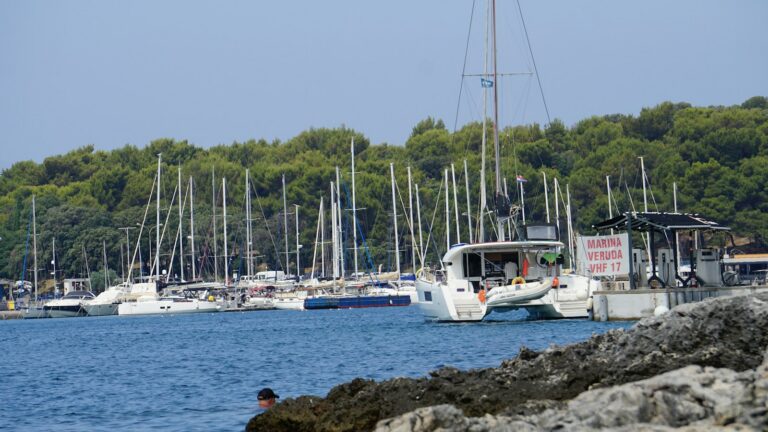
Whoever moors in a marina or town harbour pays berthing fees. They are calculated according to the size of the boat, not the number of people on board. Some harbours charge by length, others by area. Electricity, showers or washing machines cost extra depending on the harbour. Mooring buoy fields are also usually charged for, whilst anchoring in open bays is usually free of charge.
Diesel
Charter yachts are normally handed over with full tanks and must be returned with full tanks. The crew kitty therefore pays for the final tank fill. How much this is depends on how often the crew needs the engine, in light winds or for harbour manoeuvres.
Water, gas and sundries
Fresh water for topping up the tanks costs money in some harbours. Gas for the cooker is bought as an exchange bottle when needed. Then there are washing-up liquid, bin bags, toilet paper and the like.
Entry to protected areas
Some national parks charge entry fees for boats. In Brijuni National Park in Croatia, for example, each boat is charged by length, a certain number of people is included in the boat ticket, and catamarans pay double. Such fees apply to the whole boat and therefore belong in the kitty.
What is included in the cabin charter price and what isn't?
The cabin charter price usually includes the berth on board plus a share of yacht and skipper. Running costs such as food, harbours and diesel are almost always excluded and are covered by the crew kitty.
In addition, there are items that belong neither clearly to the cabin charter price nor to the crew kitty. They depend on the sailing area, the boat and the provider:
- End cleaning: charter bases usually charge a flat rate per boat. Sometimes it is included in the cabin charter price, sometimes it is added as a surcharge.
- Bed linen and towels: often included in the charter base package, sometimes for an extra charge. On some boats everyone brings their own sleeping bag or covers.
- Transit log: at many charter bases this is a flat-rate charge which, depending on the base, covers end cleaning, bed linen, the berth in the departure marina or check-in processing. What exactly is included is not uniformly regulated.
- Deposit: anyone chartering a yacht leaves a deposit for damage. It is not spent but released upon damage-free return. With a jointly chartered yacht the crew often divides it up.
- Deposit insurance: in the event of damage, it replaces the portion of the deposit that is withheld. With a jointly chartered yacht the crew usually divides the premium like the charter itself, i.e. outside the crew kitty.
What never belongs in the crew kitty: outward and return travel, restaurant meals (unless everyone eats together and this has been agreed), excursions ashore, souvenirs and personal drinks apart from the communal shop.
What fees and charges apply depending on the sailing area?
In Croatia, guests on charter boats pay a tourist levy per person per night. In Greece, the owner or operator pays a levy per boat, not per guest (as at October 2026).
Croatia: tourist levy per person per night
Anyone spending a night on a commercially used boat in Croatia, i.e. on a charter yacht, pays a tourist levy for each night. Children up to twelve years are exempt, young people from twelve to 18 years pay half. Professional skippers and other paid crew members are exempt. Payment is made to the company with which the contract exists, i.e. to the charter company or trip organiser. It collects the levy together with its service and shows it separately on the invoice. The amount is set by the Croatian Minister of Tourism by ordinance.
Greece: levy per boat, not per person
In Greece, a monthly levy applies to recreational and charter yachts over seven metres in length, calculated according to boat length. Owners or operators of the boat must pay, so in the case of commercially chartered yachts, the charter company. This regulation does not provide for a levy per guest. It is therefore not an item for the crew kitty. Details are available from the Greek tax authority.
Germany: tourist tax in harbour
In German holiday resorts on the coast, a tourist tax may be added to the berthing fee. Some harbours account for it directly for a certain number of people. In Grömitz marina, for example, the tourist tax for up to two people per overnight stay is included in the visitor berthing fee. With a larger crew it may be added for the remaining people. This too is a case for the crew kitty.
How much crew kitty per person per week? A worked example
There is no universally valid sum, because sailing area, season, boat size and the crew's habits determine the amount. The following example only shows how the calculation is structured.
All figures are self-selected, rounded assumptions, not measured average values: one week with seven nights, five people on board (four paying crew and one skipper), four nights in harbour, three nights at anchor.
| Item | Assumption | Total |
|---|---|---|
| Mooring fees | 4 nights at 80 euros per boat each | 320 euros |
| Anchoring | 3 nights in open bays | 0 euros |
| Provisions and drinks on board | 15 euros per person per day, 5 people, 7 days | 525 euros |
| Diesel | Fuel to refill at the end | 150 euros |
| Water, gas, sundries | lump sum | 35 euros |
| Total | 1,030 euros |
If four crew members share the costs and the skipper does not contribute, each pays 257.50 euros. If all five contribute, it is 206 euros per person. This example shows the variables: an additional harbour day increases the costs for everyone, one more night at anchor reduces them. With a smaller crew the share increases, because mooring fees and fuel are charged per boat.
How is the ship's kitty settled?
Best with a fixed starting amount per person, a treasurer and collected receipts. At the end any surplus is paid out or any shortfall is topped up.
- Set starting amount: on the first day everyone pays in the same amount. If it is not enough, more is added during the trip.
- Appoint treasurer: one person manages the kitty. This does not have to be the skipper, who has enough to do on board.
- Collect receipts: till receipts, harbour receipts and fuel receipts go into an envelope or are photographed. A simple list with date, item and amount is sufficient.
- Separate cash and card: many harbours and fuel stations accept card. If someone pays privately for the kitty, this is noted and settled later. For small harbours and markets some cash is still sensible.
- Settlement on the last day: add up expenses, divide by the number of contributors, pay out the rest. Easiest before parting, whilst everyone is still on board.
Tips for a fair ship's kitty
The ship's kitty is fair when it is established before the first purchase who contributes and what the kitty pays for. Most points of dispute arise over alcohol, the skipper and restaurant visits.
The skipper and the kitty
The skipper does not pay into the boat kitty but eats with the crew. This is an old seafaring custom and common practice on trips with a skipper, also as appreciation for their responsibility and work on board. It is not a legal requirement, of course. On trips among friends where one of them skippers the boat, everyone sometimes pays equally. It is important that everyone knows which model applies before the trip, as it noticeably changes each person's share.
Keep alcohol separate
Those who drink little or not at all are reluctant to pay for others' wine supplies. A simple solution: basic provisions from the kitty, beer and wine from a second kitty for all who join in drinking.
Restaurant yes or no
If the whole crew eats ashore together, the kitty can pay if everyone agrees. Otherwise everyone pays for themselves.
Shopping with a plan
A shopping list for the first two or three days prevents duplicate purchases. On small islands supplies are often limited and more expensive; a larger shop at the departure harbour saves money. Allergies, vegetarian diets and other requirements belong on the first list.
Transparency at settlement
An open final account with all receipts protects the treasurer from mistrust and the crew from errors. Anyone leaving the boat early settles their share proportionally beforehand.
Suitable trips on Törnfinder
On Törnfinder you will find Overview of all trips cabin charter offers in many sailing areas, for example with Sailing in Croatia or with Sailing in Greece. Those who want to build miles should look at the Mile building. Those who want to sail on a small budget and lend a hand on board will find offers under Working passage.
Frequently asked questions
What is a boat kitty when sailing?
A shared pot of money for the crew for costs that arise underway: provisions, drinks, mooring fees, diesel, water and gas. Everyone pays in the same amount at the start; at the end accounts are settled.
Does the skipper pay into the boat kitty?
Usually not: that the skipper does not pay in but is fed from the kitty is seafaring custom and common practice, as appreciation for their work on board. It is not a legal obligation. Among friends everyone sometimes pays the same amount.
Is diesel in the boat kitty?
Yes, usually. Charter yachts are generally handed over with full tanks and returned with full tanks. The tank refill at the end is paid by the boat kitty.
Does the deposit go in the boat kitty?
No. The deposit is security for damage to the yacht and is released when the boat is returned without damage. It runs through the charter contract, not through the boat kitty.
What happens to money left over at the end?
The remainder is paid out in equal shares to everyone who paid in. Some crews also use it for a shared farewell meal, if everyone agrees.