This page was translated automatically from German. View the original
Dunkerque (Dunkirk in English) lies on the French North Sea coast between Calais and the Belgian border. Yachts berth in two harbours, the Port du Grand Large and the Bassin du Commerce. Here you can read how to reach the start of your sailing trip in Dunkerque, which harbour is where, where to park and shop, what weather and tides to expect, which destinations are nearby and what skippers should know about the lock, commercial shipping and marine weather.
The essentials at a glance
- The Port du Grand Large lies on the fairway towards Malo-les-Bains and can be reached without going through a lock. The Bassin du Commerce is in the town centre, and by boat you can only get in through a lock and over swing bridges. As things stand (November 2026), the Trystram lock is closed, and until the end of March 2027 you lock through the Watier lock at fixed times.
- All city buses in Dunkerque are free. The five main lines run roughly every ten minutes.
- The nearest supermarket, a Carrefour Express, is about 350 metres from the Bassin du Commerce and about 500 metres from the Port du Grand Large. There is parking at both harbours.
- Dunkerque is a tidal sailing area: at spring tide, the difference between high and low water is around five and a half metres. The wind mostly blows from the southwest.
- The Port du Grand Large is being rebuilt: since October 2026 all the pontoons have been removed and the basin is being dredged, and the renewed harbour is due to open in spring 2028.
Which harbours are there in Dunkerque?
In Dunkerque, yachts berth in two places: in the Port du Grand Large on the east side of the channel leading from the breakwaters to the Trystram lock, and in the Bassin du Commerce in the middle of the city, opposite the harbour museum. As the crow flies, the two harbours are only about 500 metres apart, with the Port du Grand Large lying north of the Bassin du Commerce. By boat, however, the lock and several swing bridges lie in between.
Map from OpenStreetMap. When the map is displayed, data is transmitted to the provider.
More InformationBoth harbours belong to the public marina Dunkerque Marina, with a shared harbour office, a shared telephone number and VHF channel 9. This also includes the Bassin de la Marine right next to the Bassin du Commerce, with around 170 further berths and a pontoon at the Quai de l’Amiral Ronarc’h. The western part of the commercial port is closed to leisure craft, so yachts only use the eastern harbour.
Arriving for the start of your sailing trip in Dunkerque
When it comes to getting to your boat, what matters most is whether it is berthed at Port du Grand Large on the waterfront outside the town, or at the Bassin du Commerce in the centre.
From the airport to Dunkerque
The nearest major airport is Lille-Lesquin, around 85 road kilometres south-east of Dunkerque. A shuttle bus takes around 20 minutes from the airport to Lille Flandres station in the centre of Lille. From Lille, the train to Dunkerque takes around 35 minutes, and the stations Lille Flandres and Lille Europe are close to each other. By car, you take the A25 motorway from Lille to the coast. Brussels airport, around 160 kilometres away, has more international connections, and from there you can reach Dunkerque by train or car.
By car, train, bus or ferry
By car, you reach Dunkerque via the A25 from the direction of Lille or via the A16 from the direction of Calais. By train, the journey from Lille to Dunkerque takes around 35 minutes, and from Paris around two hours. The station is close to the town centre. As things stand (November 2026), the shipping company DFDS sails from Dover all year round, around ten times a day, taking around two hours to reach the Dunkerque ferry terminal in Loon-Plage, around 15 kilometres west of the town centre. The ferry only takes travellers with a vehicle, i.e. with a car, motorcycle, motorhome or bicycle, but not foot passengers. You can also come by car through the Channel Tunnel: Le Shuttle takes around 35 minutes from Folkestone to Calais, and from Calais it is around 40 minutes on the A16 to Dunkerque. Without a car, take the Eurostar from London St Pancras to Lille Europe and continue from there by train to Dunkerque.
In town you can travel by bus for free: since 2018, no journey on the DK’Bus city network has cost anything. The five main lines, C1 to C5, run about every ten minutes, and the network stretches from Gravelines to the Belgian border. A free bus even goes as far as De Panne station in Belgium.
Which harbour is mine?
Give the taxi driver the full name, “Port du Grand Large” or “Bassin du Commerce”. Port du Grand Large is in the new Grand Large district towards Malo-les-Bains, and the harbour office is on the Avenue des Bancs de Flandres. The Bassin du Commerce is in the centre, opposite the harbour museum.
Parking
At Port du Grand Large there is a car park around 200 metres from the pontoons, and at the Bassin du Commerce one around 50 metres from the basin. Parking in the town centre is subject to a charge. At the machines you choose your language, enter your registration number and receive a ticket. You can park for free in Malo-les-Bains, the seaside district east of Port du Grand Large. There are also park-and-ride sites on the outskirts, from which you can take the free bus into the centre.
Showers and sanitary facilities
Both harbours have sanitary facilities with showers and a launderette; Port du Grand Large has 13 showers, the Bassin du Commerce seven.
Shopping for the trip
The nearest supermarket is a Carrefour Express, around 350 metres from the Bassin du Commerce and around 500 metres from Port du Grand Large. From the Bassin du Commerce you can also reach an E.Leclerc in around 450 metres and the Monoprix in the town centre in around 700 metres; from Port du Grand Large it is around 1.2 kilometres to the Monoprix. A larger Aldi is about 1.6 kilometres away by car. With the free bus, you can get back to the harbour even with full bags.
Doctor, pharmacy and emergency services
The nearest pharmacy is the Pharmacie du Centre in the town centre, around 550 metres from the Bassin du Commerce and around 1.1 kilometres from Port du Grand Large. The Clinique Villette is east of the centre, around 1.5 kilometres from the Bassin du Commerce and around 1.9 kilometres from Port du Grand Large. The Centre Hospitalier de Dunkerque on the Avenue Louis Herbeaux, around 1.9 kilometres from Port du Grand Large, has an accident and emergency department open around the clock. In France you can reach the emergency medical services, police and fire brigade free of charge on these numbers:
- 112: European emergency number, from landlines and mobiles
- 15: medical emergency (SAMU), 17: police, 18: fire brigade
- 196: sea rescue, if you are calling from the coast. At sea, call on VHF channel 16; the responsible rescue coordination centre is CROSS Gris-Nez.
Comparing the harbours in Dunkerque
| Feature | Port du Grand Large | Bassin du Commerce |
|---|---|---|
| Location | on the fairway in front of the Trystram lock, Grand Large district | Town centre, opposite the harbour museum |
| Access | no lock, day and night | through the Trystram lock and over swing bridges; until 31 March 2027 through the Watier lock at fixed times |
| Berths | 250 on floating pontoons, plus a visitors' pontoon for up to 25 boats (rebuilding until spring 2028) | around 140 on floating pontoons, visitor berths for boats up to 13 m, plus 15 berths for boats over 13 m at the Quai des Hollandais |
| Water depth | 3.5 to 4 m | 5 m |
| Fuel station | around the clock with a card at Port du Grand Large | |
| VHF channel | 9 (shared harbour office) | |
| Phone | +33 3 28 63 23 00 | |
| Berthing fee per day (2027 rate) | April to September: 10 m 34 euros, 12 m 42 euros; October to March: 10 m 25 euros, 12 m 29 euros; catamarans 1.5 times the rate, 15% discount from 7 nights (as at November 2026) | |
Where is the Port du Grand Large?
The Port du Grand Large lies in the north of the city, on the east side of the channel that leads from the harbour breakwaters south to the Trystram lock. Malo-les-Bains and its beach begin to the east. Because the harbour lies in front of the lock, you can enter and leave without locking through and without any bridges.
The harbour has 250 berths on floating pontoons and a visitors' pontoon for up to 25 boats. It can be reached directly from the sea via the eastern fairway of the commercial port, by day and by night. It is being rebuilt: a new floating breakwater and new pontoons are intended to give it better protection and roughly double the number of berths. As things stand (November 2026), the work begins in October 2026 with the removal of all the pontoons and the dredging of the basin, and the renewed harbour is due to open in spring 2028. There will be no dry storage or travel lift from June 2026 to September 2027, and the buoys in the approach may be temporarily changed.
Facilities at the Port du Grand Large
The pontoons have electricity and water, plus free Wi-Fi. The fuel station can be used around the clock with a card. Besides showers and a launderette, there is waste separation, a waste oil collection point and a defibrillator, and the harbour is guarded at night. The harbour office is open daily from 8 am to 8 pm from 1 May to 14 September. In April and from 15 September to 14 October, it is open Monday to Saturday from 9 am to 12:30 pm and from 2 pm to 6 pm, and from 15 October to 31 March Monday to Saturday from 9 am to 12:30 pm and from 2 pm to 5:30 pm.
Where is the Bassin du Commerce?
The Bassin du Commerce lies right in the city centre, and the harbour museum with its museum ships is on the opposite side of the basin. It is only a few minutes on foot to the shops in the town centre.
By boat, the basin can only be reached through the Trystram lock and over swing bridges, or through the Watier lock for as long as Trystram is closed. In return, you lie sheltered behind the lock and independent of the tide, and the water is around five metres deep.
Facilities at the Bassin du Commerce
The roughly 140 berths are on floating pontoons, some of which are reserved for visitors with boats up to 13 metres. For boats over 13 metres there are 15 berths at the Quai des Hollandais. The berths have electricity and water, plus Wi-Fi, showers and a launderette. Refuelling is done at the Port du Grand Large.
What is the sailing weather like in Dunkerque?
The wind mostly blows from the southwest. In strong winds from the northwest to northeast, however, the swell reaches into the outer harbour. Météo-France issues warnings for coastal waters as soon as winds of Beaufort force 7 or more are observed or forecast.
Dunkerque is a tidal area: the range between high and low water is around five and a half metres at spring tides and around three and a half metres at neap tides. For legs along the coast and across the English Channel, you should therefore plan your departure time and the tidal stream together.
Which sailing destinations are near Dunkerque?
From Dunkerque you sail along the flat coast to the west towards Calais and Boulogne, or east to the Belgian coast. If you want to go further, you cross the Strait of Dover to southern England. The distances are rounded distances over water on the usual course from the Port du Grand Large; for precise planning, refer to the chart.
- Nieuwpoort (Belgium): around 17 nm
- Calais: around 22 nm
- Oostende (Belgium): around 26 nm
- Dover (England): around 40 nm
- Ramsgate (England): around 40 nm
- Boulogne-sur-Mer: around 42 nm
Nieuwpoort and Oostende are reached via the buoyed channels close inshore; the line of buoys leads as far as the Belgian border. Both harbours are within a day's sail, with Nieuwpoort being the shorter.
Calais lies to the west, beyond the western harbour of Dunkerque, which yachts are not permitted to enter. Continuing on to Boulogne-sur-Mer means rounding Cap Gris-Nez, a long day's sail that is best planned around the tidal stream.
Dover and Ramsgate lie on the other side of the Strait of Dover. On the way you cross the traffic separation scheme for large shipping. Separate entry rules apply on arrival in Great Britain.
What can you do on a harbour day in Dunkerque?
Most of the sights are in the centre around the Bassin du Commerce and can also be reached on foot from the Port du Grand Large.
- Harbour museum: The Musée portuaire opposite the Bassin du Commerce tells the story of the harbour from the 17th century to the present day. It includes three museum ships and the Risban lighthouse, from which you look out over the North Sea and the Flemish coastal region. The three-master Duchesse Anne, the lightship Sandettie and the tug Triomphant lie in the Bassin du Commerce.
- Princess Elizabeth: The paddle steamer lies in the harbour basins of the city centre and is now a tea room and restaurant. During the evacuation in 1940 she rescued 1,673 people, and she later appeared in the film “Dunkirk”.
- Museum Dunkerque 1940: The museum is housed in Bastion 32, the former command post of the French troops during the Battle of Dunkirk. Uniforms, weapons and vehicles show what everyday life in the city was like during the war.
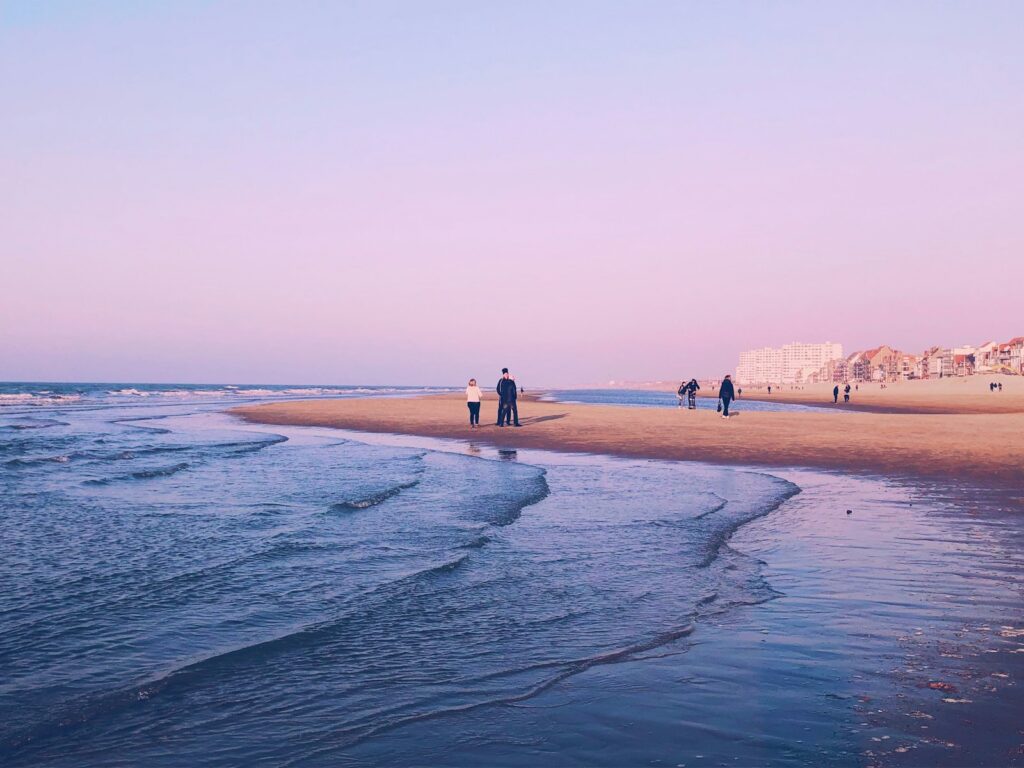
- Malo-les-Bains: From the Port du Grand Large, you walk over the footbridge to the sandy beach of Malo-les-Bains in around five minutes. Along the seafront promenade, the Digue, there are restaurants and terraces right on the sand. Parking there is free of charge.
- Fort des Dunes: Further east in Leffrinckoucke is the 19th-century fortress, with an exhibition and a walking trail with views of the beach and dunes. On the beach at Zuydcoote lies the wreck of the Crested Eagle, one of the ships from 1940.
For skippers: mooring, lock and marine weather in Dunkerque
You can reach the harbours on VHF channel 9. Before any movement in the harbour you must also report to the Dunkerque VTS traffic centre on channel 73, which is mandatory for all vessels in the port.
Registration and Berthing
The harbour office of the Port du Grand Large looks after all the basins, including the Bassin du Commerce. You can call it on channel 9 or on +33 3 28 63 23 00. In both harbours you lie alongside floating pontoons. The harbour team will assign you a berth. Immediately after arrival, you register at the harbour office with the boat's papers and proof of insurance. If you arrive late, you moor at the visitors' pontoon and report as soon as the office opens.
Harbour rules
In the harbour entrances, access channels and the commercial port, the maximum speed is 5 knots, and in the inner basins and the marina it is 3 knots. In the harbour you proceed under engine, and manoeuvres under sail are prohibited. Dogs must be kept on a lead on pontoons and bridges, and open fires on quays and pontoons are prohibited. Leisure craft are not permitted to enter the western harbour of Dunkerque. Additional restrictions may temporarily apply around the building site at the Port du Grand Large, so watch out for changed buoys.
Approach
From the west you approach via the Western Passage from the Dyck light buoy, following the “DW” buoys; from the east you come in via the Passe de Zuydcoote, following the “E” buoys. There are sandbanks north of the fairways, so stay within the buoyed channel. The large Dunkerque lighthouse is clearly visible: it is 59 metres high, with two white flashes every ten seconds. The harbour entrance is marked by a red light on the east mole and a green one on the west mole, and at night a leading light with a narrow sector around 185 degrees guides you through the entrance. In strong winds from northerly directions there is a swell in the outer harbour.
Trystram lock and commercial shipping
You reach the Bassin du Commerce and the Bassin de la Marine through the Trystram lock, which is equipped for pleasure craft. Signals on two masts above and below the lock show when you may enter. You request the lockage on channel 73, and swing bridges follow beyond the lock.
As things stand (November 2026), the Trystram lock is closed because its bridge is being replaced. Since 1 October 2026, leisure boats have been locking through the Watier lock, at fixed times every day until 31 March 2027:
- Departure: cast off in the basins at 7:00, Watier lock at 7:30. You must register on channel 73 by 6:45 at the latest.
- Arrival: Watier lock at 18:30, in the basins at 19:10. You must register on channel 73 30 minutes beforehand.
Without a timely radio call, the locking is cancelled. In persistent northerly winds the Watier lock stays closed, and other weather conditions can also shift the times or cancel the locking. The current times are published by the port operator and harbour master as a notice headed “Avis aux usagers”.
Dunkerque is a major seaport. Cargo ships and tankers use the fairway, and they have little room to manoeuvre. Keep channel 73 on watch, and you will hear which ships are currently entering or leaving.
Crossing to England
If you are sailing to Dover or Ramsgate, you will cross the traffic separation scheme in the Strait of Dover. Cross the traffic lanes in one go without stopping, with the bow as close as possible to a right angle to the direction of traffic. What counts is your heading, not your course over ground. As a sailing boat, you must not impede power-driven vessels following the traffic lane. If there is not enough wind for that, use the engine. On arrival in Great Britain, you report the boat online to the British border authority using the Pleasure Craft Report. From the 12-nautical-mile limit, fly the yellow Q flag until the report is completed. If you do not hold a British or Irish passport or a right of residence, you may only go ashore with the permission of the border authority. The details can be found on the UK government's website.
Great Britain is not part of the Schengen Area. Anyone leaving France for Great Britain, with the whole crew, is subject to French border controls, regardless of nationality. Dunkerque Marina takes part in a procedure run by customs and the border police: before departing for Great Britain, you send the harbour office the border control form with the list of everyone on board and the boat details. If you are returning from Great Britain, you ask the harbour office for permission to enter and send the form no later than when you leave the British port. The form and details can be found on the French customs website.
Which marine weather forecast applies in Dunkerque?
The Météo-France marine weather forecast is the authoritative one. Dunkerque lies in the coastal area “De la frontière belge à la baie de Somme”, and the coastal forecast applies up to 20 nautical miles off the coast.
The CROSS Gris-Nez rescue coordination centre broadcasts the weather reports on VHF channel 79. The Dunkerque station transmits at 7:20, 13:20 and 19:20 local time. All stations and broadcast times can be found in the Marine weather guide from Météo-France.
Sailing trips from Dunkerque on Törnfinder
You can find an overview of offers on all French coasts at Sailing in France, trips in the whole sailing area under Sailing in the North Sea and all offers under Trips.
Frequently asked questions
How do I get from the station to the harbour in Dunkerque?
By city bus or on foot. All buses in Dunkerque are free, and the main lines run about every ten minutes. If you have luggage, a taxi to the Port du Grand Large is more convenient.
Where can I park at the start of my sailing trip in Dunkerque?
At the Port du Grand Large, there is a car park about 200 metres from the pontoons, and at the Bassin du Commerce a car park about 50 metres from the basin. You can park for free in neighbouring Malo-les-Bains, while parking in the city centre is chargeable.
Are there showers in the harbours of Dunkerque?
Yes. The Port du Grand Large has 13 showers and the Bassin du Commerce has seven, and both have a launderette.
Where can I buy provisions for the sailing trip in Dunkerque?
The nearest shop is a Carrefour Express, about 350 metres from the Bassin du Commerce and about 500 metres from the Port du Grand Large. In the centre there is also an E.Leclerc and the Monoprix, and you can reach a larger Aldi by car in about 1.6 kilometres.
Do I need to go through a lock for the Port du Grand Large?
No. The Port du Grand Large lies in front of the Trystram lock, directly on the fairway. Only the Bassin du Commerce and the Bassin de la Marine are reached through the lock and over swing bridges.
How big is the tidal range in Dunkerque?
Around five and a half metres at spring tide and around three and a half metres at neap tide. Behind the lock in the Bassin du Commerce, you won't notice it at all.
How far is it from Dunkerque to England?
It is around 40 nautical miles to both Dover and Ramsgate. On the way, you cross the traffic separation scheme in the Strait of Dover.