This page was translated automatically from German. View the original
Sète lies in the Hérault département between the Mediterranean and the Étang de Thau lagoon, south-west of Montpellier. Yachts berth mainly in the Port de plaisance at the Môle Saint-Louis, right at the harbour entrance, and there are further berths on the quays along the Canal maritime in the middle of the town. Here you can read how to arrive by plane, train or car, where each berth is located, where to park and shop, what wind to expect, which sailing destinations lie off Sète, and what skippers should know when entering harbour.
The essentials at a glance
- The nearest airport is Montpellier-Méditerranée. Sète is about 30 minutes away by car, and a taxi to the edge of town costs around €95 during the day.
- Sète station is on the Bordeaux–Marseille line, and a direct TGV from Paris takes around 3 hours 40 minutes.
- The Port de plaisance is at the Môle Saint-Louis in the south of the town, by the harbour entrance. The Quais along the Canal maritime are further north, in the town centre.
- From the Môle Saint-Louis it is around 300 metres to the nearest car park and around 800 metres to the supermarkets in the centre. At the Quais in the centre, a supermarket, a pharmacy and a free car park are only a few hundred metres away.
- Off Sète the weather is mainly shaped by the Tramontane from the west to northwest and the humid Marin from the southeast. The Tramontane blows strongest in winter and spring.
Where are the berths in Sète?
In Sète, visiting yachts moor mainly in two places: in the Port de plaisance at the Môle Saint-Louis, the old harbour basin behind the long mole at the harbour entrance, and at the Quais along the Canal maritime, which runs north from the old harbour right through the town. The Port de plaisance lies at the southern end of the town below Mont Saint-Clair. The Quais along the Canal maritime are around a kilometre further north, between Quai de la République and Quai d’Orient, not far from the station.
Map from OpenStreetMap. When the map is displayed, data is transmitted to the provider.
More InformationBoth belong to the Port de plaisance de Sète, which the Région Occitanie, as owner, operates through the regional harbour operator Port Sud de France. In the town, the marina is also known as Port Saint-Clair. The berths for superyachts of 24 metres and above are managed in the harbour by the company IGY as IGY Sète Marina. In addition there are around 1,150 berths in the town's canals, which are looked after by a separate harbour office at the Halte nautique opposite the station.
Arriving for the start of your sailing trip in Sète
Sète is easy to reach by plane, train and car. For the last stretch, what matters is whether your berth is at the Môle Saint-Louis or in the centre.
From Montpellier airport to Sète
Montpellier-Méditerranée airport is around ten minutes by car from the centre of Montpellier. It is around 30 minutes by car to Sète. A taxi takes between 40 minutes and an hour, depending on traffic. As of now (November 2026), the fare to the edge of Sète is around €95 during the day and around €125 at night, on Sundays and on public holidays, plus surcharges for luggage. The taxi rank is in front of the arrivals hall.
The route via Montpellier is cheaper: the 620 airport shuttle (Navette) takes around 25 minutes to Montpellier Sud de France station. The fare is €2, or €3 including the tram. From there, tram line 1 takes you into the city centre to Montpellier Saint-Roch main station. Direct trains run from Saint-Roch to Sète, and the fastest take around a quarter of an hour.
By car, train, bus or ferry
If you are driving, leave the A9 motorway at exit 33 towards Sète. By train, Sète is on the Bordeaux–Marseille line. With the direct TGV, it takes around 3 hours 40 minutes from Paris, around 2 hours 10 minutes from Lyon, around 2 hours from Toulouse and around 2 hours 25 minutes from Marseille. The bus station is in front of the railway station, and the city bus lines 1, 2, 3, 4, 5 and 8 run by Sète Agglopôle Mobilité go to the centre.
Ferries connect Sète all year round with Tanger Med and Nador in Morocco, and GNV also sails to Algiers and Béjaïa in Algeria. The ferries depart from the Gare maritime Orsetti ferry terminal, which is around 17 minutes' walk from the station.
Môle or centre: two addresses
The Port de plaisance at the Môle Saint-Louis and the Quais along the Canal maritime belong to the same harbour but are in different parts of the town. The harbour office of the Port de plaisance is a floating Capitainerie on the harbour basin at the Môle Saint-Louis. The second harbour office, the Halte nautique at Quai du Pavois d’Or opposite the station, is responsible for the canals. For the taxi, it therefore matters whether you are going to the Môle Saint-Louis or to a Quai in the centre.
Parking
At the Môle Saint-Louis, the rear part of the mole is reserved for permanent berth holders with a parking permit from 1 May to 30 September. The nearest car parks are at Quai de la Consigne and Quai d’Alger, each around 300 metres from the Port de plaisance.
For the Quais along the Canal maritime, the car park at Place Delille is only around 100 metres away. You can park for free around 300 metres to the north, in the car park at Quai du Mas Coulet. Parking is prohibited on the harbour's berthing Quais: only on Quai d’Orient and on the north bank of the Bassin du Midi may vehicles with an access permit from the harbour be parked, and on all other Quais wrongly parked cars are towed away.
Arrived early: covered market and weekly market
If you have time before your sailing trip starts, head to the covered market halls of Sète at Place Édouard Herriot. They open every morning, and you can have lunch there too. On Wednesdays there is a weekly market, including on Quai d’Alger between the Môle Saint-Louis and the centre. From May to September, on Wednesdays from 9 am to 2 pm, bateaux-bus (water buses) run every 20 minutes from Quai Paul Riquet at the Mas Coulet car park to Quai Général Durand near the town centre, and daily in July and August.
Showers and sanitary facilities
The Port de plaisance has showers and toilets as well as washing machines and tumble dryers. Both are accessible around the clock with a badge.
Shopping for the trip
At the Quais along the Canal maritime, the nearest supermarket, a Carrefour Market with a petrol station, is around 400 metres away, and a Lidl is around 900 metres away. From the Môle Saint-Louis it is around 800 metres to the two Monoprix branches in the centre. For a big shop by car, there is a shopping centre with an Auchan in the west of the town, around 2.9 kilometres from the Môle Saint-Louis.
In high season, the Port de plaisance delivers breakfast to your boat. You order it at the Capitainerie by 8 pm the evening before.
Doctor, pharmacy and emergency services
The nearest pharmacy to the Môle Saint-Louis, Pharmacie Dilme, is around 400 metres away, and there are several pharmacies within roughly 150 to 300 metres on the Quais along the Canal maritime. The Polyclinique Sainte-Thérèse is around 300 metres from the Quais along the Canal maritime and around 1.3 kilometres from the Môle Saint-Louis. The hospital Centre hospitalier du Bassin de Thau is in the west of the town, around 2.7 kilometres from the Môle Saint-Louis.
- 112: Europe-wide emergency number
- 15: medical emergency service (SAMU), 17: police, 18: fire brigade
- 196: sea rescue (CROSS) from land; at sea, VHF channel 16
Where is the Port de plaisance at the Môle Saint-Louis?
The Port de plaisance lies in the old harbour basin of Sète, sheltered by the Môle Saint-Louis. The town's history began in 1666 with the building of the mole, which was meant to give the Canal du Midi access to the sea. The mole is around 650 metres long, and the Saint-Louis lighthouse stands at its end. From the harbour you can walk to the fishing harbour and along the Quai d’Alger into the centre.
There are around 300 berths at the Môle Saint-Louis. The Capitainerie floats on the harbour basin and is staffed every day all year round. At the end of the mole stands the Pôle nautique, home to water sports clubs, the sea rescue station (SNSM) and a restaurant with a view of the harbour entrance that is open all year.
Facilities at the Môle Saint-Louis
The berths have water and electricity (16, 32, 63 and 250 amps). Yachts over 15 metres pay for electricity and water according to consumption. Wi-Fi is free, and you can get the access code at the Capitainerie. In summer you can also get ice cubes and electric bikes to hire there. The fuel station is on the seaward side of the western entrance, in front of the lighthouse, and can be used around the clock with a credit card. A crane for stepping masts under 11 metres, a towing service for boats, a pump-out station for waste water and bilge water, a washdown area with boatyard service and a rigging service complete the offering. Access to the pontoons is secured and open only to berth customers.
Where are the Quais along the Canal maritime?
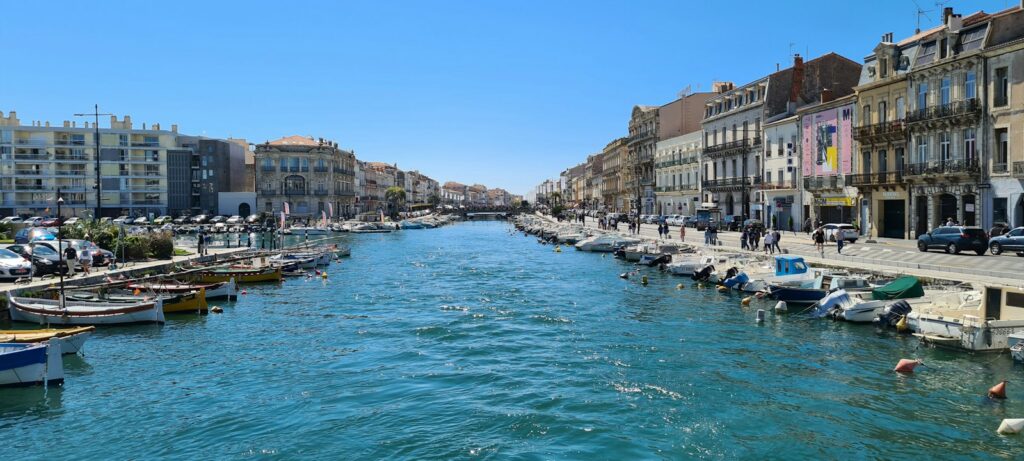
The Canal maritime runs north from the old harbour through the town centre towards the lagoon. Along its banks, at the Quai de la République and the Quai d’Orient, yachts moor in the middle of the town, not far from the railway station.
For large yachts of 18 to 50 metres, the Port de plaisance has around 60 berths in the centre. The harbour also allocates visitor berths at other quays such as Quai Paul Riquet, Quai Maillol, Quai des Moulins and Quai Vauban, as well as in the Bassin du Midi.
Bridges and harbour office in the centre
Further towards the lagoon, numerous bridges span the canals, some of which open. The harbour publishes the clearance heights; you reserve the opening of a movable bridge via the harbour's website or the app of the Région Occitanie for the bridges of Sète. The Quai Mistral in the La Pointe Courte district is the only place designated for waiting for a bridge to open. The Halte nautique at the Quai du Pavois d’Or is responsible for the canals; it is staffed Monday to Friday from 8 am to 12 noon and from 2 pm to 6 pm.
Berths in Sète compared
| Feature | Port de plaisance at the Môle Saint-Louis | Quais along the Canal maritime |
|---|---|---|
| Location | old harbour basin at the harbour entrance, southern end of the town | town centre, around 1 km to the north |
| Operator | Port Sud de France (Région Occitanie) | Port Sud de France (Région Occitanie) |
| Berths | around 300 | around 60 for yachts of 18 to 50 m, plus visitor berths at other quays |
| Harbourmaster's office | floating Capitainerie, daily | Capitainerie at the mole; Halte nautique for the canals, Mon–Fri |
| VHF | Channel 9 | Channel 9 |
| Fuel station | at the western entrance, around the clock | at the western entrance, around the clock |
| Distance to the railway station (as the crow flies) | around 1.8 km | around 800 m |
What is the weather like in Sète for sailing?
Off Sète, the sailing weather is determined mainly by two regional winds: the Tramontane and the Marin. The Tramontane can blow at any time of year, but is strongest in winter and spring.
The Tramontane comes from the west to northwest over the foothills of the Pyrenees and the Massif Central; it is cold and brings gusts of more than 100 km/h. East of Sète, from the Camargue onwards, the Mistral reaches the coast. It is usually dry, often stronger in winter and spring, and often lasts several days. The Marin from the southeast, by contrast, is humid, often strong and steady, brings cloud and rain, and is more frequent in spring and autumn.
Météo-France issues a strong wind warning for the coast as soon as force 7 on the Beaufort scale is reached or expected.
Which destinations can you reach from Sète on a sailing trip?
Sète lies on the coast of the Golfe du Lion between Cap d’Agde to the southwest and the Camargue to the east. Along the coast you can reach larger marinas in both directions, and behind the town the Thau Lagoon opens up.
Cap d’Agde
To the southwest of Sète lie the marinas of Agde and Cap d’Agde. The seaside resort of Cap d’Agde and the old port town of Agde make a worthwhile destination along the coast.
Port Camargue and Marseille
To the east, the coast leads to Port Camargue, the marina of the seaside resort of the same name in the Gard département. Port Camargue also marks the boundary between the Languedoc-Roussillon and Provence sea weather zones. Further east, beyond the Camargue, lies Marseille, a destination for a longer sailing trip. You can read how to arrive and moor there in the profile of Vieux-Port of Marseille.
Étang de Thau and Canal du Midi
Behind Sète lies the Thau Lagoon, about 19 kilometres long and 5 kilometres wide. The town's canals connect it with the sea, and the passage leads through the bridges in the centre. At the other end of the lagoon, at the Pointe des Onglous near Marseillan, the Canal du Midi begins. The canal, around 240 kilometres long, runs as far as Toulouse and has been a UNESCO World Heritage Site since 1996.
What can you do on a day in port in Sète?
The Môle Saint-Louis lies at the foot of Mont Saint-Clair, only a few hundred metres from the old quarter around the Cimetière marin. You can reach most attractions on foot.
- Saint-Louis Lighthouse: The walk along the Môle Saint-Louis starts right at the Port de plaisance and ends at the lighthouse with its 126 steps.
- Théâtre de la Mer: The open-air stage above the sea stands in a fort that was built after a British attack in 1710. It is around 600 metres as the crow flies from the Port de plaisance.
- Cimetière marin and Musée Paul Valéry: The cemetery above the sea was immortalised in verse by the poet Paul Valéry, who was born in Sète. The museum bearing his name is right next to it, around 700 metres from the Port de plaisance.
- Mont Saint-Clair: The town's hill offers a wide view over the town, the lagoon and the Mediterranean. The summit is around 1.4 kilometres as the crow flies from the Môle Saint-Louis, and the way up is steep.
- Beaches on the Lido: The sandy beaches on the Lido stretch for around 12 kilometres, ideal for a day at the beach.
For skippers: mooring and marine weather in Sète
At the Port de plaisance, you check in on VHF channel 9. Harbour staff meet you on the water and guide you to your berth.
Registration and Berthing
You can reserve a visitor berth via the booking module on the website of the Port de plaisance. On arrival, the harbour staff will assign you a berth; for yachts over 15 metres, they do so together with the Capitainerie. You can get help with mooring on VHF channel 9. Mooring is only permitted at the designated mooring lines. If operations require it, the Capitainerie may have another boat moored alongside yours. The Capitainerie is staffed daily from 07:00 to 21:30 from mid-June to mid-September, and otherwise from 08:00 to 12:00 and from 14:00 to 18:00.
Harbour rules
The harbour police regulations for the Port de plaisance stipulate, among other things:
- A maximum speed of 4 knots applies in the harbour basins and canals.
- Sailing is prohibited in the harbour basins and canals.
- Swimming is prohibited in the canals.
- Smoking is prohibited at the fuel station, the washing area and in the sanitary facilities.
- For vessels of 50 metres or more, a pilot is compulsory above the movable bridges.
Approach
The entrance to the Port de plaisance is at roughly 43°23.6′ N, 003°42.1′ E, at the harbour entrance by the Môle Saint-Louis. Sète is also a commercial, ferry and fishing port, so ferries, cargo ships and fishing boats are also moving about in the harbour. At the western entrance, seaward of the lighthouse, you will find the fuel station. For the approach, the French charts SHOM 6839, 7053 and 7434 apply.
Which marine weather forecast applies off Sète?
For Sète, the coastal weather forecast from Météo-France for the Languedoc-Roussillon zone, from the Spanish border to Port Camargue, applies. CROSS La Garde broadcasts it via the Agde station on VHF channel 79 at 07:15, 13:15 and 19:15 French time, after an announcement on channel 16. CROSS broadcasts strong wind warnings from Beaufort force 7 every hour. The current marine weather forecast is also shown on screens in the Capitainerie at the Môle Saint-Louis and in the Halte nautique. All broadcast times are listed in the Guide marine from Météo-France.
Sailing trips from Sète on Törnfinder
You'll find more sailing trips along the French coast under Sailing in France, trips in the whole sailing area under Sailing in the Mediterranean. The overview shows all offers Trips.
Frequently asked questions
How do I get from Montpellier Airport to Sète?
The quickest way is by taxi or hire car, which takes 40 minutes to an hour; a taxi costs around 95 euros during the day. It's cheaper to take the Navette 620 and the tram to Montpellier, and from there the train to Sète.
Where do I park at the start of the trip in Sète?
Parking is free at the car park on Quai du Mas Coulet, about 300 metres from the quays on the Canal maritime. At the Môle Saint-Louis, the rear part of the mole is reserved for permanent berth holders from May to September; the nearest car parks are around 300 metres away.
Are there showers at the Port de plaisance in Sète?
Yes, showers, toilets and a laundry are accessible around the clock with a badge.
Which VHF channel can I use to contact the harbour at Sète?
The Port de plaisance operates on VHF channel 9. Use it to check in, and on request you can get help with mooring.
Can I sail from Sète into the Canal du Midi?
Yes, via the Thau Lagoon: the Canal du Midi begins at the Pointe des Onglous near Marseillan at the other end of the lagoon. On the way from the sea into the lagoon you pass the bridges in the centre of Sète, whose opening you reserve at the harbour.