This page was translated automatically from German. View the original
Corinth Marina is located in the middle of the town of Corinth on Plateia Floisvou, on the Gulf of Corinth, west of the Corinth Canal. Here you can read how to get from Athens airport to Corinth by train, bus or car, where the marina is, where to shop, what wind to expect, which sailing destinations you can reach in both directions, and what skippers should know about transiting the canal and about the harbour authority.
The essentials at a glance
- From Athens airport, the suburban railway runs to Corinth with one change, and long-distance buses from Athens take about one to one and a half hours.
- The bus station for the intercity buses is about 400 metres from the marina, and you will find several supermarkets within roughly 300 to 500 metres.
- The Corinth Canal has been closed for construction work since 3 November 2026, and no date has yet been set for its reopening (as of November 2026).
- When the canal is open, it takes you to the Saronic Gulf with Poros and Aegina, while to the west the Gulf of Corinth leads to Galaxidi, Itea and Patras.
Where is Corinth Marina?
Corinth Marina lies directly on Plateia Floisvou, the waterfront square in the centre of the town, about 400 metres from the intercity bus station. It is part of the port of Corinth on the Gulf of Corinth, which also includes a fishing harbour and quays for large ships.
Map from OpenStreetMap. When the map is displayed, data is transmitted to the provider.
More InformationCorinth lies on the Peloponnese, west of Athens, where the narrow land bridge of the Isthmus joins the peninsula to mainland Greece. The modern city was rebuilt after the great earthquake of 1858 and has a clear street grid with parks and squares. East of the city, the Corinth Canal cuts through the Isthmus and links the Gulf of Corinth with the Saronic Gulf. The port of Corinth is managed by the city's municipal port fund, and the responsible authority is the Corinth Port Authority.
Arriving for the start of your sailing trip in Corinth
Getting to Corinth from Athens is easy without a car: suburban trains and intercity buses run daily.
From Athens Airport to Corinth
The nearest major airport is Athens International Airport "Eleftherios Venizelos". From the airport, the suburban railway (Proastiakos) runs towards Ano Liosia. There you change to the Piraeus – Athens – Kiato line, which stops at Megara and Corinth, among other places.
By bus or train from Athens
KTEL intercity buses connect Corinth daily with Athens, Patras and neighbouring towns. The journey takes about one to one and a half hours from Athens and about two and a half to three hours from Patras. In Athens, the buses to Corinth depart from the Kifissos bus station. The KTEL Korinthias bus station is about 400 metres from the marina.
From central Athens and the port of Piraeus, the suburban railway on the Piraeus – Athens – Kiato line runs all the way to Corinth without a change.
Parking
A public car park is about 250 metres east of the marina, and another is about 400 metres away.
Shopping for the trip
Stocking up on provisions is easy: the nearest supermarket, a Galaxias, is about 300 metres from the marina. An AB Vassilopoulos is about 350 metres away, a Kritikos about 450 metres and a Sklavenitis about 500 metres. So you can buy the provisions for your trip on foot.
There are also petrol stations in the city for your hire car; the nearest is about 500 metres from the marina.
Doctor, pharmacy and emergency services
The nearest pharmacy is about 300 metres from the marina, and there are more pharmacies in the centre from about 350 metres. A doctor's surgery is about 350 metres away. Corinth General Hospital is about 1.2 kilometres east of the marina.
- 112: European emergency number for police, ambulance and fire brigade
- 166: Emergency services, 100: Police, 199: Fire brigade
- 108: Coast Guard, also for emergencies at sea; at sea also VHF channel 16
What does Corinth Marina offer?
Corinth Marina is a city harbour with short distances: the bus station, supermarkets and pharmacies are all within a few hundred metres. Its great advantage is its position between two sailing areas, the Gulf of Corinth to the west and the Saronic Gulf beyond the canal.
Corinth Marina at a glance
| Feature | Details |
|---|---|
| Location | Plateia Floisvou, Corinth city centre, Peloponnese |
| Sailing area | Gulf of Corinth, west of the Corinth Canal |
| Administration | Municipal port fund of the city of Corinth |
| Responsible authority | Corinth Port Authority (Limenarchio Korinthou) |
| KTEL bus station | around 400 m |
| Nearest supermarket | around 300 m |
| Hospital | around 1.2 km |
| Corinth Canal | east of the city, 6.3 km long, fees to be agreed with the canal authority on VHF channel 11 |
Equipment
Besides the marina, the port of Corinth includes a fishing harbour and quays where large ships, even cruise ships, also moor.
What wind can you expect in the Gulf of Corinth?
The Gulf of Corinth is a narrow strait between high mountains. The mountains steer the wind, so its direction and strength depend greatly on where in the gulf you are sailing, and strong winds are common here. At the western end of the gulf, towards Patras, the wind is especially frequent and strong from the east. The strongest wind events there occur in winter, from December to February.
East of the canal, in the Saronic Gulf, the Meltemi is part of the summer: a strong, dry northerly wind of the Aegean that blows periodically from about mid-May to mid-September.
Which sailing destinations can you reach from Corinth?
From Corinth you can choose between two sailing areas: west into the Gulf of Corinth, or east through the canal into the Saronic Gulf. For precise planning of the legs, the nautical chart is what counts.
Corinth Canal
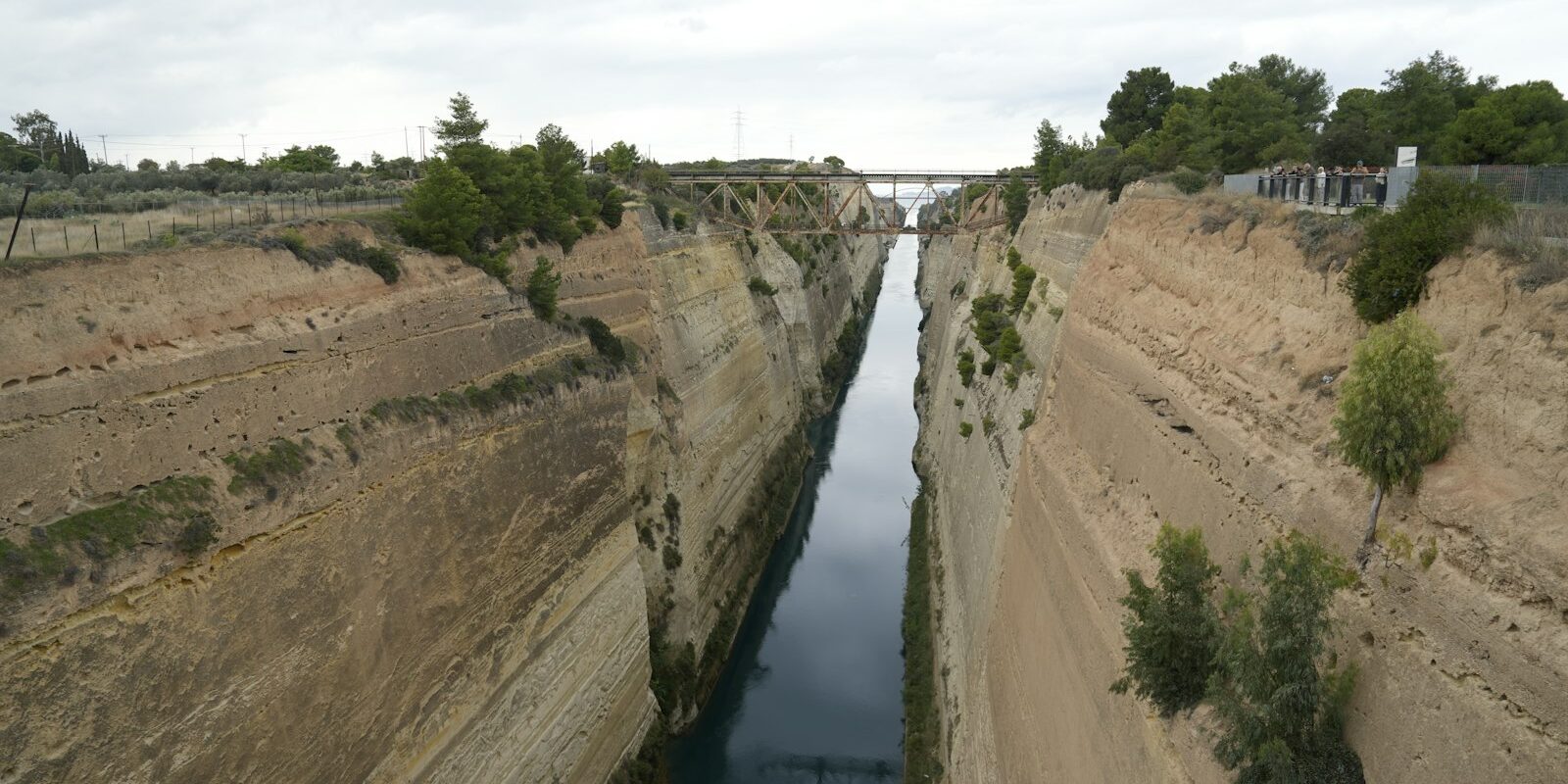
The Corinth Canal is a destination in its own right. It runs dead straight through the isthmus, is around 6.3 kilometres long and cuts up to 79 metres deep into the land. The transit takes about 40 minutes. If you want to get from Corinth into the Saronic Gulf, it saves you the long way round the Peloponnese. As things stand (November 2026), however, the canal is closed.
Saronic Gulf: Poros and Aegina
Beyond the canal, the Saronic Gulf opens up. Aegina lies in the middle of the gulf and is known for its pistachios, which have had protected designation of origin status since 1996, and for the Temple of Aphaia from around 500 BC. Further south lies Poros, where yachts moor at the quay of the waterfront promenade right in the main town. You can read more about it in our profile of the harbour of Poros. On the northern edge of the Saronic Gulf lies Athens, with the Marina Alimos, the largest marina in Greece.
Gulf of Corinth: Galaxidi, Itea and Patras
Galaxidi lies on the north shore of the gulf, on a rocky bay with small islands and lighthouses. The town has two natural harbours, Agora and Chirolakas, and was long home to seafarers who sailed the whole Mediterranean in their ships. Captains' houses with colourful façades shape the townscape.
Itea also lies on the north shore, between the sea and the vast olive groves of Amfissa, with Mount Parnassus in the background. In antiquity, neighbouring Kirra served as the port of Delphi, the sanctuary of Apollo on the slopes of Parnassus.
Patras at the western end of the gulf is the third-largest city in Greece and one of the great ports of the Mediterranean. The city lies opposite the Rio–Antirrio Bridge, on the threshold of the Ionian Sea.
What can you do on a harbour day in Corinth?
The town centre lies right in front of the marina, and the great sights of antiquity are quickly reached by taxi or bus.
Town centre: The centre of Corinth is partly pedestrianised and invites you to stroll through its parks, squares and shops.
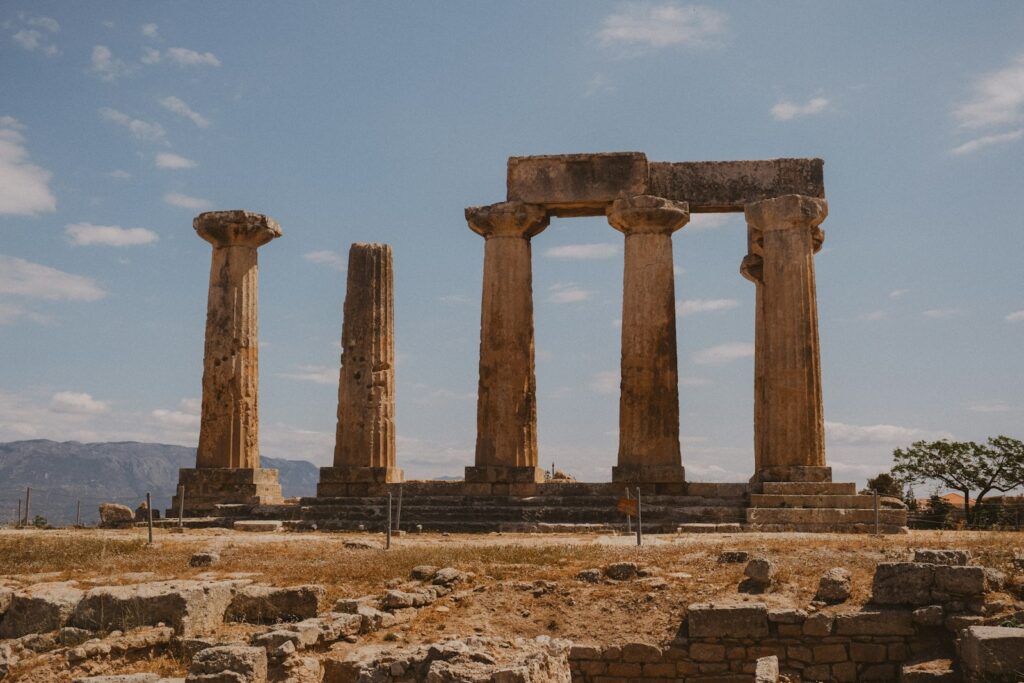
Ancient Corinth: The excavation site with the Temple of Apollo is in the village of Archaia Korinthos, about five minutes by car from the town. A bus runs there roughly hourly from the town and takes around 15 minutes; alternatively, you can take a taxi. In antiquity, Corinth was a prosperous city of trade and seafaring. A museum forms part of the excavation site.
Acrocorinth: Above ancient Corinth towers the fortress hill of Acrocorinth, the city's acropolis, with three gates and three rings of walls. Above the second gate is the Lion of St Mark, the emblem of Venice. From the highest point, with the remains of the Temple of Aphrodite, you look out over the Gulf of Corinth and the Saronic Gulf, and in clear conditions even as far as the Acropolis of Athens.
For skippers: canal, harbour authority and marine weather in Corinth
The harbour authority of Corinth is responsible for the marina in Corinth, and at sea VHF channel 16 is the distress and calling channel. You arrange payment of the canal fees with the canal administration on VHF channel 11 or by phone.
Harbour authority and formalities
Harbour fees are collected by the harbour authority of Corinth (Limenarchio Korinthou). In an emergency at sea, you can reach the coastguard on 108 or on VHF channel 16.
Transit through the Corinth Canal
The canal is operated by the canal company AEDIK. As things stand today (November 2026), it has been closed to shipping since 6 a.m. on 3 November 2026 because the final phase of the work to secure the canal walls is under way. The operator will announce separately when the canal will reopen. You can find the current status on the canal operator's website. When the canal is open, the following rules apply:
- Entry by permission only: No boat may enter the canal without clearance from the canal authority. The canal authority sets the order according to arrival time or advance registration, and passenger ships have priority. You can register in advance via the operator's online services.
- Signals at the entrances: A blue flag by day or a white light at night means “entry permitted”, while a red flag by day or two white lights one above the other at night means “entry prohibited”.
- Dimensions: The canal is 24.6 metres wide at the water surface and 8 metres deep. Because of the railway and road bridges, the clearance height is limited to 52 metres. There are submersible bridges at both ends, in Posidonia and Isthmia.
- Passage through the canal: 6 knots at most, and as slowly as possible at the entrance and exit. Keep a distance of roughly one nautical mile between boats. Fenders are provided on both sides.
- You cannot do it without an engine: Sailing boats with no engine, or with an engine that is too weak, are towed by the canal's tug.
- Fees: These depend on the length overall and the category of the boat. The fee calculator on the operator's website shows the exact amount. You can pay online, by bank transfer or at the customer service office in Isthmia, daily from 8 a.m. to 10 p.m., in cash or by card.
On one fixed weekday, the canal is also closed from 6 a.m. to 8 p.m. for maintenance work. The operator decides which day this is and usually keeps it unchanged for a long time.
Which marine weather forecast applies in the Gulf of Corinth?
The authoritative forecast is the marine weather forecast issued by the Greek meteorological service EMY (HNMS in English). You can receive it via NAVTEX and on the Meteorological Service website.
For NAVTEX, the automatic reception of weather and warning messages on board, Greece operates transmitters on Lemnos, Crete and Corfu. Forecasts are updated every six hours, and gale warnings are sent out immediately after they are issued.
Sailing trips from Corinth on Törnfinder
You can find sailing trips throughout the country, including through the Gulf of Corinth and into the Saronic Gulf, on Törnfinder under Sailing in Greece. All sailing areas and dates at a glance are shown on the page Trips.
Frequently asked questions
How do I get from Athens airport to Corinth?
Take the suburban railway from the airport to Ano Liosia, and from there the Piraeus – Athens – Kiato line to Corinth. Alternatively, you can take the KTEL intercity bus from Athens, which takes roughly one to one and a half hours.
How far is it from the bus station to Corinth Marina?
Around 400 metres. The intercity buses from Athens stop at the KTEL Korinthias bus station, and from there you can walk to the marina at Plateia Floisvou.
Where can I park at the start of the sailing trip in Corinth?
In the public car park around 250 metres east of the marina. Another car park is around 400 metres away.
Is there a supermarket near Corinth Marina?
Yes, several. The nearest is around 300 metres away, and you will find AB Vassilopoulos, Kritikos and Sklavenitis within a radius of around 500 metres.
The Corinth Canal is not only an impressive structure but for sailors a real short cut between the Aegean and the Ionian Sea. Since June 2026 it has been open again; for a cruising yacht around 12 metres experience reports cite just under 200 euros including VAT. The fare calculator provides the binding amount. Check the canal company's current notices before approaching, remember the maintenance closure on Tuesdays and register in good time online or on VHF channel 11.
No. As things stand today (November 2026), the canal has been closed since 3 November 2026 because of work on the canal walls. The canal operator will announce the reopening date separately.
How long does the passage through the Corinth Canal take?
About 40 minutes for the roughly 6.3 kilometres. A maximum speed of 6 knots applies in the canal, and you may only enter with clearance from the canal authority.
How do I contact the canal authority by radio?
On VHF channel 11. You can use it, for example, to arrange payment of the fees directly at the canal; alternatively, this can be done by telephone.