This page was translated automatically from German. View the original
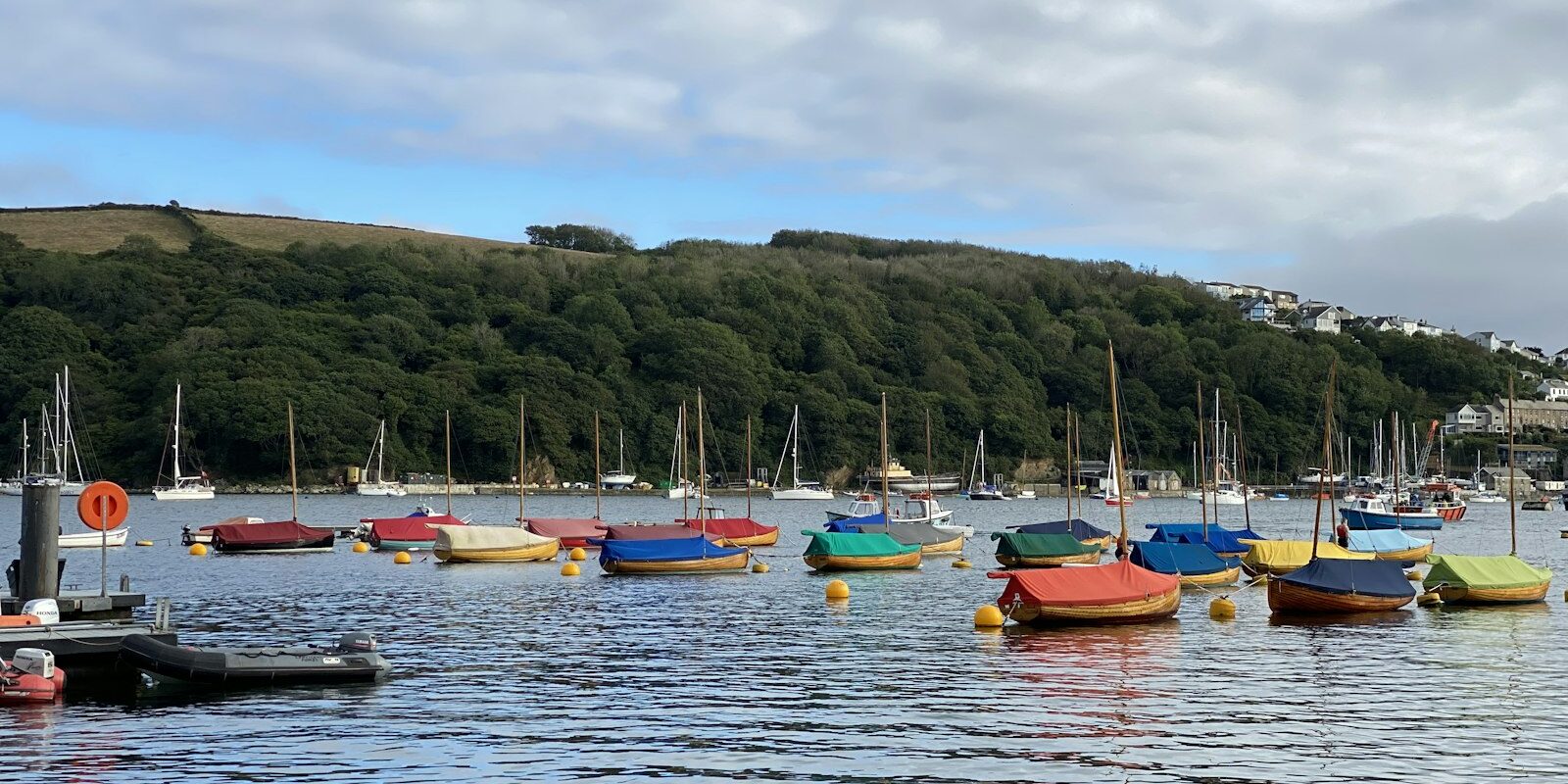
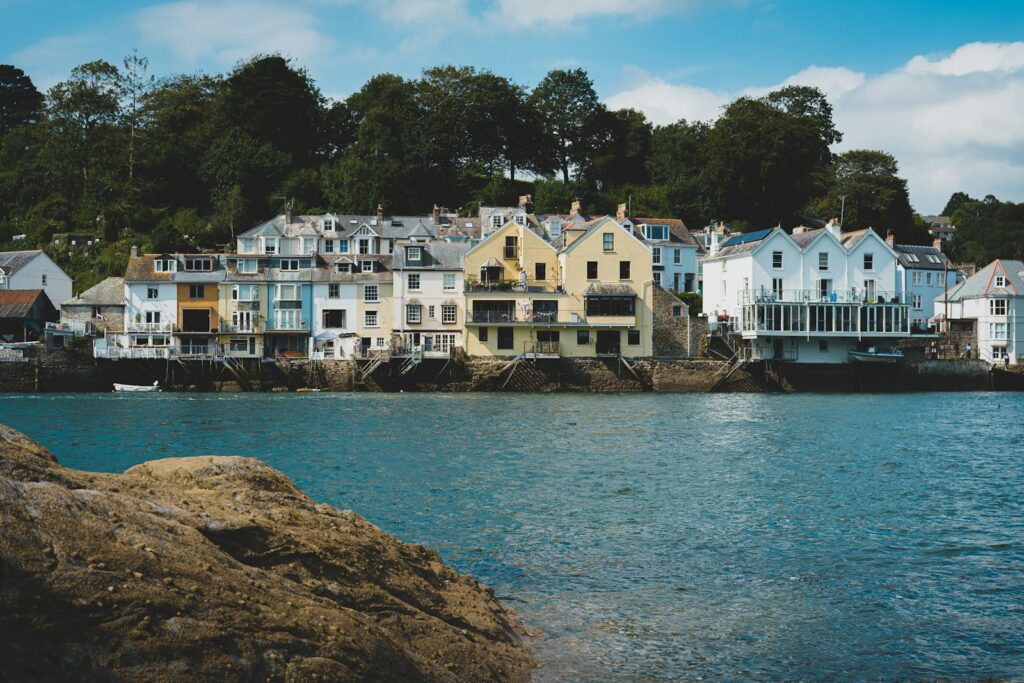
Fowey lies on the south coast of Cornwall, where the River Fowey flows into the sea through a deep, sheltered natural harbour. Here you can read how to get to Fowey for the start of your sailing trip, where the visitor berths are in Fowey Harbour, where to park and shop, what sailing weather to expect, which sailing destinations are nearby and what skippers should bear in mind when entering and leaving the harbour.
The essentials at a glance
- The nearest railway station is Par on the main line to London; from there the 24 bus runs to the large car park above Fowey.
- The visitor berths are mainly on the east side of the harbour, opposite the town: blue moorings and visitor pontoons, plus a pontoon with a shore connection at the lifeboat station and one at Penmarlam further upriver.
- Visitor berths cannot be reserved, except for registered rallies and events.
- If you come by car, it is best to park in the large car park at the top of the town; a small town bus runs from there into the centre.
- The wind mostly comes from the south-west. It blows strongest from November to March and weakest from June to August.
Where are the berths in Fowey?
In Fowey Harbour, visiting yachts lie mainly in two places: at the visitor pontoons in the river off Fowey and further upriver at the Penmarlam pontoon. The visitor pontoons in the river are on the east side opposite the old town: two visitor pontoons at the mouth of the Pont Pill creek and three more at Underhills, with room for boats of all kinds. The Penmarlam pontoon is also on the east side, in Mixtow Pill creek above the car ferry to Bodinnick; visiting boats moor on its south side.
Map from OpenStreetMap. When the map is displayed, data is transmitted to the provider.
More InformationOn the town side there is also the Berrill’s Yard pontoon by the lifeboat station, where you may stay overnight on the outside from 4 pm to 8 am. There are also the blue visitor moorings along the east side of the lower harbour, a pontoon at Grid Irons above the car ferry and three blue moorings at Wiseman’s Reach. Opposite Fowey lies the village of Polruan; a passenger ferry connects the two.
Arriving in Fowey at the start of your sailing trip
You can reach Fowey by train and bus, by car or via Newquay Airport.
From the airport to Fowey
Cornwall Airport Newquay is about 20 miles from Fowey. There is no direct public transport connection; by bus you travel to Fowey via St Austell.
By car, train and bus
By car, leave the M5 motorway at Exeter and take the A38 towards Plymouth, cross the Tamar Bridge into Cornwall and, after Liskeard, take the A390 towards St Austell. Shortly after Lostwithiel, the road to Fowey branches off to the left. For your satnav, the harbour office at Albert Quay has the postcode PL23 1AJ and the pontoon at Penmarlam has the postcode PL23 1LZ.
By train, travel to Par; the station is on the main line from London Paddington to Cornwall. There is no rail connection to Fowey itself; the tracks there are used only for freight to the port. From Par station, the 24 bus runs to Fowey and ends at the large car park above the town. In the other direction, the same route goes to St Austell. By taxi, you can be in Fowey from Par in a short time.
Entry to the United Kingdom
If you are not travelling on a British or Irish passport, you will usually need an electronic travel authorisation (ETA) or a visa for the UK. You apply for the ETA before your journey on the UK Government website, it costs £20 and allows stays of up to six months.
Parking
The road through the old town is narrow and one-way. The large car park is at the top of the town on Hanson Drive, and from there a small town bus shuttles into the centre about every 15 minutes. A second car park is down by the water at Caffa Mill, right by the car ferry to Bodinnick, and a third is on the way to Readymoney Cove, south of the town.
Showers and sanitary facilities
Showers are available at the Royal Fowey Yacht Club, the Fowey Gallants Sailing Club and at Penmarlam, and they are coin-operated. Penmarlam also has toilets and a café, both within walking distance of the pontoon. There is a self-service launderette at the Four Turnings Garage on the edge of town.
Shopping for the trip
There is a SPAR in the town. The post office is in the Fowey Mini-Market at 39 Fore Street, where you can change money for a fee. Another supermarket, a Co-op, is about 6.4 kilometres to the west towards Par. For a big shop, the 24 bus goes to St Austell, where it stops at the Asda supermarket.
Doctor, pharmacy and emergency services
There is a pharmacy, Boots, in the centre of the town, about 350 metres from the harbour. The GP surgery for Fowey and Polruan is the Fowey River Practice in the town. Minor injuries are treated at the hospital in St Austell, and the nearest A&E department is at the Royal Cornwall Hospital in Truro. If you need medical advice quickly and cannot reach a GP, you can call the NHS on 111.
- 999: Emergency number for police, fire brigade and ambulance service
- 999 and “Coastguard”: emergency on the coast or at sea; HM Coastguard will take the call
- 101: police, if it is not urgent
- VHF Channel 16: Distress and calling channel at sea
What does Fowey harbour offer?
Fowey is a deep-water natural harbour that you can enter by day or night and at any state of the tide. It is also a commercial port, mainly used to ship china clay from Cornwall. The harbour authority, Fowey Harbour Commissioners, manages the river estuary, which runs about eleven kilometres up to Lostwithiel, and around 1,500 permanent moorings. It welcomes around 6,000 visiting yachts every year.
Equipment
Water is available at the pontoons at Albert Quay, in Berrill’s Yard and in Penmarlam, and electricity at the pontoons in Berrill’s Yard and Penmarlam. You can fill up with diesel and petrol around the clock and at any state of the tide at the fuel barge, which lies just above the car ferry to Bodinnick, and you pay directly at the pump. Boat supplies are available from Mixtow Marine, and there is also a small selection at the harbour office. In summer a water taxi operates, which you can call on VHF channel 6.
The pontoons at Albert Quay, in Berrill’s Yard, in Polruan and in Penmarlam are connected to the shore. Of these, visiting boats can stay overnight only in Berrill’s Yard and Penmarlam.
| Fowey Harbour at a glance | Details |
|---|---|
| Operator | Fowey Harbour Commissioners, harbour office at Albert Quay, Fowey PL23 1AJ |
| Phone | +44 1726 832471 |
| VHF | Channel 12 (Fowey Harbour Patrol) |
| Access | by day and night, at any state of the tide |
| Guest berths | blue moorings, visitor pontoons at Pont Pill (1 and 2), Underhills (3 to 5) and Grid Irons (6), pontoons with shore access at Penmarlam and Berrill’s Yard |
| Advance booking | no, only for rallies and events |
| Tidenhub | 5.5 m at spring tides, 2 m at neap tides |
| Maximum speed | 6 knots |
| Berthing fees per metre per night, 2026 tariff incl. harbour dues and VAT (as of November 2026) | Monohull £2.85, multihull £3.15, pontoon with shore access £3.95, electricity £3.55 per night and boat |
| Fuel station | Diesel and petrol, around the clock, above the car ferry to Bodinnick |
What is the sailing weather like around Fowey?
The south-west of England is one of the windiest parts of Britain. The wind usually comes from the south-west. When lows pass in from the Atlantic, it often starts out from the south or south-west and later veers west to north-west. When lows track through the English Channel, easterly to north-easterly winds can also become strong, and in spring they come from the north-east more often.
The wind is strongest on average from November to March and weakest from June to August. In its inshore waters forecast, the UK Met Office lists winds of Beaufort force 6 and above separately and issues a gale warning from force 8. In strong south-westerly winds and an ebbing tide, the harbour entrance and the lower harbour can become rough. You will then find shelter further upriver at Grid Irons, Penmarlam and Wiseman’s Reach.
Which sailing destinations are near Fowey?
From Fowey you can sail east to Plymouth and west to Falmouth, or, on longer sailing trips, to the Isles of Scilly or across the English Channel to Brittany. The distances given are rounded figures over water on the usual course; for precise planning, refer to the chart.
- Plymouth: around 24 nm. The city on the large bay of Plymouth Sound has several marinas.
- Falmouth: To the west of Fowey lies one of the largest natural harbours in the world, with many marinas and moorings, a visitors’ harbour and access around the clock. The Helford River flows out just to the south.
- Isles of Scilly: The island group lies about 28 miles west-south-west of Land’s End. The harbour is on St Mary’s, the largest inhabited island, and there are many rocks and shallows around the islands.
- Brittany: You can reach the French coast on a longer sailing trip across the English Channel. On your return to Great Britain, the reporting requirements for pleasure craft apply.
You can read more about the marinas in the neighbouring sailing area in our profile of the marinas in Plymouth, and about the harbours further east on the English south coast in our profile of the harbours of Cowes.
What can you do on a day in port in Fowey?
- Hall Walk: The most popular circular walk along the river is about four miles long and takes around two and a half hours. It uses both ferries and leads via Bodinnick, Pont and Polruan, with views over the estuary and out to sea.
- Readymoney Cove and St Catherine’s Castle: It is about a 30-minute walk to the bathing cove south of the town. Above it stands the fortress, built in 1542 to protect the harbour entrance, which is free to visit all year round.
- Polruan: The passenger ferry takes you across to the village on the other side of the harbour in ten minutes, leaving Whitehouse Quay every 15 minutes during the day in summer. Polruan has one of the two medieval defensive towers between which a chain could once be stretched across the harbour entrance.
- St Fimbarrus Church and Fowey Museum: The parish church, dating from 1460, has the second-tallest church tower in Cornwall. The small museum in the town, housed in a 16th-century building, tells the maritime history of Fowey.
For skippers: berthing and marine weather in Fowey
The harbour byelaws and the instructions of the Fowey Harbour Commissioners apply in Fowey harbour. In summer the harbour patrol is out on the water from 8am until dark, and outside the season during office hours.
Registration and Berthing
When entering, call the Fowey Harbour Patrol on VHF channel 12 and they will assign you a berth. Visitor berths are allocated in order of arrival, and when it is busy you will be rafted up. Boats over 20 metres are best reported in advance. The blue moorings at Underhills take boats up to 12 metres, those in Polruan Pool up to 15 metres, and larger boats go on yellow moorings with a flat buoy. Orange moorings close to the shore are for day boats. On the Albert Quay and Polruan pontoons you may only tie up on the outside for one hour, and the same applies in Berrill’s Yard during the day, with overnight stays from 4pm to 8am. The harbour patrol collects the berthing fee on the water by card payment, otherwise you pay online. With the loyalty card, every seventh night is free.
In winter the harbour takes some of the pontoons out of the water: as things stand (November 2026), the short-stay pontoon at Albert Quay has been dismantled since 21 October, and the removal of the pontoon at Polruan was announced for 19 October. Further pontoons spend the winter on moorings in Wiseman’s Reach.
Harbour rules
- A speed limit of 6 knots applies throughout the harbour, and you should keep your wash as small as possible. The harbour area begins between St Catherine’s Castle and Punches Cross and extends as far as Lostwithiel.
- Keep your distance from cargo ships, especially when they are manoeuvring, and from the car ferry between Caffa Mill and Bodinnick, which has only limited room to give way in strong wind and current.
- Anchoring is prohibited in the main fairway and in the cargo ships’ turning area. An anchored boat must never be left unattended, and it pays the same fee as on a mooring.
- Boats and dinghies without navigation lights must show a light at night and in poor visibility.
- Motor boats are not allowed in the bathing zones marked with purple buoys.
- On Wednesday evenings and Saturday afternoons, races start and finish in front of the Royal Fowey Yacht Club, and it gets crowded there and in the harbour entrance.
Approach
The relevant chart is British chart no. 31. You enter the harbour on a north-north-easterly course and then head north-east towards the turning area in front of Town Quay. At night, stay in the white sector of the Whitehouse light until you are abeam of the defensive tower at Polruan. During the day, the red-and-white tower on Gribbin Head marks the approach. As things stand (November 2026), the Fowey lighthouse (characteristic LFl.WR.5s) is showing unreliable sectors; this does not affect the Whitehouse light.
The tidal range is 5.5 metres at spring tides, up to 6 metres at the equinox, and 2 metres at neap tides. The current often runs at more than one knot, at up to 1.75 knots at spring tides, and stronger still after heavy rain. Above Wiseman’s Reach the river dries out at low water. In Mixtow Pill the water may be shallower than stated; current survey data is available on the harbour’s website.
Entering the country with your own boat
If you come directly to Fowey from outside the UK, including from the Channel Islands, you report the passage online to the British authorities (Pleasure Craft Report) and fly the yellow Q flag once you reach the 12-nautical-mile limit. If you are not coming from Ireland, the Isle of Man or the Channel Islands, everyone on board without a British or Irish passport needs entry permission from the Border Force before going ashore. The rules can be found on the UK government's website.
Which marine weather forecast applies to Fowey?
The Met Office coastal waters forecast applies to Fowey, with the section “Lyme Regis to Land’s End including the Isles of Scilly”. It is issued four times a day, is valid for 24 hours each time and extends up to 12 nautical miles off the coast. BBC Radio 4 also broadcasts it at around 00:48 UK time at night. The current weather at the entrance is shown on the website of the National Coastwatch Institution lookout station up in Polruan.
Sailing trips from Fowey on Törnfinder
You can find sailing trips along the Cornish coast, across the English Channel and in all other sailing areas in the trip overview.
Frequently asked questions
How do I get to Fowey by train?
Take the train to Par and continue by bus 24 or taxi. Fowey itself has no passenger railway station; the bus ends at the large car park above the town, and from there the town bus runs to the centre.
Where do I park at the start of my sailing trip in Fowey?
In the large car park on Hanson Drive above the town, or down at Caffa Mill by the car ferry. It is better not to drive through the narrow old town; a town bus shuttles from the large car park to the centre.
Can I reserve a berth in Fowey?
No, visitor berths are allocated in order of arrival. The only exceptions are for registered rallies and events. When you enter, the harbour patrol will assign you a berth on VHF channel 12.
Can I enter Fowey at any state of the tide?
Yes, Fowey is a natural deep-water harbour, and you can enter by day or night and at any state of the tide. Only above Wiseman’s Reach does the river dry out at low water.
How do you pronounce Fowey?
“Foy”, which rhymes with the English word “toy”. The name comes from the Cornish word for beech and derives from the river, not the town.