This page was translated automatically from German. View the original
Livingston lies on Guatemala's Caribbean coast in the Departamento Izabal, right where the Río Dulce flows into the Bahía de Amatique. There is no road inland, so you can only reach the town by water. Here you can read how to get to Livingston, where boats and yachts can tie up, where to shop, what the sailing weather is like, how to head up the Río Dulce and what skippers should know about customs and the bar at the river mouth.
The essentials at a glance
- Livingston can only be reached by boat: about 30 minutes from Puerto Barrios, or one to two hours from Fronteras on the Río Dulce, depending on the number of stops.
- From La Aurora international airport in Guatemala City, it is a five- to six-hour journey overland to Puerto Barrios or Río Dulce. There are also domestic flights to Puerto Barrios, taking about 1 hour 15 minutes.
- There is no marina in Livingston. Small shops are within walking distance of the main jetty, and many shops in the town do not accept cards.
- Hurricane season runs from June to the end of November. For boat trips along the coast, February to August is considered the calmer period, while on the river it is driest from November to April.
Where is the landing stage in Livingston?
Livingston has no marina with pontoons. The most important point on the water is the main jetty, Muelle Principal, south-east of the town centre, right at the river mouth. This is where the lanchas, the open motorboats, depart for Puerto Barrios, for Fronteras and for the beaches. It is about 400 metres from the main jetty to the town centre, and a second boat jetty lies roughly 350 metres further north on Calle Principal. For yachts, Livingston lies at the entrance to the Río Dulce, which leads upstream to the marinas near Fronteras.
Map from OpenStreetMap. When the map is displayed, data is transmitted to the provider.
More Information| Feature | Livingston |
|---|---|
| Location | Mouth of the Río Dulce into the Bahía de Amatique, Departamento Izabal |
| Access | by water only, no road connection |
| berthing | no marina, main jetty Muelle Principal |
| Boat to Puerto Barrios | around 30 minutes |
| Boat to Fronteras (Río Dulce) | one to two hours, depending on stops |
| Customs | SAT office, Calle Principal, municipal building 2nd floor, 8am to 8pm, tel. +502 2329-7070, extension 7555 |
| distress call | 110 police, 122 and 123 fire brigade, 125 Red Cross |
| Wave forecast | INSIVUMEH, Bahía de Amatique point, updated daily |
Arriving in Livingston for the start of your sailing trip
The journey to Livingston always has two parts: overland to Puerto Barrios or Río Dulce, and then onwards by boat.
From the airport to Livingston
International flights land in Guatemala City at La Aurora airport in the Zone 13 district. There is no direct connection to Livingston. From the capital to Puerto Barrios it is 297 to 317 kilometres, depending on your starting point, and by bus or car you will need around five and a half to six hours. The journey to Río Dulce takes five to six hours. As things stand (November 2026), there are also direct flights from Guatemala City to Puerto Barrios, with a flying time of about 1 hour 15 minutes.
Robberies are increasingly common on the roads around the airport, often in traffic jams by passing motorcyclists. The tourist board INGUAT can arrange vetted taxis via the short number 1500 or +502 2421 2810, and there is also an INGUAT desk at the airport. You can recognise licensed taxis by number plates beginning with “A” and by the licence number on the side doors.
By bus and boat
Long-distance buses to Río Dulce leave from the bus station in Zone 1 of Guatemala City, and it is best to reserve your seats in advance. Shared minibuses also connect Antigua Guatemala with Río Dulce. Río Dulce and Puerto Barrios are about 65 kilometres apart, roughly two hours by car or taxi. You should avoid travelling overland at night, as there is an increased risk of accidents from unlit vehicles and potholes.
From Puerto Barrios, ferries and lanchas run from the municipal jetty to Livingston in about 30 minutes. From Fronteras, the village by the bridge over the Río Dulce, the public boats depart from the municipal jetty. The trip downriver takes one to two hours, depending on the boat and any stops, and passes through El Golfete and the gorge of the Río Dulce.
Parking
You cannot reach Livingston by car, as there is no road connection. If you travel by car, leave it in Puerto Barrios or Río Dulce and continue by boat. Only park the vehicle in a guarded car park and do not leave any valuables in it.
Shopping for the trip
For provisions, Livingston has several small shops within walking distance of the main jetty: a Mini Tienda about 150 metres away, the Tienda Herrera about 250 metres, the Tienda Rosita about 300 metres and the Super24 in the town centre about 450 metres. Bring cash in small notes, as many shops in Livingston do not accept cards. The local currency is the quetzal, and US dollars are usually easier to exchange than euros.
You will find more choice in Puerto Barrios, where shops and restaurants line the centre. From there, the lanchas take about 30 minutes to return to Livingston.
Doctor, pharmacy and emergency services
The Centro de Salud, the town's health centre, is about 450 metres from the main jetty. You can reach the Clínica Auto Cuidado Familiar after about 400 metres and the Farmacia y Clínica Católica after about 600 metres. The nearest pharmacy, the Farmacia de mi tierra, is about 450 metres from the main jetty. In rural areas, medical care is often basic. There is a low risk of malaria in the region all year round, as well as dengue and chikungunya fever, which are transmitted by mosquitoes that bite during the day. Consistent mosquito protection by day, at dusk and at night is therefore essential.
- 110 and 120: Policía Nacional Civil
- 122: Bomberos Voluntarios (fire and rescue service)
- 123: Bomberos Municipales
- 125: Cruz Roja Guatemalteca
- 1500: ASISTUR, the tourism authority's assistance service for travellers
What does Livingston have to offer?
Livingston is a small town with a relaxed pace, where you can reach everything on foot: the streets, restaurants, accommodation and landing stages are all close together. For anything further afield, you take a boat.
Equipment
There are no pontoons with electricity and water in Livingston. In town you will find small shops, simple accommodation and family-run restaurants serving Caribbean cuisine, in which coconut, fish, seafood and plantains take centre stage. On the second floor of the municipal building on Calle Principal there is a branch office of the customs authority. The infrastructure is more basic than in the country's major destinations, and access for people with reduced mobility is limited at the landing stages and when getting into and out of the boats.
What is the sailing weather like in Livingston?
From June to the end of November it is hurricane season in the Caribbean and Central America, and tropical storms and heavy rain are to be expected along the coast. In the cooler season around the turn of the year, cold fronts move across Guatemala.
For boat trips along the coast, February to August is regarded as the most pleasant time, as the rainfall is then usually lighter and the sea calmer. From September to January there is more rain, often in heavy but short showers. On the Río Dulce the water is calmest in the morning between seven and eleven o'clock; in the rainy season the showers usually fall in the afternoon.
How do you get from Livingston up the Río Dulce?
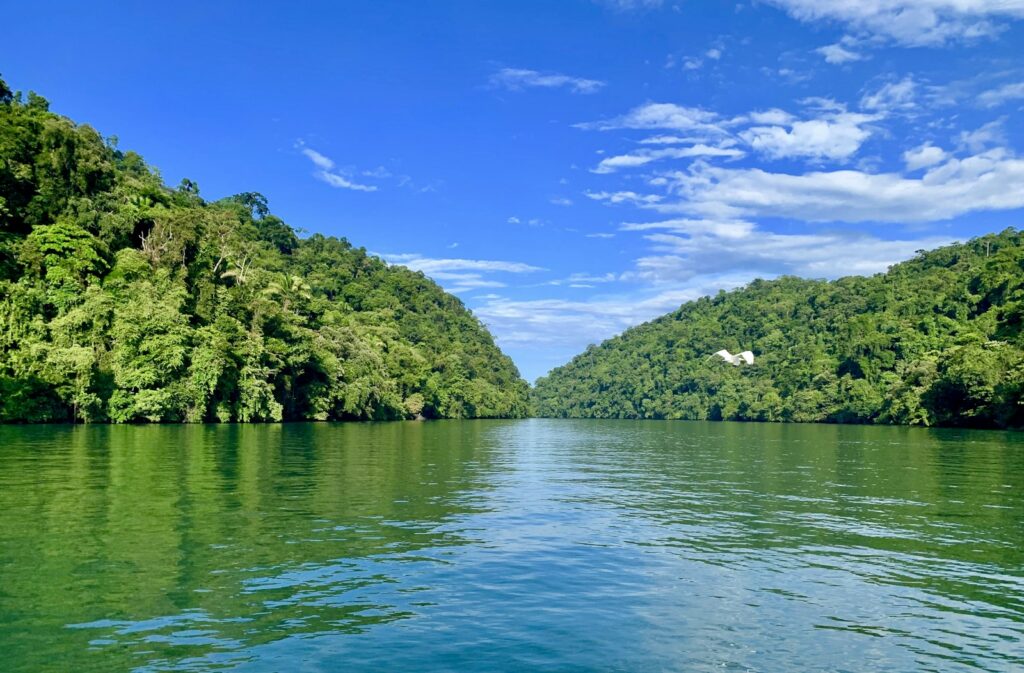
The Río Dulce connects Lake Izabal, the largest lake in Guatemala, with the Caribbean. From Livingston you first travel through a gorge with limestone walls over 100 metres high and dense rainforest. The river then widens into the large lagoon of El Golfete, before narrowing again and reaching Fronteras with its bridge over the Río Dulce. The river and its banks are protected as a national park.
- The gorge: Just beyond Livingston the rock walls rise steeply. At one spot on the bank, warm thermal water flows straight out of the rock.
- El Golfete: At the eastern end of the lagoon lies the Biotopo Chocón Machacas nature reserve, one of the best places to see manatees. Herons, pelicans, cormorants and frigatebirds nest on the small Isla de Pájaros; you may not set foot on it, but you can watch the birds from the boat.
- Fronteras: The town by the bridge is the hub of the region, with bus connections, accommodation and the landing stages. Nearby on the shore there are marinas with berths, including the marina of the Tortugal River Lodge near the Castillo de San Felipe.
- Castillo de San Felipe de Lara: This Spanish fortress dating from 1651 guarded the outlet of Lake Izabal against pirates. Today you can visit its passageways, tower and cannons.
Manatees live in the river, where they are among the protected species. The animals are most active in the early morning, which is when your chances of spotting manatees are best.
Which sailing destinations can you reach from Livingston?
The nearest destinations lie along the coast of the Bahía de Amatique, which opens out between the east coast of Guatemala and the south of Belize. Further away are the Islas de la Bahía off Honduras.
- Playa Blanca: One of the few pale sandy beaches on Guatemala's Caribbean coast, reachable only by water and around 15 to 30 minutes from Livingston by boat. The beach lies within a private nature reserve; you pay an entrance fee, which includes a drink. The water is calm and shallow, and there are hammocks, changing rooms and a small restaurant.
- Punta de Manabique: This peninsula separates the Bahía de Amatique from the Gulf of Honduras. The protected area covers more than 132,000 hectares of lagoons, mangroves, reefs and seagrass meadows, and the bay is home to manatees, dolphins and sea turtles.
- Puerto Barrios: The port town on the other side of the bay has a waterfront promenade, the Malecón, with views over the Bahía de Amatique, and provides the link to the road to the capital.
- Islas de la Bahía with Roatán: The island group off Honduras is regarded as one of the best diving areas in the region.
Further south, Bocas del Toro on Panama's Caribbean coast is a long-distance destination; you can find out more in the profile of the marinas in Bocas del Toro.
What can you do on a day in port in Livingston?
Livingston is home to the Garífuna in Guatemala, an Afro-Caribbean community with its own language, cuisine, music and dance. UNESCO has recognised their culture as intangible cultural heritage.
- Through the town: Steep streets with colourful houses, Garífuna music such as Punta and Parranda, and the bustle at the landing stage shape the town.
- Try tapado: This soup of fish, seafood, coconut milk, plantains and spices is Livingston's best-known dish. It goes well with rice and beans cooked in coconut and with coconut bread.
- Siete Altares: Seven pools with waterfalls lie about three kilometres north of the town centre. On foot along the shore it takes 35 to 45 minutes, and by boat from the jetty about 15 minutes. You pay the entrance fee in cash, and you will need water shoes because the rocks are very slippery.
- Playa Quehueche: Livingston's beach has golden sand, palm trees and a wooden suspension bridge over the river. There are simple restaurants serving Garífuna cuisine nearby.
For skippers: clearing in, the bar and marine weather in Livingston
Livingston lies at the entrance to the Río Dulce, and the town has its own customs office.
Customs and crew entry
The SAT tax and customs authority has a branch office in Livingston on the second floor of the municipal building on Calle Principal. It is staffed from 8 am to 8 pm and can be reached on +502 2329-7070, extension 7555.
The following applies to the crew: passports must still be valid for six months on entry, and an ID card is not sufficient. Holders of a German passport do not need a visa for stays of up to 90 days, while other nationalities are subject to their own rules. These 90 days apply to Guatemala, El Salvador, Honduras and Nicaragua combined. Make sure your passport receives an entry stamp; if it is missing, a lengthy trip to the authorities in the capital usually follows. Before entering and leaving, a digital traveller declaration must be completed, the Declaración Jurada Regional de Viajero. Fresh animal products such as meat, sausage and dairy products may not be brought in, and you must declare cash amounts of US$10,000 or more.
The bar at the river mouth
There is a sandbar at the mouth of the Río Dulce. Deep-draught yachts can be heeled over it by a motorboat pulling on a halyard.
Which marine weather forecast applies in Livingston?
The authority responsible is the Instituto Nacional de Sismología, Vulcanología, Meteorología e Hidrología (INSIVUMEH). On its Website it publishes a wave forecast every morning at 7:30 am for today and the following two days, covering the Atlantic coast for the points Bahía de Amatique, Punta de Manabique and El Quetzalito. The figure given is the significant wave height; individual waves can be considerably higher. If the wave height exceeds set limits, the weather service issues a special bulletin. During the hurricane season, also follow the warnings from the National Hurricane Center.
Sailing trips from Livingston on Törnfinder
You can find sailing trips in the region under Sailing in the Caribbean, and all offers worldwide under Trips.
Frequently asked questions
How do I get to Livingston?
Only by boat, as there is no road to Livingston. From Puerto Barrios the journey takes about 30 minutes, and from Fronteras on the Río Dulce one to two hours, depending on the stops.
Is there a marina in Livingston?
No. Boats moor at the main jetty, Muelle Principal, at the river mouth. Marinas with berths can be found upriver near Fronteras.
Where do I park at the start of my trip in Livingston?
Not in the town itself, because Livingston has no road connection. Leave your car in Puerto Barrios or Río Dulce, ideally in a guarded car park.
Where do I shop in Livingston?
In small shops about 150 to 450 metres from the main jetty, including Super24 in the town centre. Bring cash in small notes; you will find more choice in Puerto Barrios.
When is the best time to visit Livingston?
For boat trips along the coast, February to August is considered the calmer period. The hurricane season runs from June to the end of November, and it rains more from September to January.
Where is customs in Livingston?
On the second floor of the municipal building on Calle Principal. The SAT customs authority branch office is staffed from 8 am to 8 pm.