This page was translated automatically from German. View the original
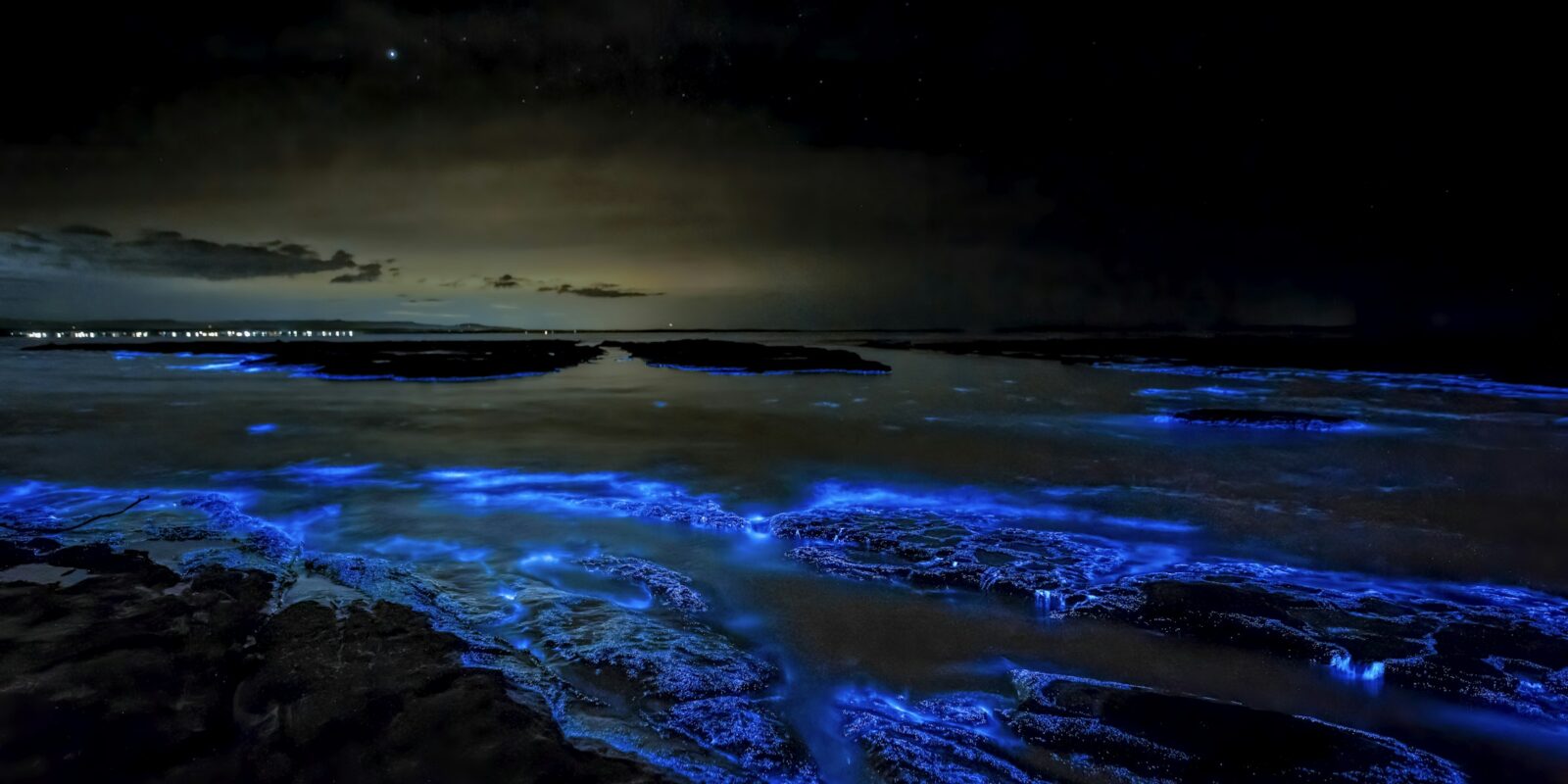
Bioluminescence is light from living single-celled organisms: tiny dinoflagellates, in the North Sea chiefly the sea sparkle Noctiluca scintillans, flash blue-green as soon as the water around them is disturbed. You are most likely to see it on warm, calm summer nights, and on board especially in the bow wave and the wake.
The essentials at a glance
- It glows brightest in the bow wave, the wake and breaking waves, in other words wherever the water is churned up.
- Off Helgoland, Noctiluca is most common in June and July, with the densest populations at a water temperature of around 17 degrees and light winds.
- In the Baltic Sea, Noctiluca is rare, because this marine species hardly occurs in the brackish Baltic water.
- Noctiluca is non-toxic to humans, and swimming is safe.
- The darker the night, the better: moonless nights, little light on board and eyes that have adjusted to the dark.
What glows in the sea at night?
Almost always it is dinoflagellates, single-celled plankton organisms. In the North Sea the main cause is Noctiluca scintillans, known in German as Meeresleuchttierchen.
During the day, large numbers give themselves away as reddish streaks on the water or as a pink gelatinous layer along the tideline. Each individual cell measures only about one millimetre. Under the microscope it looks like a transparent bubble with a flagellum attached. Noctiluca does not photosynthesise; it feeds on smaller algae and other plankton. When these are plentiful, it multiplies rapidly. In calm conditions the cells then gather in dense mats on the water surface.
How does bioluminescence work?
The cell produces its own light, and almost without any heat. Two substances are needed for this: luciferin, the actual light-emitting molecule, and the enzyme luciferase, which speeds up the reaction with oxygen.
The light-producing substances are stored in tiny vesicles inside the cell. When the cell wall is deformed by a current, pressure-sensitive channels open, an electrical signal passes through the cell, and the inside briefly becomes more acidic. It is precisely this surge of acidity that triggers the light reaction. A single flash lasts only 0.1 to 0.5 seconds. The light falls in the blue-green range at around 472 nanometres.
Many dinoflagellates only glow brightly at night. Their internal clock ramps up their ability to glow after dark, most strongly about two hours later. During the day they barely glow, even if it is dark.
Why do single-celled organisms glow at all?
The common explanation is called the burglar alarm theory: when a small copepod tries to eat the cell, it flashes. The flash startles the copepod and at the same time makes it visible to fish, which eat it. However, the function has not been fully explained.
Why do you see bioluminescence when night sailing?
Because your boat provides exactly the stimulus the cells respond to. What matters is not speed in itself, but shear force, that is, how strongly the water tugs at the cell.
It glows brightest where the water is churned up: at the bow wave, along the hull, behind the helm and in the wake. Air bubbles also trigger the glow, which is why breaking wave crests and the foam trail behind the stern sparkle especially. Sometimes dolphins draw glowing trails through the water when they swim alongside the bow.
Anyone who sails on longer passages according to a fixed watch schedule spends many dark hours on deck. It remains important to keep looking outwards. You interpret unfamiliar lights on the water by the navigation lights of other vessels, not by the sparkle along the hull.
Bioluminescence: when and where in the North Sea, Baltic Sea and Mediterranean
Your best chance is in high summer on the North Sea. Noctiluca is rare in the Baltic Sea and appears only irregularly in the northern Adriatic.
North Sea
Off Helgoland, Noctiluca reaches its highest cell counts in June and July, after the spring bloom of diatoms. Concentrations are densest at a water temperature of around 17 degrees and wind below 6 metres per second, which is just under 12 knots. The cells then gather at the surface. Strong sunlight stresses the cells and helps bring the bloom to an end.
Noctiluca has become considerably more common off Helgoland. Since the 1990s, the amount recorded in the Helgoland time series has risen 1.65-fold, and the bloom season has lengthened from around 28 to 98 days. The main hotspots are the coastal waters off the mouths of the Elbe and the Rhine, extending in summer to the East Frisian Islands and north up the Danish coast. Off Sylt, too, you can watch the glow in the surf at night in high summer. Anyone who sails on the North Sea in summer or joins a cabin chartertherefore has a realistic chance of seeing it.
Baltic Sea
The sea sparkle Noctiluca is the exception in the Baltic Sea. The species is found from the North Sea to the Kattegat. In German Baltic waters the cells appear only sporadically, for example in Lübeck Bay and Mecklenburg Bay, when salty North Sea water flows in through the Kattegat. Earlier sightings were isolated and disappeared again.
Mediterranean
Noctiluca also occurs in the western Mediterranean and in the northern Adriatic. Blooms have been observed off Istria since the 1970s, but irregularly and not every year. They are favoured by warm, nutrient-rich water and light winds.
Is bioluminescence dangerous?
No. Noctiluca scintillans is not toxic to humans. You can swim in glowing water, and bathing water quality is not affected either.
For the ecosystem, however, dense blooms are not entirely harmless. Noctiluca feeds on other plankton, and when large quantities die off, the decomposition uses up oxygen and releases ammonium. That is why the species is counted among the harmful algal blooms, even though it does not produce any toxin itself. More bioluminescence therefore does not automatically mean a healthier sea. It is linked to nutrient inputs and warmer water.
How do you photograph bioluminescence?
Your best bet is a tripod, a longer exposure and no flash, because the individual flashes are faint and brief.
- This is easier from the beach or a jetty than on board, where the boat moves during the exposure.
- Create some movement: drag a hand through the water or wait for waves breaking on the shore.
- Avoid torches and screens where possible, so that your eyes can adjust to the darkness and no stray light gets into the picture.
A simple test on board: scoop up a bucket of seawater at night and swirl it around. If it glows, there are luminous single-celled organisms in the water.
Night passages on Törnfinder
You are most likely to see bioluminescence on sailing trips with night passages. On Törnfinder you will find Mile building, on which sailing also takes place at night, as well as sailing trips on the North Sea and on the Baltic Sea.
Frequently asked questions
When is bioluminescence at its strongest?
Off Helgoland in June and July, on warm nights with little wind. Many luminous single-celled organisms are brightest about two hours after dark.
Is there bioluminescence in the Baltic Sea?
Only rarely from Noctiluca, the main cause in the North Sea: the species appears only occasionally in German Baltic waters, when North Sea water flows in.
Can you swim in bioluminescent water?
Yes. Noctiluca is non-toxic to humans, so swimming is safe.
Why does the water only glow when it moves?
Because the cells react to mechanical stimuli. The light reaction is only triggered when water tugs at the cell wall. Still water stays dark.