This page was translated automatically from German. View the original
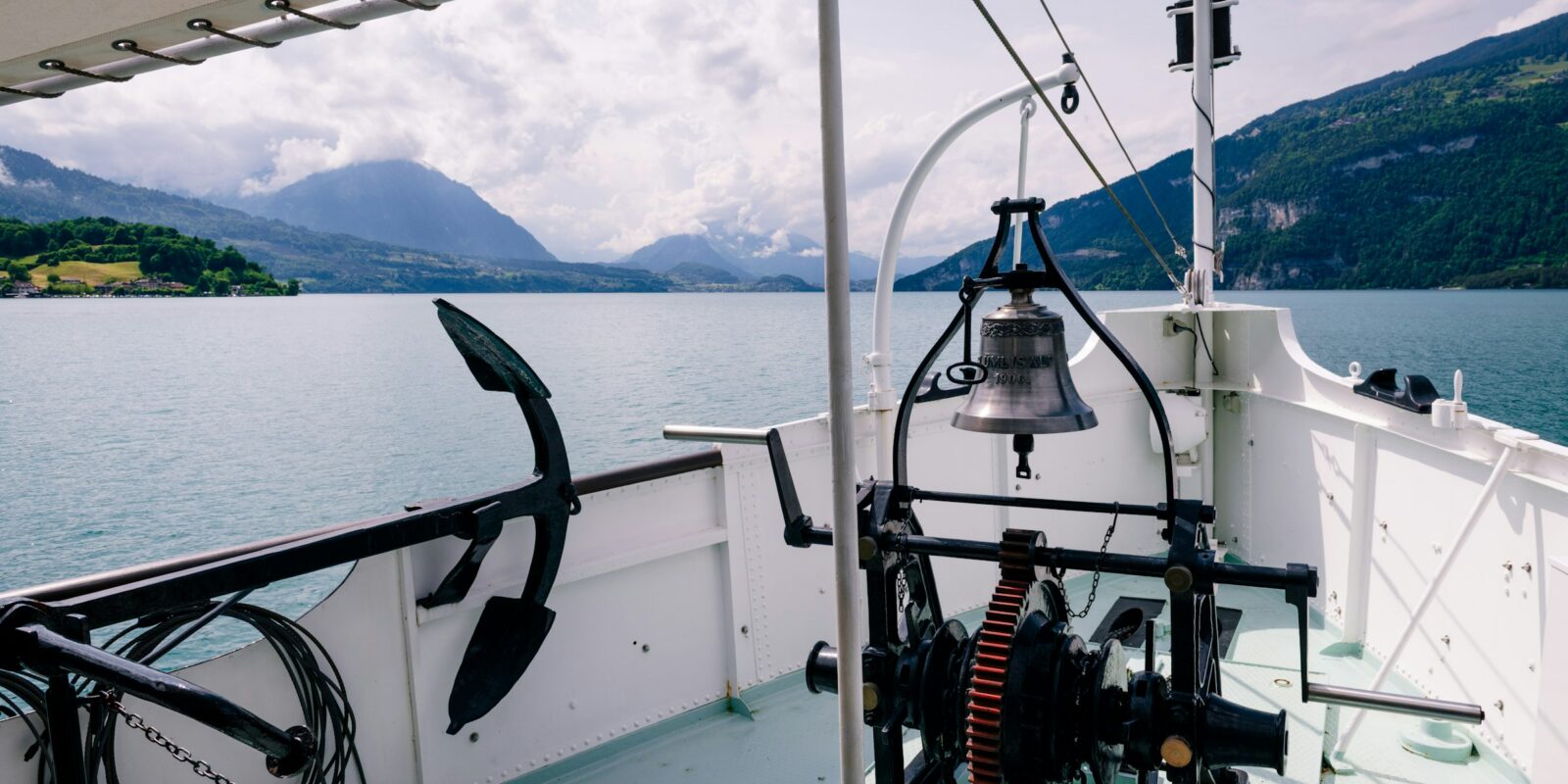
Glasen are the half-hours of a watch on board, indicated by strikes on the ship's bell. Each half-hour adds one strike; at 8 bells four hours have passed and the watch is relieved.
The essentials at a glance
- One bell is half an hour. The count starts from the beginning of the watch, not from the time of day.
- 8 bells are struck at 04:00, 08:00, 12:00, 16:00, 20:00 and 24:00. That is when the watch changes.
- The strikes come in pairs: 3 bells sound like “ding-ding, ding”.
- The Hundewache is the night watch from midnight to 04:00, and the Plattfuß is the watch from 16:00 to 20:00.
- The name comes from the half-hour glass, an hourglass that the helmsman usually turned over after every half hour.
What does Glasen mean?
Glasen means using the ship's bell to show how many half-hours of the current watch have already passed. This nautical term exists as a verb (“es glast”) and as a unit of time: one bell, two bells, eight bells.
What is counted is not the time of day, but the time since the start of the watch. That is why it sounds the same at 00:30 as at 08:30 or 16:30: a single strike. If you know the watch times, though, you immediately know what time it is.
Glasen table: how many bells are struck at what time?
Every watch starts at zero and counts up to eight. The table shows the forenoon watch from 08:00 to 12:00; the other watches follow the same pattern, just shifted by four hours each time.
| Time (08:00–12:00) | Same bells also at | Bells | Strike pattern |
|---|---|---|---|
| 8.30 | 0.30, 4.30, 12.30, 16.30, 20.30 | 1 bell | ding |
| 9.00 | 1.00, 5.00, 13.00, 17.00, 21.00 | 2 bells | ding-ding |
| 9.30 | 1.30, 5.30, 13.30, 17.30, 21.30 | 3 bells | ding-ding, ding |
| 10.00 | 2.00, 6.00, 14.00, 18.00, 22.00 | 4 bells | ding-ding, ding-ding |
| 10.30 | 2.30, 6.30, 14.30, 18.30, 22.30 | 5 bells | ding-ding, ding-ding, ding |
| 11.00 | 3.00, 7.00, 15.00, 19.00, 23.00 | 6 bells | ding-ding, ding-ding, ding-ding |
| 11.30 | 3.30, 7.30, 15.30, 19.30, 23.30 | 7 bells | ding-ding, ding-ding, ding-ding, ding |
| 12.00 | 4.00, 8.00, 16.00, 20.00, 24.00 | 8 bells | ding-ding, ding-ding, ding-ding, ding-ding |
The full hours of the watch are struck as double strokes, with the second stroke slightly stronger, followed by a short pause. An odd number ends with a single stroke. That way you can keep count even from your bunk.
How were the watches on board traditionally divided?
The nautical day was divided into six watches of four hours each, counted from noon. Two watch crews relieved each other: one was on watch while the other was off watch.
| Time | German name |
|---|---|
| 12:00–16:00 | Afternoon watch |
| 16:00–20:00 | Plattfuß |
| 20:00–24:00 | First watch |
| 0:00–4:00 | Hundewache |
| 4:00–8:00 | Morning watch, also known as the day watch |
| 8:00–12:00 | Forenoon watch |
Why is it called the Hundewache?
The Hundewache is the second night watch. The name alludes to the idea that at this hour ashore only the farm dog is still keeping watch. The prefix “Hunde-” (dog) also underlines how inhospitable these hours are, much as in “Hundekälte” (bitter cold).
Where does the Plattfuß come from?
Plattfuß is the name given to the watch from 16:00 to 20:00. The name comes from Dutch. In the Dutch model, which was also common in Germany and Scandinavia, the afternoon watch and the Plattfuß were combined into one long eight-hour watch. Anyone who stood it probably felt literally flat-footed after so much standing and walking about on deck.
Is the English Dog Watch the same as the Hundewache?
No. The English Dog Watch falls between 16:00 and 20:00 and is split into two watches of two hours each. This gives the day seven watches instead of six, so the watch crews do not get the same times every day. It has nothing to do with the German Hundewache at night; the English name possibly comes from “docked watch”, meaning a shortened watch.
Where does “Glasen” (striking the bells) come from?
From the hourglass. Before accurate clocks were available on board, time was measured with an hourglass, usually a half-hour glass. When the sand had run through, the helmsman turned the glass over and struck the bell, one more stroke with each turn.
On English ships the hourglass is attested as early as the end of the 13th century, and on a Hanseatic ship shortly before 1400. A ship's bell from around 1400, probably from a Hanseatic ship, has survived in Lübeck. Reasonably accurate ship's clocks only came into use around 1800. In navies with long traditions, hourglasses did not disappear until the 1860s.
The bell had other duties too: it called the crew to meals and to prayers, and gave warning in fog.
Are the bells still struck today?
Yes, above all on sail training ships. The tradition is kept alive on the “Gorch Fock”. For safety reasons, anyone working in the rigging there wears no watch and goes by the bells.
Which watch systems are used on sailing trips today?
On sailing yachts that sail through the night, the crew usually divides into two or three watches. Watches of three or four hours are usual.
- Two watches: the crew goes “watch and watch”, that is, four hours on duty and four hours off in turn. This is simple and works even with a small crew, but it becomes tiring over several days.
- Three watches: each watch gets noticeably longer off after its duty. This needs more people, but it conserves energy on long passages.
To make sure the same people do not always get the dog watch, the schedule can be shifted regularly, on the same principle as the split dog watch of the past. What everyday life with watches is like on a large ship is described in the article about the Cabin Charter on Traditional Sailing Ships, and what watches mean on an ocean passage is explained in the article on Blue-water sailing.
What is a Glasenuhr (ship's bell clock)?
A ship's bell clock is a ship's clock with a striking mechanism that strikes the bells itself. It was invented at the end of the 19th century and took over the job of the hourglass and the bell.
It strikes in a four-hour cycle with double strikes and a single strike, exactly as in the table above. It is available with a mechanical or a quartz movement, often in a brass case.
Experience night watches for yourself
If you would like to experience night watches yourself, you will find on Törnfinder Mile buildingwhere the crew sails around the clock in watches. Why right is called starboard and left is called port on board is explained in the article Starboard and port.
Frequently asked questions
What does 8 bells mean?
8 bells means: four hours are up and the watch is over. It is struck at 04:00, 08:00, 12:00, 16:00, 20:00 and 24:00.
What time is 3 bells?
3 bells is one and a half hours after the start of the watch, so 01:30, 05:30, 09:30, 13:30, 17:30 or 21:30. Which time is meant depends on the watch currently running.
When does the dog watch run?
The Hundewache (dog watch) runs from midnight to 4 am. It is the second night watch, after the First Watch from 8 pm to midnight.
Why is it called Glasen?
Because in the past a half-hour glass, that is, an hourglass, measured the time. Each turning of the glass was signalled with the bell.