This page was translated automatically from German. View the original
Gaios is the main town of Paxos, the smallest of the seven major Ionian Islands, south of Corfu and opposite the mainland coast near Parga. The harbour lies in a narrow strait between the town and the island of Agios Nikolaos just off it. Here you can read how to get to the start of your trip, where the yachts moor, where to park and shop, what winds to expect, which sailing destinations between Lakka, Antipaxos and Parga are close at hand, and what skippers should know about the approach, the harbour police and the marine weather.
The essentials at a glance
- Paxos has no airport. You fly to Corfu and continue by boat to Gaios, which takes just under one to one and a half hours from Corfu Town. From the mainland you can take the car ferry from Igoumenitsa.
- The yachts moor stern-to or bow-to along the quay in the strait in front of the town and at the north quay.
- All ferries and fast boats berth in the New Harbour at the northern end of the strait, around 700 metres from the main square.
- Three supermarkets are between roughly 190 and 300 metres from the harbour, and a pharmacy is around 140 metres away.
- There are small car parks in the town, around 250 to 350 metres from the harbour.
- Antipaxos, with the beaches of Voutoumi and Vrika, is only around 4 nautical miles to the south, and Lakka and Loggos in the north of the island are short hops.
Where is Gaios harbour?
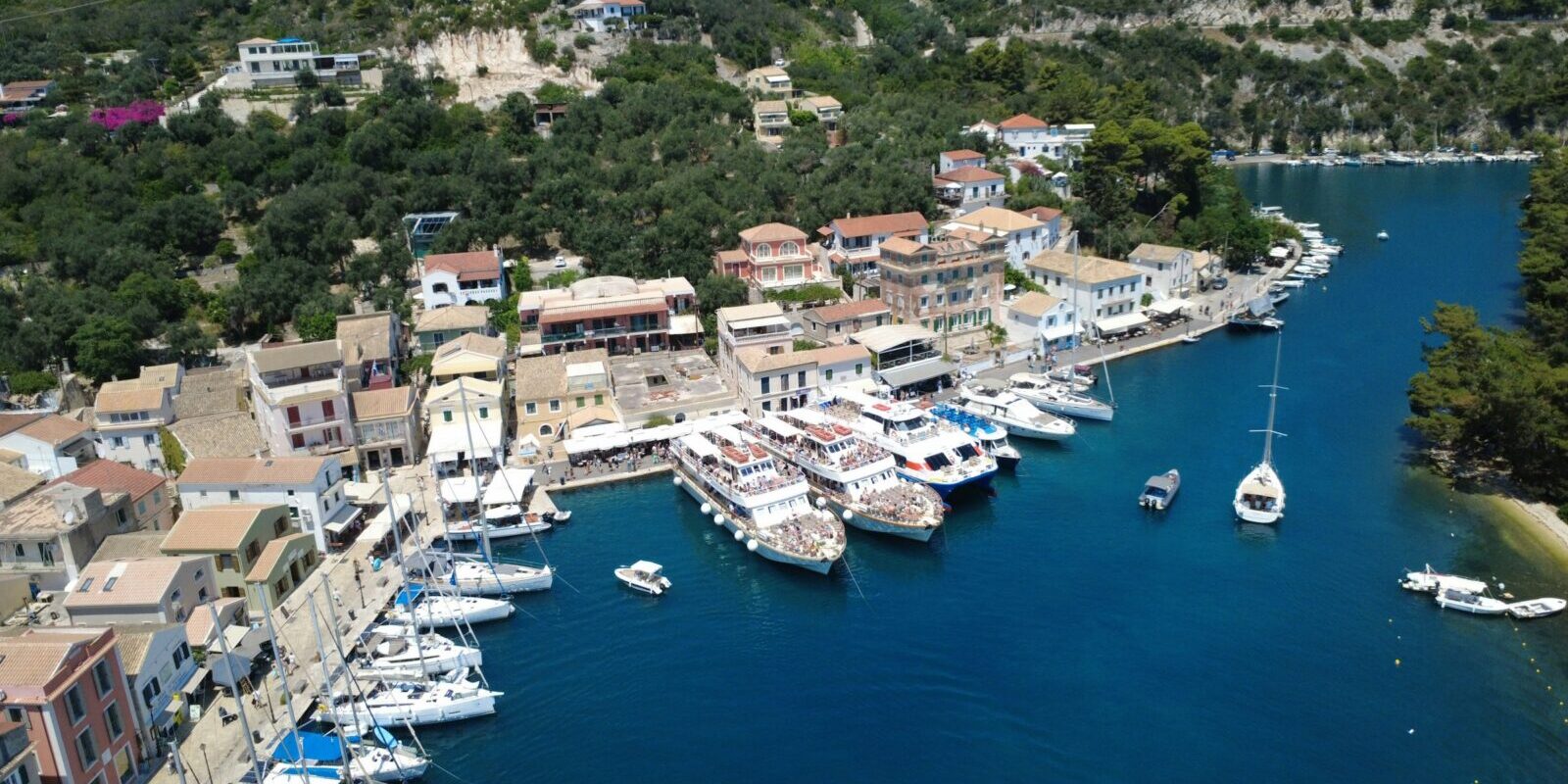
Gaios lies on the east coast of Paxos, in the southern part of the island. The harbour is a natural channel: on one side stand the houses of Gaios, and on the other lies the wooded island of Agios Nikolaos with the remains of a Venetian fortress. To the north lies the second small island, Panagia, with a monastery and a lighthouse. Both islands shelter the harbour from the open sea.
Map from OpenStreetMap. When the map is displayed, data is transmitted to the provider.
More InformationThe strait has two entrances. The north entrance is deep and is used by ferries and excursion boats, while the south entrance is shallow. The New Harbour with the ferry landing is at the north end, opposite Panagia. From there, the waterfront road runs south along the quay to the main square with the Church of the Ascension, the heart of the town.
Arriving for the start of your trip in Gaios
The way to Gaios always leads across the water. Most guests joining the trip fly to Corfu and take a fast boat or ferry from there. If you are coming by car, drive to Igoumenitsa and take the car ferry across.
From Corfu Airport to Gaios
Corfu Airport is on the edge of Corfu Town. In summer, direct flights land here from many European cities, and there are flights from Athens all year round. City bus line 15 connects the airport with the long-distance bus station, San Rocco Square and the town harbour. Alternatively, you can take a taxi to the harbour.
Fast boats and ferries to Gaios leave from the town harbour in Corfu. Depending on the vessel, the crossing takes just under one to one and a half hours. The route from Lefkimmi in the south of Corfu is shorter at around 45 to 50 minutes, but you first have to travel across the island to get there. As things stand today (November 2026), the boats run all year round, much more frequently in the season than in winter. There are no night services, so plan your flight so that you can continue your journey during the day.
By car, coach or ferry
If you are travelling by car, drive to Igoumenitsa on the northwest coast of the Greek mainland. Car ferries to Gaios leave from there, and the crossing takes around one and a half hours. There is hardly any room for cars on the ferries from Corfu Town. The ferries berth in the New Harbour at the north end of the harbour, and from there it is around 700 metres on foot to the main square.
On the island, a bus run by the municipality of Gaios connects the town with Loggos and Lakka. The bus stop in Gaios is around 300 metres from the harbour. You can hire cars and scooters through travel agencies in the town.
Parking
Small car parks are located in the town to the south and west of the main square, around 250 to 350 metres from the harbour. One of them has nine free spaces.
Shopping for the trip
The nearest supermarket is the Coop behind the church on the main square, around 190 metres from the harbour. This is also where you can get the cards for water and electricity at the quay. A little further into the town are the OK Supermarket and Deli at around 280 metres and the Paxos Market at around 300 metres. There are also several bakeries around the main square. The supermarkets in the town are small.
Doctor, pharmacy and emergency services
A pharmacy is on the main square, around 140 metres from the harbour. The island's health centre, the Kentro Ygeias Paxon, is around 1.3 kilometres west of the harbour. The nearest hospital is the General Hospital of Corfu in Kontokali. In urgent cases, the Greek emergency numbers apply:
- 112: European emergency number for police, ambulance and fire brigade
- 166: Emergency services, 100: Police, 199: Fire brigade
- 108: Coast Guard, also for emergencies at sea; at sea also VHF channel 16
What does Gaios harbour offer?
The harbour of Gaios is a town harbour with no marina facilities. The quays run for over a kilometre along the strait. It is operated by the Corfu port company, and the harbour dues are collected by the harbour police.
| Details | Gaios harbour |
|---|---|
| Location | Strait between Gaios and the island of Agios Nikolaos, east coast of Paxos |
| Position | 39° 11,9′ N, 020° 11,2′ E |
| Berths | Quays over 1,000 metres long, plus floating pontoons for around 40 yachts west of the ferry quay |
| Water depth at the quay | usually 2.0 to 3.0 m, less in the southern part |
| berthing | stern-to or bow-to the quay with your own anchor; on the floating pontoons with mooring lines |
| VHF channel | 12 (harbour police) |
| Harbour police | Limenikos Stathmos Paxon, telephone +30 26620 32533 |
| Nearest airport | Corfu (CFU), then onwards by ship |
Equipment
Water and electricity are available from a few bollards on the quay, which are spaced far apart. You pay with a prepaid card, which you can buy at the Coop on the main square. A small tanker truck brings diesel to the quay in the morning. The harbour has no public toilets, showers, chandlery or workshop. Waste containers with recycling are at both ends of the quays. Restaurants, bars and cafés line the waterfront road, and most of them offer Wi-Fi.
What wind can you expect around Paxos?
In summer, the wind around Paxos is mostly from the northwest. It follows a daily pattern: mornings are often calm, the north-westerly Maestro sets in from early afternoon and blows at 3 to 5 Beaufort, and it usually dies down again after sunset. From May to September, gales are almost unheard of on the open sea west of Greece; stormy weather occurs mainly from November to mid-March.
For Gaios, winds from the south and southeast matter. They make the southern part of the harbour very uncomfortable, and a swell builds up at the shallow southern entrance. Lakka is difficult to approach in northerly to north-easterly winds above 6 Beaufort. In addition, a weak current runs north along the west coast of Greece, which strengthens in strong westerly or south-easterly winds.
Which destinations are near Gaios?
Paxos and Antipaxos lie close together, so you can reach many destinations on a short hop. The mainland coast with Parga and Sivota and the south of Corfu are day sails. The distances are rounded distances over water from the northern entrance of Gaios; for precise planning, rely on the chart.
- Mongonissi (about 2 nm): The small island almost touches the southern tip of Paxos. In the bay you moor stern-to at a short quay, and there is a taverna and grottoes nearby.
- Loggos (about 2.5 nm): The fishing village north of Gaios has a small harbour with fish restaurants. Space for visiting yachts is only at the end and on the outside of the mole. The bay is open from the north to the southeast, and when approaching from the southeast, rocks and a reef lie in the way.
- Lakka (about 4.5 nm): The second-largest village on Paxos lies on an almost circular bay at the northern tip, around 800 metres long and 500 metres wide. In the season many yachts anchor here, and some moor at the quay in front of the village.
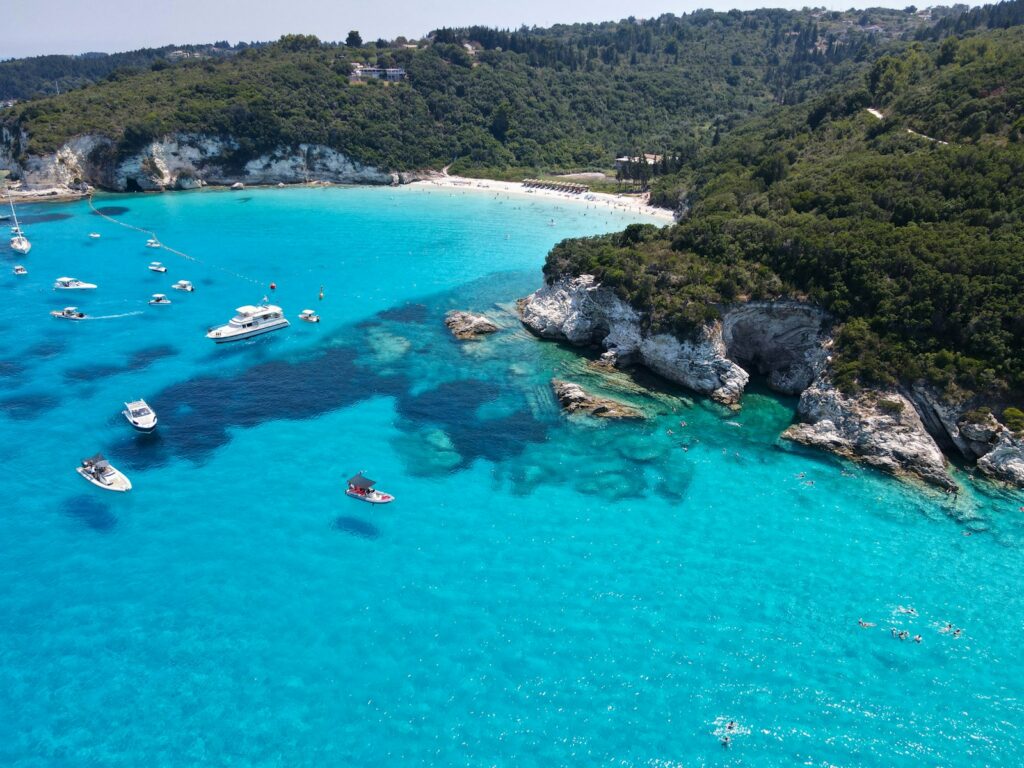
- Antipaxos (about 4 nm): The small island south of Paxos is largely covered in vines. On the east coast you will find the beaches of Vrika, Mesovrika and Voutoumi, with very clear water. The small harbour of Agrapidia is reserved for fishing boats, and yachts anchor off it.
- Parga (about 11 nm): The small town on the mainland lies opposite Paxos, with a Venetian castle and small islands off the town. In summer the landing quay is reserved for local boats, and many yachts anchor in the bay of Valtos west of the town. The Panagia reef lies between Gaios and Parga.
- Sivota (about 13 nm): The village on the mainland coast was called Mourtos until 1959. The inner harbour is sheltered all round and usually has mooring lines; in front of it lie wooded islands with anchorages.
- Petriti (about 18 nm): The fishing village on the east coast of Corfu is a stopover on the way north. You can find out more about the harbours around Corfu Town in the profile of the Ports on Corfu.
What can you do on a harbour day in Gaios?
Gaios is small, and everything worth seeing is within walking distance of the quay.
- Main square and Church of the Ascension: The Analipseos church on the central square was the seat of the Metropolitan of Paxos until 1916. At the north end of the waterfront promenade stands the former residence of the British governor from the early 19th century, still the largest building in the town.
- Local history museum: The museum, housed in the former primary school near the southern entrance, displays fossils, archaeological finds, furniture, tools and clothing from everyday island life. One section is dedicated to Ludwig Salvator, who published a book on Paxos and Antipaxos in 1887.
- Monument to Georgios Anemogiannis: South of the harbour in the town stands the bronze statue of the young man from Paxos who fell in the Greek War of Independence in 1821 and is revered on the island as a folk hero.
- Agios Nikolaos and Panagia: The fortress on Agios Nikolaos was built from 1423 under the Venetians to protect the harbour from pirates. To visit it, you need a permit from the town hall. On Panagia stands the church of the Mother of God, whose feast on 15 August is one of the most important on the island.
- Boat trip: Excursion boats leave from the main square for the beaches of Antipaxos and, daily, for the caves on the west coast of Paxos. There, white limestone cliffs drop steeply into the sea, with the rock of Ortholithos rising up in front of them.
For skippers: harbour police, approach and marine weather in Gaios
Gaios gets very busy in the season, above all with excursion boats and yachts from Italy. Arrive early in the afternoon and you will usually still find a berth. Channel 16 is the distress and calling channel; you can reach the harbour police on Channel 12.
Mooring in Gaios
- North quay: around 100 metres for 20 to 25 yachts, stern-to or bows-to the quay in around 2.5 metres of water, anchor in the narrows in 6 to 8 metres, good holding in mud and weed. Many bars are located here, and it is noisy in the evening.
- Pontoons west of the ferry quay: Since 2024 with mooring lines for around 40 yachts, quieter than the north quay.
- West quay: space for 8 to 10 yachts in 2.5 to 3 metres of water.
- South quay in front of the town: water depth just over 2 metres. The last 150 metres or so towards the southern entrance are 1.5 metres deep or less and occupied by fishing boats. You will lie more quietly in front of or north of the local history museum.
- Sections for excursion boats: On the west quay and the south quay, parts are reserved for excursion boats during the day, roughly from 10 am to 5 pm. If you spend the night there, you need to leave in good time in the morning.
- Chain: The narrows are tight and anchors often cross. Don't pay out too much chain, around 25 metres at the west quay.
Harbour police and harbour fees
The competent authority is the Paxos harbour police, the Limenikos Stathmos Paxon, telephone +30 26620 32533. The office is on the waterfront road north of the main square. Gaios is an official port of entry to Greece with border control. The harbour fee is collected by a harbour police officer in the early evening, directly at the boat.
Approach
Most yachts approach from the north. You leave Panagia to port and the ferry quay to starboard. Keep clear of the north-west point of Agios Nikolaos. After around 500 metres, the narrows bend sharply to the south, and the bend is blind. Go slowly here at 2 to 3 knots and keep to the right. The entrance has 6 to 10 metres of depth, and the narrows usually 3.5 to 4 metres.
The southern entrance leads between two short breakwaters and is only 2 to 2.5 metres deep, less in a swell. In a southerly wind, avoid it altogether. In the afternoon, especially between 3 and 5 pm, many excursion boats head out and need almost the full width of the narrows to turn.
Anchoring near Gaios
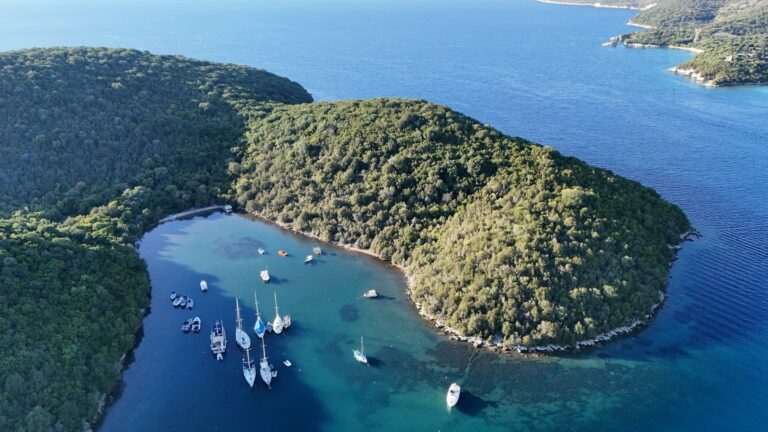
Opposite the north quay, you anchor in 6 to 8 metres with a line ashore to Agios Nikolaos. Further spots lie next to the breakwater between Agios Nikolaos and Panagia in 5 to 8 metres of sand and mud. In a north-westerly, the south-east side of Agios Nikolaos offers shelter in 6 to 10 metres; in a southerly wind it is unsuitable.
Formalities in Greece
Recreational boats over seven metres in Greek waters are liable for the TEPAI yacht fee. It is paid monthly and in advance via the platform of the Greek tax authority AADE, and for commercially used yachts it is paid by the owner or operator (as of November 2026). Details can be found in the AADE FAQ on TEPAI (in Greek).
Which marine weather forecast applies around Paxos?
The relevant forecast is the marine weather report of the Greek meteorological service EMY, known in English as HNMS. You can get it on the Meteorological Service website and via NAVTEX. The nearest NAVTEX station is in Kerkyra on Corfu and broadcasts on 518 kHz six times a day.
Sailing trips from Gaios on Törnfinder
You will find sailing trips around Paxos, Corfu and Lefkada under Sailing in the Ionian Sea, and offers from all over Greece under Sailing in Greece and all sailing areas in the trip overview.
Frequently asked questions
How do I get from Corfu airport to Gaios?
Take a bus or taxi from the airport to Corfu town harbour, then continue by speedboat or ferry to Gaios. The crossing takes just under one to one and a half hours, and there are no night services.
Where do I park at the start of the trip in Gaios?
In the small car parks south and west of the main square, around 250 to 350 metres from the harbour. One of them has nine free spaces.
Where can I shop for provisions in Gaios?
At the Coop on the main square, about 190 metres from the harbour, at OK Supermarket and Deli after about 280 metres, or at Paxos Market after about 300 metres. There are also several bakeries in the village.
Are there showers in the harbour at Gaios?
No, the harbour has neither public showers nor toilets. Water and electricity are available from individual pillars on the quay using a prepaid card from the Coop.
Which side should I enter Gaios from?
From the north, with Panagia to port, and slowly through the sharp bend in the strait. The southern entrance is only 2 to 2.5 metres deep and should be avoided in southerly winds.
How far is it from Gaios to Antipaxos?
About 4 nautical miles to the beaches of Vrika and Voutoumi on the east coast. If you want to get across without a boat, take a water taxi from Gaios, which takes about 15 minutes.