This page was translated automatically from German. View the original
Yarmouth lies on the northwest coast of the Isle of Wight at the mouth of the Western Yar, where the western Solent begins. Here you can read how to get to the start of your sailing trip in Yarmouth, how Yarmouth Harbour is laid out, where to park and shop, what sailing weather to expect, which destinations are close by and what skippers should bear in mind when entering and berthing.
The essentials at a glance
- From the mainland, the car ferry from Lymington takes about 40 minutes to reach Yarmouth. The ferry terminal is on Quay Street, about 250 metres from the harbour.
- From Southampton Airport, take the train via Brockenhurst to Lymington Pier. The station is right next to the ferry terminal.
- Yarmouth Harbour has over 150 visitor berths every day. The Berthing Masters allocate the berths on arrival, and boats are often rafted up.
- For provisions, there are two small grocery shops on St James‘ Square in the town centre, one of which is open daily from 7 am to 10 pm.
- If you travel to the United Kingdom without a visa, for example with a passport from an EU country, you need to obtain an electronic travel authorisation (ETA) in advance.
Where is Yarmouth Harbour?
Yarmouth Harbour lies in the estuary of the Western Yar on the west side of the small town. A breakwater protects the entrance from the Solent, and behind it the visitor berths lie on pontoons and floating jetties in the harbour basin. Upriver, the Yar Swing Bridge closes off the harbour to the south. The harbour office stands on the quay, The Quay, and right next to it the buses stop on Bridge Road. East of the entrance, the pier juts out into the Solent, and the car ferries to Lymington also berth in the harbour.
Map from OpenStreetMap. When the map is displayed, data is transmitted to the provider.
More InformationDo not confuse the town with Great Yarmouth in the county of Norfolk. For taxis and sat nav, the address of the harbour office is: Harbour Office, The Quay, Yarmouth, Isle of Wight, PO41 0NT.
Arriving for the start of your sailing trip in Yarmouth
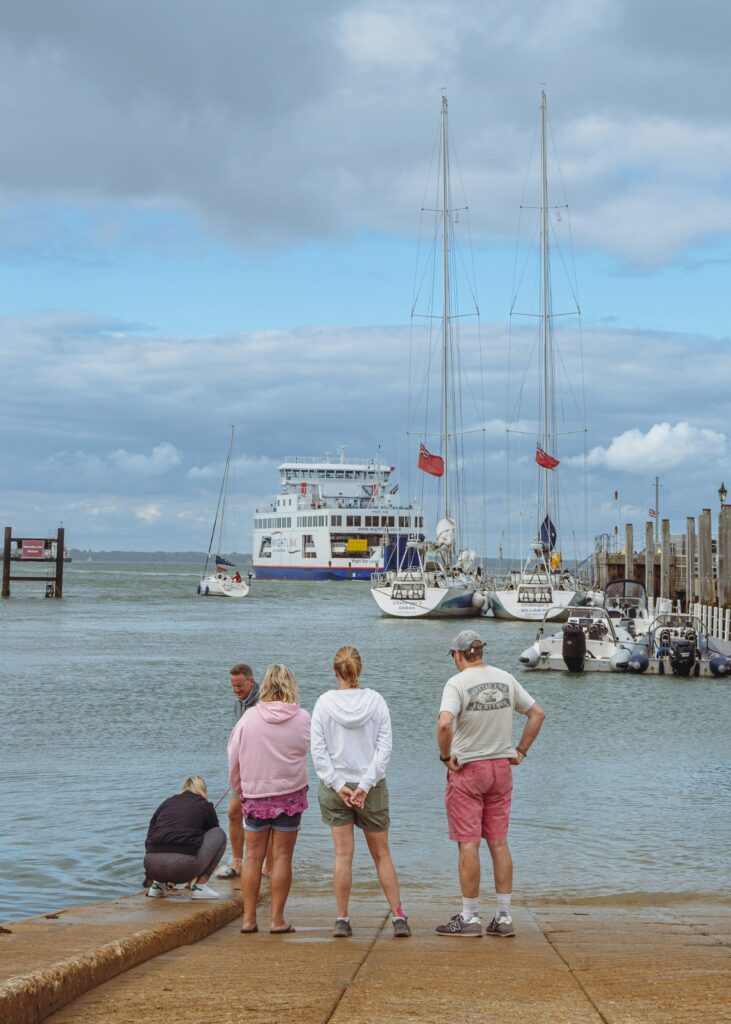
You reach Yarmouth from the mainland by ferry. The shortest car ferry route is via Lymington: the ferry carries vehicles and foot passengers and berths right in the centre of Yarmouth.
If you are travelling by plane or ferry and do not hold a British or Irish passport or need a visa, you must apply for an ETA beforehand. It costs £20 (as of November 2026) and allows stays of up to six months.
From Southampton Airport to Yarmouth
The nearest airport is Southampton on the mainland. From the terminal it is only 99 steps to Southampton Airport Parkway station. From there you take the train on the main line towards Bournemouth as far as Brockenhurst, then change to the train for Lymington Pier. This station is right next to the ferry terminal. As a foot passenger, report to the terminal no later than 15 minutes before departure.
By ferry, bus or car
The Wightlink ferry between Lymington and Yarmouth takes around 40 minutes and carries cars, motorbikes, bicycles and foot passengers. In Lymington it departs from the ferry terminal on Undershore Road, and in Yarmouth it arrives at the ferry terminal on Quay Street. If you are travelling by car, you must check in 30 minutes before departure. There is no railway in the west of the island, but there are buses: from the bus stop on Bridge Road in front of the harbour office, route 7 runs to Newport, where you can connect to all parts of the island. The small local bus FYTbus runs to Freshwater and Totland. Taxis wait at the rank next to the ferry terminal.
You can hire and return bicycles directly at the harbour office, and a hire car from a car club is also available there.
Parking
Directly in front of the harbour office is the South Quay car park, with a pay-and-display machine for longer stays. The car park at the harbour office itself is for permit holders only. Around 300 metres from the harbour is the council car park on River Road, also pay and display. There, up to ten hours costs £12.50 (as of November 2026). For short stops, there are short-stay spaces at Pier Square.
If you leave your car on the mainland, you can park at the Lymington ferry terminal, which has over 200 spaces.
Showers and sanitary facilities
You reach the showers and toilets via reception in the harbour office, and their use is included in the visitors' berthing fee. In summer they open at 6am and close at 10pm, in winter from 7am to 7pm. There are accessible showers and toilets, hairdryers and a baby changing room. Further showers and toilets are located outside at the back of the harbour office, close to the gate to the visitors' pontoons. The harbour office also has a laundry, and you can get wash tokens at reception.
Shopping for the trip
At St James‘ Square in the town centre, around a two-minute walk from the harbour, there are two small grocery shops. One sells fresh fruit and vegetables, bread, wine and household goods, while the other is open daily from 7am to 10pm. You can reach a larger supermarket, a Tesco, by car in Freshwater, around 2.9 kilometres from the harbour. Small items such as drinks, ice cream, snacks and gas bottles (Calor and Camping Gaz) are also sold by the shop Cockpit Essentials in the harbour office, where you can also get cash at reception (cashback). Yarmouth no longer has a bank, but there is a cash machine on Quay Street.
Doctor, pharmacy and emergency services
Yarmouth Pharmacy is on Quay Street in the town centre, around 250 metres from the harbour. It is open Monday to Saturday from 8.30am to 6pm and on Sundays from 10am to 4pm. The nearest GP surgery is around 3 kilometres away at Brookside Health Centre in Freshwater (telephone +44 1983 758998). The nearest hospital is St Mary’s Hospital in Newport (telephone +44 1983 524081).
- 999: emergency number for ambulance, police, fire service and Coastguard
- 111: NHS medical advice when it's urgent but not an emergency
- At sea: VHF channel 16 for emergencies, channel 67 for routine enquiries to the Coastguard, in the Solent also used as a distress channel for small craft
- Harbour emergency number: +44 7909 524277
What does Yarmouth Harbour offer?
Yarmouth Harbour is a visitors' harbour with over 150 visitor berths every day, welcoming visitors all year round and accessible at any state of the tide. It is operated by the harbour authority, the Yarmouth Harbour Commissioners.
Yarmouth Harbour at a glance
| Feature | Yarmouth Harbour |
|---|---|
| Location | North-west coast of the Isle of Wight, mouth of the Western Yar, western Solent |
| Harbour entrance | 50° 42,42′ N, 001° 30,05′ W |
| Visitor berths | over 150 daily: finger pontoons, floating pontoons with and without shore access, buoys outside the harbour |
| Depth of approach | around 2 m below chart datum, accessible at any state of the tide |
| Electricity and water | at finger pontoons and pontoons with shore access |
| Fuel station | Diesel and petrol, pontoon near the entrance |
| VHF channel | 68 (harbour and swing bridge), 15 (water taxi) |
| Operator | Yarmouth Harbour Commissioners |
| Phone | +44 1983 760321 |
| Website | yarmouth-harbour.co.uk |
Equipment
The visitor berths are spread across finger pontoons, floating pontoons with shore access (walk ashore) and pontoons without shore access. Visitor buoys are available in addition outside the breakwater. Electricity and water are available at the finger pontoons and at the pontoons with shore access; you bring your own cable and hose. The electricity connection is charged extra per night. From the pontoons without shore access and from the buoys, the harbour's water taxi will take you ashore; it carries up to twelve people and can be reached on VHF channel 15 or on +44 7969 840173.
The fuel berth is on a floating pontoon near the harbour entrance and has room for four boats. From the end of October to the end of March you can refuel from 8am to 5.30pm, and in the summer half-year from 8am to 8.30pm. At West Quay next to the harbour office there is a 5-tonne crane, which only authorised users may operate. Lifting and repairs are handled by the boatyards along the river, one of them right by the swing bridge. In the town centre there is a large chandlery, and Yarmouth also has a sailmaker with a 24-hour repair service. Free Wi-Fi is available in the harbour office.
What is the weather like for sailing in Yarmouth?
In southern England the wind blows most often from the southwest. When a low moves through from the Atlantic, the wind usually sets in from the south to southwest and later veers to west or northwest. In spring it more often comes from the northeast, and from late spring into summer a sea breeze often sets in along the coast.
The tides are the defining feature here. A strong current runs through the harbour, especially towards the end of the ebb. At springs, the stream in the entrance can be very strong in the last hour of the flood and the ebb, and high water can occur twice or stand for a long time. In its inshore waters forecast, the UK's Met Office warns of strong winds from force 6 and issues a gale warning from force 8.
Which sailing destinations are near Yarmouth?
From Yarmouth you can reach the harbours and river mouths of the Solent in one to two days' sailing.
- Lymington: opposite on the mainland, at the mouth of the Lymington River.
- Newtown Creek: a peaceful inlet on the north coast of the Isle of Wight, ideal for a day sail.
- Beaulieu River: Sailing up the river takes you to the marina at Buckler’s Hard.
- Cowes: at the mouth of the Medina on the island's north coast, one of the best-known sailing centres in the Solent. Find out more in the profile of the Harbours in Cowes.
- Hamble: Several marinas on the River Hamble can be reached regardless of the tide. Find out more in the profile of the Marinas in Hamble-le-Rice.
- Poole: In the extensive harbour you can anchor behind the islands or lie alongside in the town.
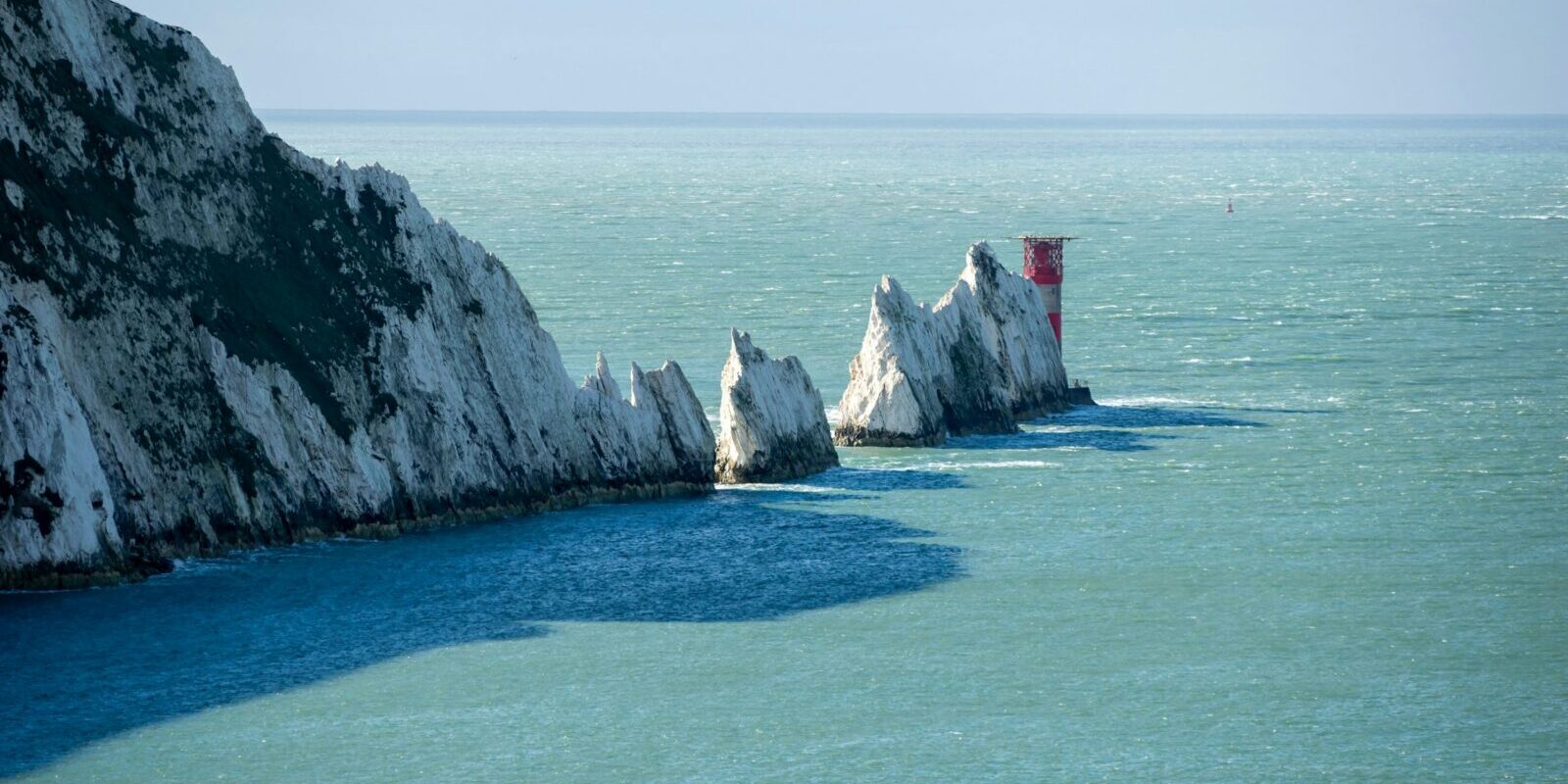
- The Needles: The three white chalk stacks with the lighthouse at the western tip of the island are among the most photographed sights on the Isle of Wight.
What can you do on a day in port in Yarmouth?
- Yarmouth Castle: The castle at the mouth of the Yar was completed in 1547 and was among the most modern coastal fortresses of Henry VIII. It stands on Quay Street next to the ferry terminal. An exhibition tells the story of the shipwrecks off Yarmouth. As things stand (November 2026), it is closed in winter until March.
- Pier: The listed wooden pier leads from Pier Square out into the Solent and opened in 1876. You pay a fee for the walk, which goes towards the upkeep of the pier.
- Sandhard: The sandy beach is right in the harbour, with a barbecue area next to it. Barbecuing on board is prohibited throughout the harbour area.
- Western Yar Estuary Walk: The circular route along the estuary is about 6 kilometres long and takes around an hour and a half at a brisk pace. It starts at the sailing club by the swing bridge and partly follows a former railway line.
- Fort Victoria and The Needles: The fort on the edge of the village was built between 1852 and 1855 and today houses a planetarium and a woodland park with views over the Solent. In season, the open-top tour bus Needles Breezer runs to the Needles.
For skippers: berthing and marine weather in Yarmouth
Before entering, call the harbour on VHF channel 68 using the call sign “Yarmouth Harbour”, about five minutes before you arrive at the entrance. You do not need to call ahead, as berths are allocated on arrival.
Registration and Berthing
The Berthing Masters will meet you at the entrance in their boat, assign you a berth and, if you wish, help you with berthing and unberthing. Have fenders and lines ready on both sides, as many berths are rafted up. In the harbour, the current partly runs across the berths. If the harbour is full, a red flag flies by day at the ferry pier, and when space is limited a “Limited Space” sign is displayed at the entrance.
You can book some finger pontoons online in advance for overnight stays, for boats up to 14 metres and no later than 48 hours before arrival. Summer weekends book up quickly. Booked berths are held until 6 pm. For boats over 14 metres and for multihulls, you book by phone. On the day of departure you must vacate the berth by 12 noon. Short-stay visitors must leave the pontoons with shore access by 3 pm. When it is busy, they may be sent to the buoys or to pontoons without shore access from 1 pm. You pay the berthing fee at reception in the harbour office or to the harbour staff on the water.
Harbour rules
- In the river and the inner harbour as far as the dolphin at the entrance, a limit of 4 knots over the ground applies; from the entrance to the pier and through the outer mooring field as far as the Black Rock buoy, the limit is 6 knots.
- You may not sail between the harbour entrance and the swing bridge. Between the breakwater and the swing bridge, swimming, stand-up paddling and windsurfing are also prohibited.
- You may not anchor between the breakwater and the swing bridge or in the fairways. Anchoring in the rest of the harbour area is subject to a fee and requires permission on channel 68.
- From 10 pm to 7 am, no engines may be run while stationary.
- The RNLI lifeboat can launch at any time without warning.
Approach
Yarmouth can be entered at any state of the tide; the approach is maintained at a depth of about 2 metres below chart datum. The leading marks for 187 degrees are white diamonds with a black horizontal stripe, and at night green LED leading lights show the line. From the east, leave the East Fairway buoy to port and keep at least 100 metres from the north end of the pier, as anglers cast their lines there. From the west, stay well north of the Black Rock buoy and the buoys off the breakwater, and leave the Poole Belle buoy to starboard. Then turn onto 187 degrees, enter at minimum speed on the leading marks and expect to wait.
Always give way to the car ferries; in the narrow fairway, Rule 9 of the collision regulations applies. If you come out from behind the pier from the east, the ferries may have difficulty seeing you.
The swing bridge upstream opens at fixed times between 8 am and 8 pm in summer, and by arrangement in winter. Report your passage at least 30 minutes beforehand on channel 68 using the call sign “Yar Bridge”.
Entering by boat from abroad
If you arrive by boat from outside the UK, for example from France, you report your journey in advance via the British government's online service for pleasure craft. As soon as you cross the 12-mile limit, you fly the yellow Q flag and only take it down once the report has been completed. Anyone on board who is not a British or Irish national needs permission to enter from Border Force before going ashore. The details can be found in the British government's guidance for pleasure craft.
Which shipping forecast applies in Yarmouth?
For Yarmouth, the Met Office's Inshore Waters Forecast applies for the stretch from Selsey Bill to Lyme Regis, which includes the Isle of Wight. It is issued four times a day and extends up to 12 nautical miles offshore. The Inshore Waters Forecast on the Met Office website.
On the radio, BBC Radio 4 broadcasts the shipping forecast at 0:48 and 5:20 on long wave and FM, and at 12:01 and 17:54 usually on long wave only. For the current weather at the Needles, contact the National Coastwatch Institution lookout station on VHF channel 65 (“Needles NCI”) or call +44 1983 754231.
Sailing trips from Yarmouth on Törnfinder
You can find sailing trips in the UK on the page Cabin Charter in Great Britain, and all sailing areas and dates in the trip overview.
Frequently asked questions
How do I get from Southampton Airport to Yarmouth?
By train and ferry: from Southampton Airport Parkway station, take the train via Brockenhurst to Lymington Pier, then cross to Yarmouth by ferry in around 40 minutes.
Where do I park at the start of my trip in Yarmouth?
In the South Quay car park directly in front of the harbour office or in the car park on River Road, around 300 metres from the harbour. Both are pay-and-display, and the car park at the harbour office itself is reserved for permit holders.
Are there showers in Yarmouth harbour?
Yes, the harbour office has showers and toilets, including accessible facilities, as well as a laundry. The showers are included in the berthing fee.
Can I reserve a visitor berth in Yarmouth?
Only some of them: you can book a number of finger pontoons for overnight stays online up to 48 hours before arrival, for boats up to 14 metres. All the remaining visitor berths, of which there are more than 150, are allocated by the Berthing Masters on arrival.
Which VHF channel do I use in Yarmouth?
Channel 68 for the harbour (“Yarmouth Harbour”) and the swing bridge (“Yar Bridge”), and channel 15 for the water taxi. In an emergency, call the coastguard on channel 16.