This page was translated automatically from German. View the original
Helgoland lies about 70 kilometres off the coast in the middle of the Deutsche Bucht (German Bight), and yachts moor in the South Harbour and the Northeast Harbour. Here you can read how to get there by ship for the start of your trip, what applies to luggage, shopping and parking, which rules matter for duty-free shopping, how wind and tide shape the sailing, which destinations lie nearby and what skippers should know before arriving.
The essentials at a glance
- Ships run to Helgoland from Cuxhaven all year round, taking around 75 minutes by catamaran or around 150 minutes by ferry. In the season there are also services from Hamburg, Büsum and Hörnum on Sylt.
- No private cars or bicycles are allowed on the island. Your car stays on the mainland, for example at the Helgolandparkplatz car park by the ferry terminal in Cuxhaven.
- Both marinas are managed by the Wassersportclub Helgoland: you can only use the pontoons in the South Harbour with advance booking, while in the Northeast Harbour the harbour master assigns berths without advance booking.
- An Edeka supermarket is located in the middle of the Unterland (lower town) between the two harbours, about 200 metres from the centre of the Unterland.
- Helgoland is not part of the EU customs territory. If you take more than the duty-free allowances back to the mainland, you must declare this beforehand at the Helgoland customs office.
Where are the marinas on Helgoland?
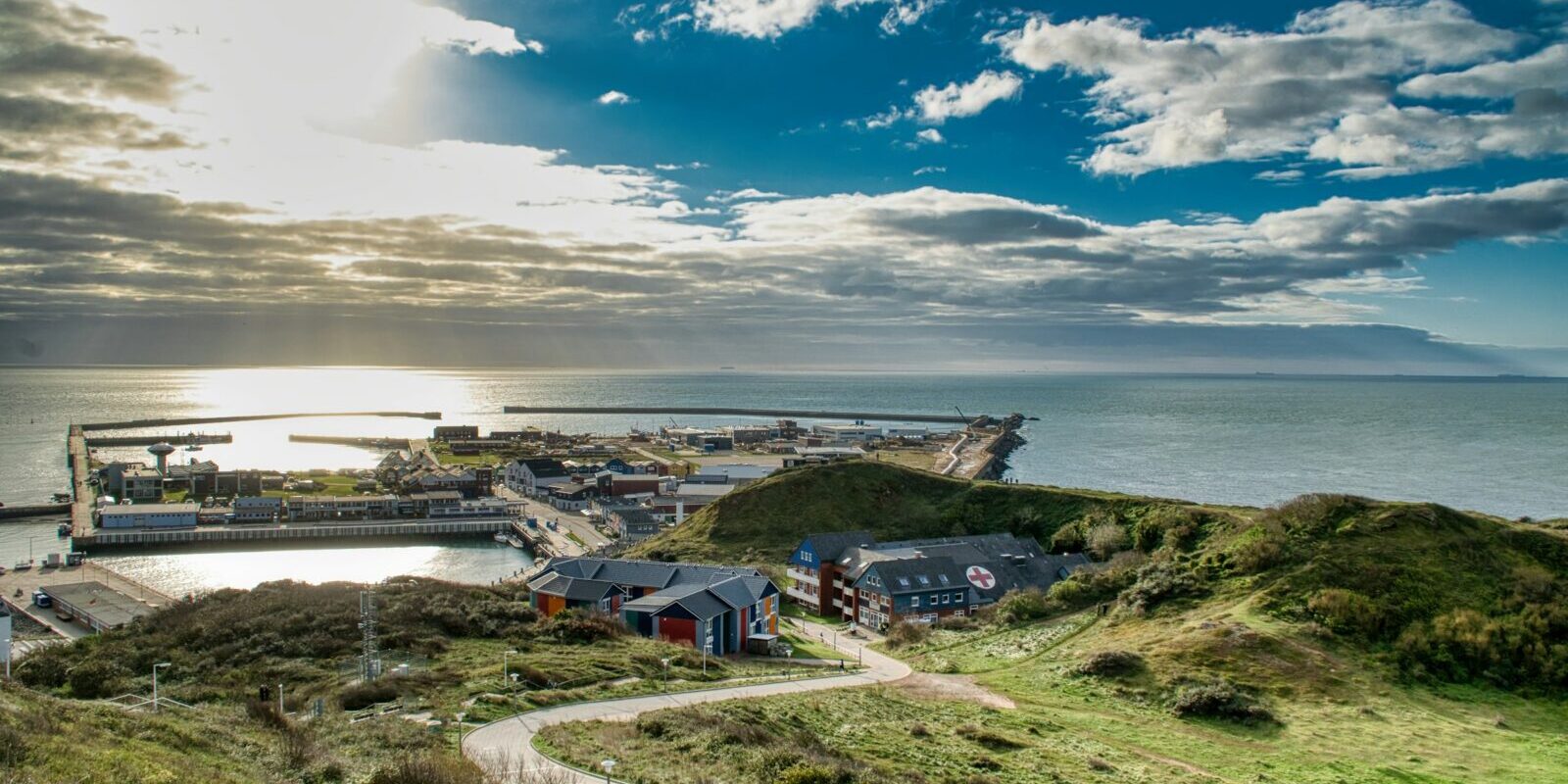
Yachts and motorboats moor in two places on Helgoland: at the pontoons in the South Harbour and in the Northeast Harbour on the Kurpromenade, about 800 metres further north. Between them lies the inner harbour with the colourful Hummerbuden (lobster sheds), the customs office and the diesel bunkering station. The landing stages for the ferries and catamarans are about 250 to 400 metres from the pontoons in the South Harbour.
Map from OpenStreetMap. When the map is displayed, data is transmitted to the provider.
More InformationThere are five harbour areas on the main island: the outer harbour (Vorhafen), South Harbour, inner harbour (Binnenhafen), Northeast Harbour and the landing stage (Landungsbrücke), plus the Dünenhafen on the Düne. The South Harbour and the outer harbour belong to the Federal Government, and the harbour authority there is the Wasserstraßen- und Schifffahrtsamt with its outlying office on Helgoland. The inner harbour, Northeast Harbour, landing stage and Dünenhafen, as well as the Helgolandkai in the outer harbour, form the harbour area of the municipality of Helgoland. Yachts and motorboats may not moor in the inner harbour, at the landing stage or in the Dünenhafen. There is no marina in the usual sense: the Wassersportclub Helgoland passes on its members' vacant berths to guests.
Arriving on Helgoland for the start of your trip
You travel to the start of your trip by ship.
From Hamburg or Bremen Airport
From Hamburg Airport, the S-Bahn line S1 runs every 10 minutes and takes about 25 minutes to the main station. From there you continue to the Landungsbrücken, where the catamaran to Helgoland departs in the season, or take the train to Cuxhaven. From Bremen Airport, tram line 6 takes you to Bremen main station, and from there you take the train to Cuxhaven.
By train, car and ship
The main departure port is Cuxhaven. From Hamburg, regional trains run directly to Cuxhaven. From Bremen main station, take the RE8 or RE9 to Bremerhaven-Lehe and change there to the RB33 to Cuxhaven, which takes about an hour and a half in total. From Cuxhaven station it is a walk of about 20 minutes to the ferry port, and bus line 1006 also runs there. If you are driving, follow the signs “Helgoland / Fährhafen” via the A27 or B73.
From Cuxhaven, an excursion ship sails to Helgoland all year round, and the crossing usually takes about 150 minutes. In the season a catamaran also runs, taking about 75 minutes. From March to early November, the catamaran “Halunder Jet” runs from the Hamburg Landungsbrücken via Brunsbüttel and Cuxhaven to Helgoland. Also in the season, there is an excursion ship from Büsum and, Monday to Friday, a catamaran from Hörnum on Sylt. From early November to early March, you can only reach the island from Cuxhaven. As things stand (November 2026), there are no scheduled flights to the airfield on the Düne, which is open to private air traffic only.
Parking
On Helgoland you are not allowed to drive your own motor vehicle, and bicycles are not permitted on the island either. You therefore park your car at the port of departure. In Cuxhaven there are car parks right by the excursion ship's landing stage, signposted as Helgolandparkplatz. The number plate is recorded automatically on entry, a day costs 8 euros, and you pay at the machine or by smartphone (as of November 2026).
Arriving early: luggage and electric taxi
Electric taxis wait at the arriving ships and take guests in the order of their arrival. A luggage service takes suitcases from the ship to your accommodation and back, and as things stand (November 2026), one item of luggage up to 20 kilograms costs 6 euros each way. You reach the Oberland (upper town) via steps, up to 260 of them, or by lift for a small fee.
Showers and sanitary facilities
For visiting boats in the Northeast Harbour, use of the sanitary facilities is included in the service charge.
Shopping for the trip
An Edeka supermarket is located in the middle of the Unterland, about 200 metres from the centre of the Unterland. If you pay by card, you can also get cash there from a purchase of 10 euros. There is no larger supermarket reachable by car on this car-free island, so do your main shopping on the mainland before departure. There is a small supermarket on the Düne.
Doctor, pharmacy and emergency services
The Nordseeklinik Helgoland and, right next to it, the Gesundheitszentrum Helgoland with general practitioners' surgeries are located on the Invasorenpfad, about 300 metres from the centre of the Unterland. You will find the Insel-Apotheke pharmacy in the Oberland near the lift and the steps, about 350 metres from the centre of the Unterland.
- 112: Fire brigade and emergency medical services
- 110: Police
- 116 117: medical emergency service
- At sea: VHF channel 16 or DSC on channel 70, call sign “Bremen Rescue”, the maritime rescue coordination centre of the Deutsche Gesellschaft zur Rettung Schiffbrüchiger (DGzRS); by telephone on +49 421 53687-0. From German mobile networks you can also reach it near the coast via the short code 124 124.
What do the Südhafen and Nordosthafen on Heligoland offer?
Both marinas are run by the Wassersportclub Helgoland, which has looked after the berths for sports boats on the island since 1965. Visiting boats each get their own berth; rafting up is not provided for in the club's facilities.
Pontoons in the Südhafen
The pontoons in the Südhafen lie in the island's sheltered harbour, right next to the club's clubhouse and boat shed. A submarine bunker stood in the eastern part of the facility until 1945. Its rubble still lies in the harbour basin today, and at low water stones and concrete become visible. For this reason you may only approach the pontoons after registering in advance, and a club member will guide you in. There are coin-operated power pedestals at the pontoons.
Northeast Harbour
The Nordosthafen belongs to the municipality, and the club's second set of pontoons is located here. A harbour master allocates free berths on the spot, and advance registration is not necessary. There are only a few power connections, and electricity is included in the service charge. In easterly winds the Düne ferry departs from the Nordosthafen, and mooring is prohibited at the Lesehalle.
Equipment
There is no drinking water at the pontoons in either harbour. You can get diesel at the fuel station in the Binnenhafen in front of the Hummerbuden, about 300 metres from the pontoons in the Südhafen.
Marinas on Heligoland at a glance
| Feature | Südhafen | Northeast Harbour |
|---|---|---|
| Managed by | Wassersportclub Helgoland e. V. | Wassersportclub Helgoland e. V. |
| Owner | Federal government | Helgoland municipality |
| Arrival | only with advance registration by email, guidance in by a member | no advance registration, harbour master assigns the berth |
| Contact | kontakt@wsc-helgoland.de | Harbour master (Hafenwart) 0170 7845480 |
| VHF | Channel 67, Helgoland-Port (WSA harbour office) | – |
| Berthing fee | – | €2.00 per metre of boat length per night |
| Service charge | – | €2.00 per person per day (sanitary facilities, electricity, waste), children up to 12 years free |
| Power | Coin-operated power pedestals, €1.00 per unit | few connections, included in the service charge |
| Drinking water at the jetty | no | no |
| Diesel | Fuel station in the Binnenhafen in front of the Hummerbuden | Fuel station in the Binnenhafen in front of the Hummerbuden |
In addition there is the visitor tax, which the harbour master invoices together with the berthing fee and service charge. Prices (as of November 2026).
Duty-free shopping: what applies to crews on Heligoland?
Heligoland belongs to Germany, but not to the customs territory of the EU. For everything you take from the island to the mainland, the same duty-free allowances therefore apply as when returning from a country outside the EU.
For tobacco and alcohol (from the age of 17), the allowances include 200 cigarettes, 1 litre of spirits over 22 per cent or 2 litres of drinks up to 22 per cent, as well as 4 litres of wine and 16 litres of beer. For other goods a value limit applies: anyone travelling on a private yacht that the owner or charterer uses themselves is not considered a sea traveller, and for them the limit is 300 euros. Ferry passengers may take goods worth up to 430 euros, and travellers under 15 years of age up to 175 euros.
Anything above this must be declared before departure at the Zollamt Helgoland customs office on the customs pier (Zollmole) at the Binnenhafen. Later clearance on the mainland is not possible. There is no customs clearance in the Nordosthafen or the Südhafen. If checked on the mainland, undeclared excess quantities are treated as goods imported in breach of the regulations, and in addition to the duties you may face surcharges or administrative fine or criminal proceedings.
What is the weather like around Heligoland for sailing?
As across the whole of northern Germany, westerly winds prevail. Stormy winds over the sea occur mainly from mid-October to mid-March.
For the sea area around Heligoland, the German Weather Service (Deutscher Wetterdienst) issues a wind warning from Beaufort 6 and a storm warning from Beaufort 8. It also issues gust warnings for gusts of Beaufort 7 or more when the mean wind stays below Beaufort 6. The tidal forecast does not take the current wind into account, so high and low water may turn out higher or lower than predicted.
Which sailing destinations are near Heligoland?
Yachts usually head for Heligoland from Cuxhaven, Büsum, Wilhelmshaven or Hörnum, and the usual routes from the Netherlands, Great Britain and Scandinavia also lead to the island. From here you sail back to the coast, into the estuaries of the Elbe, Weser and Jade, or to the islands in the Wadden Sea.
- Cuxhaven: The harbour at the mouth of the Elbe has a year-round connection to Heligoland. Find out more in the profile of Ports in Cuxhaven.
- Büsum: In the season, a seaside excursion ship also sails from here to Heligoland.
- Wilhelmshaven and Hooksiel: On the Jade, the Marina Hooksiel lies in the Hooksmeer behind a lock, so it is free of tides. Find out more in the profile of Marina Hooksiel.
- Bremerhaven: The Lloyd Marina on the Outer Weser lies behind the Neuer Hafen lock. The lock is closed and is not due to reopen fully until the 2027 season. Until then, leisure boats can only pass through the Kaiserschleuse in exceptional cases and after registering (as at November 2026).
- Norderney: The leisure boat harbour on the East Frisian island is run by the Seglerverein Norderney e. V.
- Sylt: In the harbour at Hörnum, the Wasserstraßen- und Schifffahrtsamt (waterways and shipping office) allocates the berths. In the season, a catamaran also sails from here to Heligoland.
What can you do on a harbour day on Heligoland?
You can reach every sight on the island on foot: up to the Oberland by lift, and to the Düne by ferry.
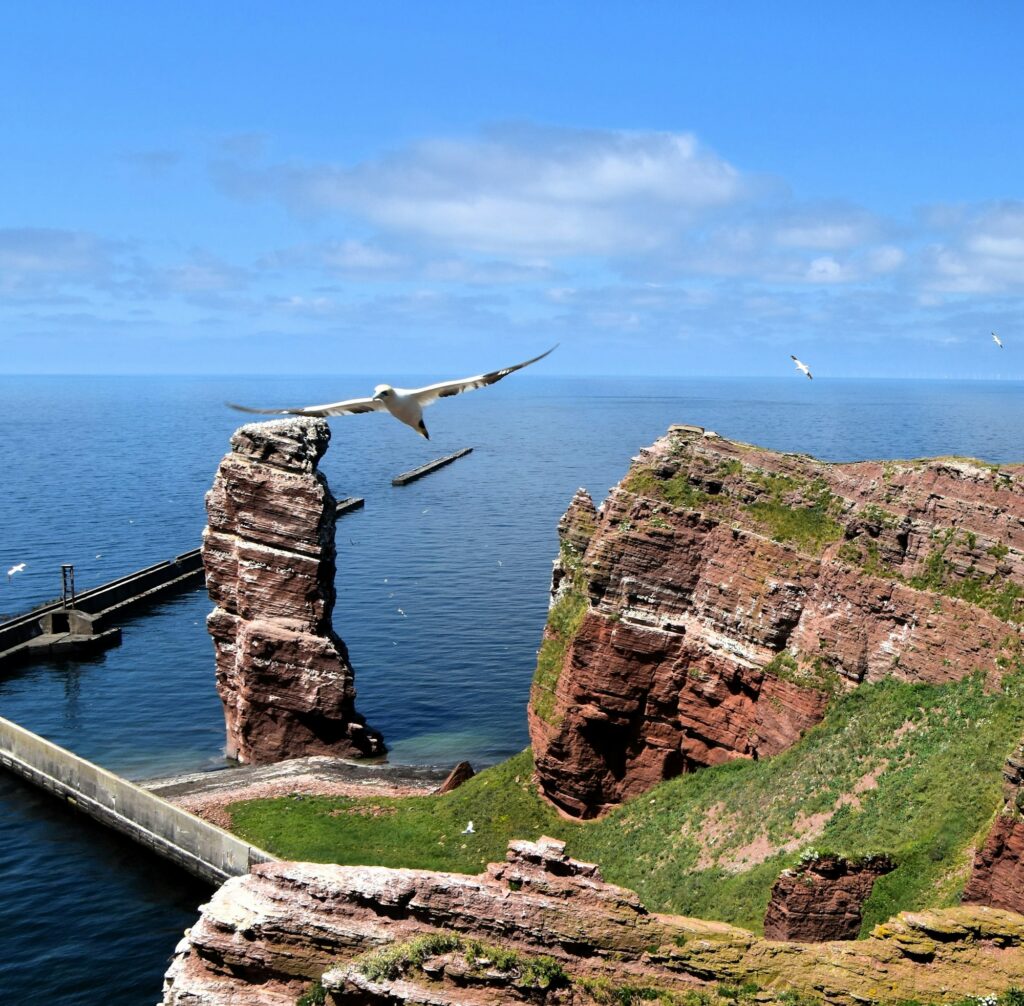
- Lange Anna: This free-standing rock, 47 metres high, is the island's landmark. You reach it via the Klippenrandweg, a cliff-edge path about 3 kilometres long on the Oberland. It stands at the north-western end of the island.
- Lummenfelsen: Germany's only bird cliff lies along the Klippenrandweg. Between April and October, more than 10,000 pairs of various seabirds breed here.
- Düne: You can reach the neighbouring island with its two sandy beaches on the municipality's Düne ferry. Grey seals and harbour seals are often found lying on the beach, so keep 30 metres away from the animals. Dogs are not allowed on the Düne.
- Museum Helgoland: The museum in the Nordseehalle shows the history of the island, and in front of it, in the museum courtyard, stand replica lobster huts. It is open daily from 11 am to 4 pm from mid-March to October, and on Wednesdays and Saturdays in winter.
- Hummerbuden: In the colourful huts by the Binnenhafen you will find art, culture and Knieper, the claws of the edible crab. In two of the huts, the island's registrar marries couples.
For skippers: registration, harbour rules and sea weather on Heligoland
For the pontoons in the Südhafen, you register with the Wassersportclub Helgoland by e-mail before departure. In the Nordosthafen, you register with the harbour master after mooring. Because of the debris in the harbour basin, we do not recommend that those unfamiliar with the area use the pontoons in the Südhafen on their own.
Registration and Berthing
Straight after mooring, every visiting skipper registers with the harbour master. There you pay the berthing fee, service charge and visitor's tax. You can reach the harbour master in the Nordosthafen before the crossing on 0170 7845480, as the club itself has no public telephone number. Your boat needs valid third-party liability insurance, and you show proof of it on request.
Harbour rules
In the club facilities, the harbour regulations of the Wassersportclub apply. In the federally owned Südhafen and Vorhafen, the harbour regulations of the Wasserstraßen- und Schifffahrtsamt apply, and in the Nordosthafen, the municipality's harbour user regulations. These points are important for guests:
- In the harbour you proceed at walking pace and avoid suction and wash.
- Anchoring is prohibited in the federally owned harbour, and in the municipal harbour only with permission from the harbour authority. You switch off your radar after berthing.
- Swimming is prohibited in all harbours, as are surfing and jet skiing.
- Open fires and barbecuing on the pontoons and on boats near the pontoons are prohibited. You keep dogs on a lead.
- If a storm is forecast, you take additional precautions to secure your boat yourself, as neither the club nor the harbour master keeps a storm watch.
- You must not enter the Dünenhafen or land on the Düne.
Approach and tides
Expect heavy shipping traffic around Heligoland: around 120,000 ships pass through the German Bight every year, and around 10,000 of them use the north–south route east of the island. In the harbour, ferries, supply ships and offshore vessels are on the move. With a range of around 30 nautical miles, the 35-metre-high lighthouse on the Oberland is the most powerful light in the German Bight.
At the tide gauge in the Binnenhafen, the mean tidal range is around 2.3 metres, around 2.7 metres at spring tide and around 1.9 metres at neap tide. The times of high and low water are predicted by the Bundesamt für Seeschifffahrt und Hydrographie (BSH), and you can find them on the BSH tide pages. The harbour authority for the Südhafen and Vorhafen is the Außenbezirk Helgoland of the Wasserstraßen- und Schifffahrtsamt, at the Westkaje in the Südhafen. You can reach the harbour office on VHF channel 67 (call sign “Helgoland-Port”, also channel 16) and by telephone on 04725 81593-583.
Which marine weather forecast applies to Heligoland?
The German Weather Service (DWD) marine weather forecast for the North Sea and Baltic Sea applies, covering the German Bight area, together with the coastal marine weather forecast, which lists Heligoland as a separate area. It gives wind and gusts in Beaufort, wave height and visibility, and is updated twice a day, at around 0.15 and 12.15.
For the Heligoland sea area, the DWD broadcasts wind, storm, gust and thunderstorm warnings around the clock. You can read the current report on the DWD sea weather page.
Sailing trips from Heligoland on Törnfinder
You can find sailing trips across the German Bight and to the islands under Sailing in the North Sea, and sailing trips along the German coast under Sailing in Germany. All sailing areas together are listed in the trip overview.
Frequently asked questions
How do I get to Heligoland for the start of my sailing trip?
By ship, all year round from Cuxhaven and, in season, also from Hamburg, Büsum and Hörnum. The catamaran from Cuxhaven takes around 75 minutes, the ferry around 150 minutes.
Where do I park at the start of my sailing trip on Heligoland?
On the mainland at the departure port, as the island is car-free. In Cuxhaven, the Helgolandparkplatz at the ferry terminal currently costs 8 euros a day (as of November 2026).
Are there sanitary facilities in the harbours on Heligoland?
Yes, for visiting boats in the Nordosthafen, the sanitary facilities are included in the service charge.
How much may I bring from Helgoland duty-free?
On a private yacht, goods up to 300 euros; as a ferry passenger, up to 430 euros, plus tobacco and alcohol in fixed quantities, for example 200 cigarettes and 1 litre of spirits. You declare larger quantities before departure at the Zollamt Helgoland.
Do I have to register for the Südhafen on Heligoland?
Yes, you can only enter the pontoon facility in the Südhafen after registering in advance by e-mail with the Wassersportclub Helgoland, and a member will show you in. No advance registration is needed in the Nordosthafen.
How strong is the tide on Heligoland?
The mean tidal range at the gauge in the Binnenhafen is around 2.3 metres, and around 2.7 metres at spring tide. The wind can make the water rise higher or lower than predicted.