This page was translated automatically from German. View the original
Sydney lies on the east coast of Australia on the natural harbour of Port Jackson, Sydney Harbour for short. Visitor berths can be found in Rushcutters Bay, east of the city centre, and in Darling Harbour on the western edge of the centre, among other places. Here you can read how to get from the airport to the marinas in Sydney, which marina is where, where to park and shop, what the sailing weather is like, which sailing trip destinations lie near Sydney, and what skippers need to bear in mind when clearing in and on Sydney Harbour.
The essentials at a glance
- Sydney Airport is around 8 kilometres from the city centre. The train takes 13 minutes to the centre, and a taxi to Rushcutters Bay takes less than 25 minutes.
- Rushcutters Bay has two marinas with visitor berths right next to each other: the marina of the Cruising Yacht Club of Australia (CYCA) and the d’Albora Rushcutters Bay Marina. In Darling Harbour there is a visitor marina in Cockle Bay.
- Parking is scarce at Rushcutters Bay, with mostly on-street spaces. It is more convenient to come by train, taxi or water taxi.
- Coles and Aldi are in Edgecliff, around 650 to 700 metres from Rushcutters Bay, right next to the railway station.
- From October to February, the Southerly Buster, a sudden, gusty southerly wind, can sweep through in the late afternoon on hot days.
Where are the marinas in Sydney?
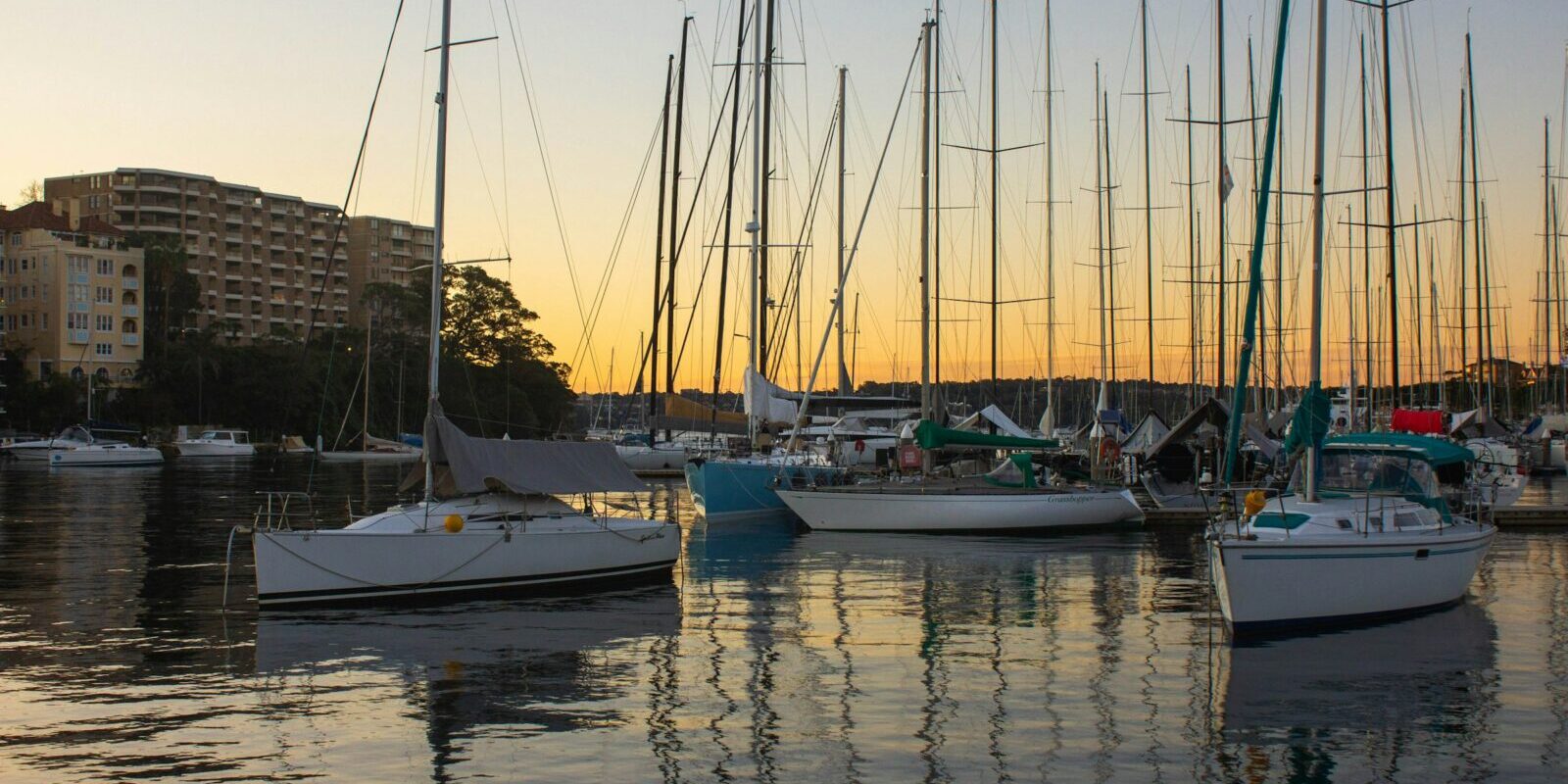
The two marinas in Rushcutters Bay are on the south shore of Sydney Harbour on New Beach Road, between Rushcutters Bay Park and Darling Point: the CYCA Marina and, only around 100 metres further on, the d’Albora Rushcutters Bay Marina. The Darling Harbour Marina is in Cockle Bay on the western edge of the city centre, around 3 kilometres west of Rushcutters Bay as the crow flies. There are other marinas in between.
Map from OpenStreetMap. When the map is displayed, data is transmitted to the provider.
More Information| Feature | CYCA Marina | d’Albora Rushcutters Bay Marina | Darling Harbour Marina |
|---|---|---|---|
| Location | Rushcutters Bay, 1 New Beach Road, Darling Point | Rushcutters Bay, 1B New Beach Road | Cockle Bay, east side |
| Berths | 213 floating pontoon berths | 106 berths for boats up to 40 m | – |
| Visitor berths | on request, subject to availability | on request, subject to availability | Visitor marina, fees apply |
| Fuel station | next door at d’Albora | around the clock | – |
| Access | directly from the harbour | directly from the harbour | through Pyrmont Bridge: clearance height 6.05 m, taller masts require the bridge to be opened |
Arriving for the start of your sailing trip in Sydney
Sydney International Airport is on Botany Bay. From there you can reach both mooring areas by train, taxi or shuttle bus.
From Sydney Airport to the marinas
You will find taxis at the taxi ranks outside all terminals. It is around a 20-minute drive to the city centre and costs roughly 45 to 55 Australian dollars (as of November 2026). It takes less than 25 minutes by taxi to Rushcutters Bay.
The train takes 13 minutes to the city centre, with services roughly every ten minutes. The station at the international terminal is on the arrivals level, behind Arrivals Hall A. You do not necessarily need a ticket: you simply tap your Opal card or a contactless credit card on the reader when getting on and off. Shuttle buses also run from the international terminal to the city centre, including to Kings Cross and Darling Harbour.
By train, bus or water taxi
The nearest railway station to Rushcutters Bay is Edgecliff on the Eastern Suburbs Line, less than ten minutes' walk from the CYCA Marina. At the CYCA Marina you can also be picked up or dropped off by a water taxi directly at the pontoon.
Parking
Parking is difficult at Rushcutters Bay. In front of the CYCA clubhouse there are only a few on-street parking spaces for visitors along New Beach Road. The d’Albora Rushcutters Bay Marina has a small car park of its own, plus on-street parking in the surrounding area, where you need to pay close attention to signs and parking times. One car park is on New Beach Road, around 100 metres from the CYCA Marina. At the Darling Harbour Marina there are several multi-storey car parks around the bay, including the car park of the Harbourside shopping centre on Murray Street. One car park is on Wheat Road, around 100 metres from the marina.
Showers and sanitary facilities
CYCA Marina has showers and toilets next to the Sailing and Marina Office, open 24 hours a day with an access card. Right beside them are washing machines and tumble dryers for visiting boats. d’Albora Rushcutters Bay Marina also has showers and toilets for berth holders and visitors.
Shopping for the trip
For provisions, head from Rushcutters Bay to Edgecliff: there is an Aldi and a Coles on New South Head Road, around 650 to 700 metres from CYCA Marina. You can use the trolleys that the CYCA keeps in front of the clubhouse to bring your shopping down to the pontoon. More supermarkets can be found in Potts Point on Macleay Street and Darlinghurst Road, around one kilometre to the west. About 1.1 kilometres to the east is a Woolworths in Double Bay.
At Darling Harbour Marina, the nearest supermarket is a Coles Local, about 500 metres away as the crow flies.
Doctor, pharmacy and emergency services
There are pharmacies in Edgecliff on New South Head Road, around 650 metres from CYCA Marina, and in Elizabeth Bay, around 750 metres away. You will find doctors' surgeries in Potts Point and Double Bay, each around 700 metres away. St Vincent’s Hospital in Darlinghurst is about 1.3 kilometres as the crow flies from Rushcutters Bay, and Saint Luke’s Private Hospital in Elizabeth Bay is around 650 metres away. In Darling Harbour, the pharmacy and doctor's surgery are each around 700 to 850 metres from the marina.
- 000 (Triple Zero): emergency number for police, fire brigade and ambulance; from a mobile you can also dial 112
- 1800 022 222: healthdirect health hotline, staffed by nurses around the clock
- At sea: VHF channel 16
CYCA Marina in Rushcutters Bay
The marina of the Cruising Yacht Club of Australia lies on the eastern shore of Rushcutters Bay in Darling Point, right next to Rushcutters Bay Park. The club hosts the Sydney to Hobart race and welcomes visiting yachts when berths are available.
You can book a visitor berth using the form on the club's website or directly with the marina manager. The marina office is staffed Monday to Friday from 8 am to 4 pm, and at weekends and on public holidays from 8 am to 5 pm. The clubhouse has a restaurant and a bar.
Facilities at CYCA Marina
All 213 berths are on floating pontoons. Every berth has 15-amp power, and some also have 32-amp three-phase power. Shore power cables must be tested and tagged by an electrician. Fresh water is available at all berths; you bring your own hose and fittings. In addition, there is Wi-Fi in the clubhouse, gas bottle refilling via the marina office, and rubbish and waste oil disposal. You can fill up with diesel and petrol around the clock next door at d’Albora.
d’Albora Rushcutters Bay Marina
d’Albora Rushcutters Bay Marina lies right next to CYCA Marina on New Beach Road. It has 106 berths for boats of up to 40 metres and offers visitor berths as well as permanent berths, depending on boat dimensions and availability.
The office for berth holders and visitors is open daily from 8:30 am to 5 pm, and the dock staff help with mooring and refuelling seven days a week.
Facilities at d’Albora Rushcutters Bay Marina
The fuel dock is open around the clock. Besides showers and toilets, there is an outdoor lounge for guests and a café serving coffee and light meals.
What does Darling Harbour Marina offer?
Darling Harbour Marina is the visitor marina on the eastern side of Cockle Bay on the western edge of the city centre, not far from the Maritime Museum. Berths are chargeable, and you may only use the landing stages on the west and south sides of the bay by arrangement with the state authority Property NSW.
You can reserve a berth online or by phone on +61 2 9211 5227. On New Year's Eve and on Australia Day (26 January) the marina is closed, and petrol-engined boats are not permitted there during fireworks displays. For sailing yachts, the key issue is access: the Pyrmont Bridge at the entrance to Cockle Bay has a clearance of 6.05 metres. Taller masts need a bridge opening, which is requested from Property NSW.
What is the sailing weather like in Sydney?
The most striking weather in Sydney is the Southerly Buster: a sudden, gusty southerly wind that sweeps up the coast, mainly between October and February. It usually arrives in the late afternoon or early evening after several hot days, bringing gusts of over 29 knots, and 40 knots or more with strong fronts.
Often hardly a cloud announces it, though sometimes a roll cloud forms across the coast. The strongest gusts come with the front, and after 30 to 60 minutes the wind usually eases noticeably. The Australian weather service issues wind warnings from a mean wind of 26 knots: strong wind warnings extend up to 33 knots, and from 34 knots a gale warning applies. Gusts can be up to 40 per cent stronger than the forecast mean wind.
Which sailing destinations are near Sydney?
From Sydney, sailing trips lead either along the coast to the north and south or out onto the Tasman Sea. You leave Sydney Harbour through the entrance between North Head and South Head.
- Pittwater and Broken Bay: north of Sydney lies the Palm Beach peninsula, surrounded by Pittwater, the Pacific and Broken Bay at the mouth of the Hawkesbury River.
- Botany Bay: the bay south of the city is Sydney's major commercial port, with container and liquid cargo terminals.
- Port Hacking: the inlet south of Botany Bay is quieter and less industrial. It opens onto the Tasman Sea between Cronulla and Bundeena, is a good 9 metres deep on average and has six marinas. The southern shore belongs to the Royal National Park.
- Newcastle: the port city in the Hunter region north of Sydney has the largest deep-water port on Australia's east coast. Like Sydney, Newcastle is an official port of entry for yachts arriving from abroad.
- Hobart: the classic offshore route runs around 628 nautical miles south across the Tasman Sea to Tasmania. Every year on 26 December, the Sydney to Hobart race starts here.
The distance in nautical miles is a rounded figure for the passage over water on the usual course. For precise planning, use the nautical chart.
What can you do on a harbour day in Sydney?
From Rushcutters Bay you can reach several of the city's best-known sights on foot.
- Rushcutters Bay Park: The park, with its waterside path, lies right next to the two marinas and is a good choice for a first stroll ashore.
- Elizabeth Bay House: Built in the 1830s, the villa was regarded at the time as the finest residence in the colony. It lies roughly 750 metres as the crow flies from Rushcutters Bay. All around in Potts Point you will find many Art Deco buildings, restaurants and bars.
- Woolloomooloo and the Finger Wharf: The former cargo wharf is one of the longest timber wharves in the world and now houses restaurants and a hotel, roughly 1.3 kilometres as the crow flies.
- Art Gallery of New South Wales and Royal Botanic Garden: The art gallery, with two buildings in the Domain, is roughly 1.6 kilometres away. The Botanic Garden, with its view of the Opera House, is roughly 2 kilometres away.
- Australian National Maritime Museum: The maritime museum at Darling Harbour, next to Pyrmont Bridge, is open daily except 25 December and is roughly 400 metres from Darling Harbour Marina.
For skippers: berthing, clearing in and marine weather in Sydney
Sydney Harbour is a very busy harbour with commercial shipping, fast ferries, seaplanes and many pleasure boats. Yachts under 30 metres in length do not need a pilot.
Berth and registration
Visitor berths in Sydney are only available where space is free. At CYCA Marina, you book via the booking form or with the marina manager; at d’Albora Rushcutters Bay Marina, via the booking page or the hotline 1800 32 52 672; at Darling Harbour Marina, online or by telephone. In addition, the transport authority Transport for NSW has set up a network of visitor berths at 19 marinas around the harbour: green flags or banners mark these marinas, and blue ones mark the berth where you may tie up. Each marina may limit the length of stay.
Harbour rules in Sydney Harbour
The most important rules from the transport authority Transport for NSW for Sydney Harbour:
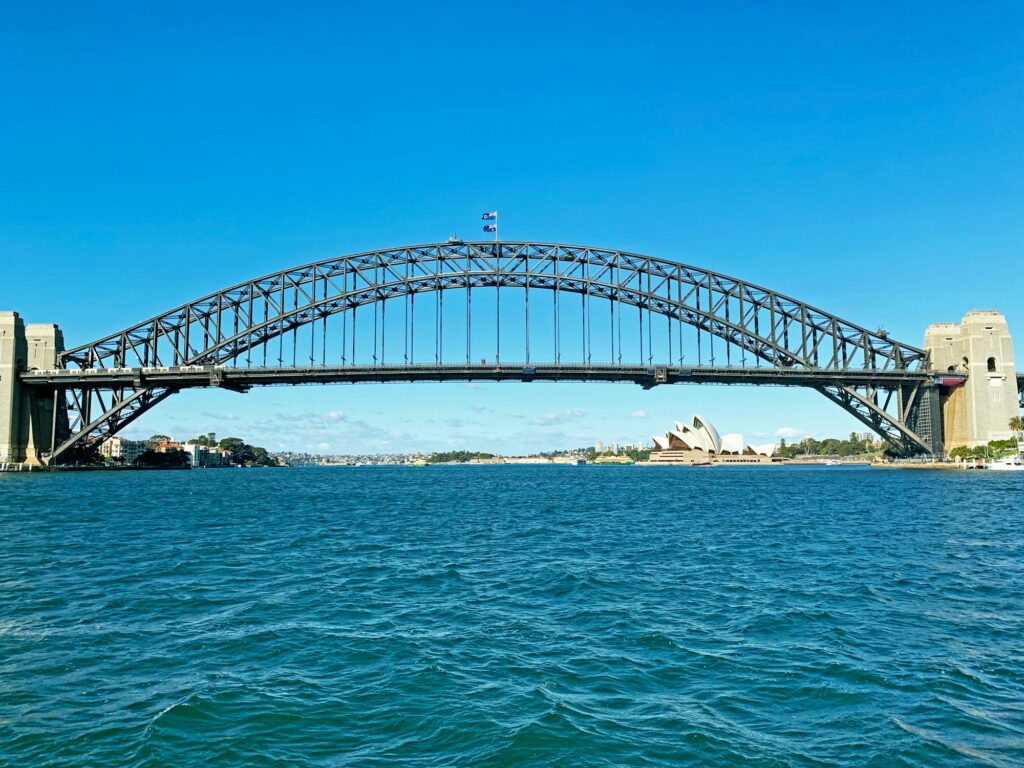
- Transit zone at the Harbour Bridge: The zone around the bridge extends from the line Bennelong Point–Kirribilli Point to the line Millers Point–Blues Point. You may only pass through it, at a maximum of 15 knots, and you may not stop, drift or anchor within it. If you are sailing from Rushcutters Bay to Darling Harbour, you will cross this zone.
- Ferries have priority: Ferries displaying an orange diamond have priority over sailing boats during the day. Keep at least 200 metres clear of their bow and 30 metres from their sides and stern. Fast ferries show a flashing yellow light.
- Commercial shipping: In the channels, keep to the right and give commercial shipping room.
- Circular traffic flow: As a general rule, all boats should travel around the harbour anticlockwise.
- Restricted areas: Pleasure craft may only enter Sydney Cove at Circular Quay with written permission. Anchoring is prohibited in naval waters, you keep 60 metres away from moored warships, and yellow buoys mark the exclusion zones around Garden Island.
- Major events: At the start of the Sydney to Hobart race on 26 December, on New Year's Eve and on other festive days, temporary exclusion zones and speed limits apply in the harbour.
Clearing in to Australia
If you arrive from abroad, strict rules apply (as of November 2026). You must notify the Australian Border Force, the border authority, at least 96 hours before arrival; for shorter passages, shorter deadlines apply, down to 12 hours. You must also send the Department of Agriculture a Pre-Arrival Report for the biosecurity inspection via its web portal, no earlier than 90 days and no later than 12 hours before arrival. Everyone on board needs a valid passport and a visa.
In Australian waters, you hoist the yellow Q flag and head straight for the clearance point. In Sydney, this is the Border Force buoy in Watsons Bay, at the tip of the South Head peninsula. Until the border authority and biosecurity have cleared you, nobody may go ashore or have contact with other boats. Depending on your arrival time, you stay on board overnight. Food and animals remain sealed until inspected, and waste must not be thrown overboard. You must declare medicines containing narcotics, weapons and cash of 10,000 Australian dollars or more. The border authority does not charge a fee, but fees may apply for the biosecurity inspection. Foreign yachts in transit can obtain a permit for up to twelve months, but no longer than the validity of the visa. The details can be found on the page of the Australian Border Force for yachts.
Approach and radio
You enter the harbour between North Head and South Head. At Bradleys Head, since 2024 there has been a special mark about 200 metres east of the former approach buoy: large ships pass between the headland and the mark, while ferries leave it to port. The traffic service Sydney VTS broadcasts safety messages and shipping movements every two hours from about 1 a.m. daily on VHF channels 16 and 13. For Darling Harbour, you can find out on channel 13 from the Pyrmont Bridge bridge operator whether Cockle Bay is closed; a display in the middle of the bridge shows closures. Before setting out, you check in with Marine Rescue NSW via its app, on VHF channel 16 or by telephone, and check out again on your return. The current rules for Sydney Harbour are published by Transport for NSW.
Which marine weather forecast applies in Sydney?
For Sydney, the marine weather forecast of the Australian weather service, the Bureau of Meteorology (BOM), applies. It issues forecasts for local waters, meaning harbours and bays such as Sydney Harbour, and for coastal waters up to 60 nautical miles offshore, each for three to four days.
In New South Wales, the reports are issued four times a day at around 4:00, 10:00, 16:00 and 22:00 local time, and are updated when conditions change significantly. On the water, Marine Rescue NSW broadcasts weather warnings on VHF channel 16 and on 27 MHz channel 88. You can reach the BOM warning service by phone on 1300 132 536.
Sailing trips from Sydney on Törnfinder
On Törnfinder you will find all current offers starting or ending in Sydney and on the Australian east coast at Trips.
Frequently asked questions
How do I get from Sydney Airport to Rushcutters Bay?
By taxi it takes less than 25 minutes. By train it takes 13 minutes to the city centre. The nearest station to Rushcutters Bay is Edgecliff, less than ten minutes on foot from the CYCA Marina.
Where do I park at the start of a sailing trip in Sydney?
In Rushcutters Bay there are only a few street parking spaces on New Beach Road and a small car park at d’Albora Marina. There is a car park on New Beach Road, about 100 metres from the CYCA Marina. Train, taxi or water taxi are usually easier.
Where do I go shopping in Rushcutters Bay?
In Edgecliff, around 650 to 700 metres away: there is an Aldi and a Coles on New South Head Road, right by the station.
Are there showers at the marinas in Sydney?
Yes. The CYCA Marina has showers that are open around the clock with an access card, and a laundry. The d’Albora Rushcutters Bay Marina also has showers for guests.
Where does a yacht clear in at Sydney?
At the border authority’s clearance buoy in Watsons Bay. Beforehand, you notify the Australian Border Force of your arrival at least 96 hours in advance and send the Pre-Arrival Report to the Department of Agriculture. You may only go ashore once you have been given clearance.
When does the Southerly Buster blow through Sydney?
Mainly between October and February, usually in the late afternoon or early evening after hot days. It brings a sudden, gusty southerly wind of over 29 knots, which usually eases off after 30 to 60 minutes.