
Sailing expedition Outer Hebrides special Ullapool – Oban 2027
 Seehase
This page was translated automatically from German. View the original
5th to 14th July 2027 … 10 days from € 1,815
A trip focused on discovering the most beautiful places in the Outer Hebrides (and St Kilda).
At the outermost western edge of Scotland lies a unique group of islands that this voyage focuses on: the Outer Hebrides. These islands have been inhabited for centuries and are famous for their nature, vastness, tranquillity and remoteness. From the large islands such as Harris & Lewis to the smaller ones like the Monachs, all the islands have their very own character and atmosphere. What could be better than exploring these (remote) islands by sailing ship!
Possible itinerary:
Around the Outer Hebrides, wind and tides are the deciding factors.
There is no fixed programme for this voyage; instead we shall be guided by the elements.
If conditions are suitable, our principal destination is the hard-to-reach St Kilda. A place accessible only by boat, telling a unique story. If the sea is too rough, we shall remain on the sheltered side of the Outer Hebrides, for here too there is more than enough to discover!
The sea around the Outer Hebrides is home to a great diversity of life. From puffins to dolphins, basking sharks and whales.
On this voyage we shall not spend every night in a harbour but shall also lie at anchor between the islands for several nights. The undisturbed peace of anchoring in remote places is a unique experience!
On all our sailing voyages flexibility remains the rule, and especially so on this trip!
Possible destinations:
Embarkation in Ullapool
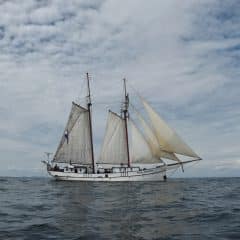
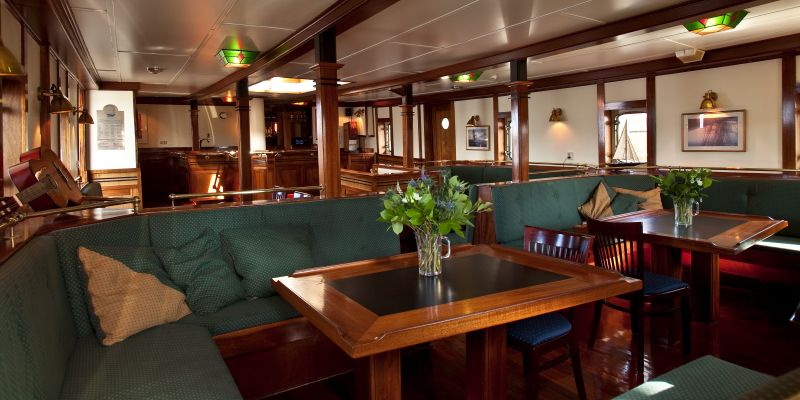
In the early evening we board the majestic Flying Dutchman, a classic tall ship that combines tradition with comfort. Ullapool, a charming fishing village on Loch Broom, is the starting point for our North Atlantic adventure. At dinner on board you will meet the crew and your fellow travellers. Afterwards we set sail along the dramatic west coast of the Scottish Highlands.
Harris and Lewis
Harris & Lewis is one island but, as the name suggests, consists of two parts: the northern part Lewis and the southern part Harris. It is the largest island of the Outer Hebrides, with clear differences in landscape and atmosphere between the two parts. Lewis is flatter than Harris, which in turn has more mountains and cliffs. The largest town on Harris and Lewis is Stornoway in the north-east, a pleasant town with shops, restaurants and museums. West of Stornoway lie the "Callanish Standing Stones", a relic from the Neolithic period used for ritual practices. The stone circle is estimated to be 6,000 years old. The "Harris Distillery" is known for its fine gin.
North Uist
North Uist is relatively flat and consists mostly of marshes and lochs, which are an important habitat for rare bird species. Lochmaddy is the largest settlement on the island with about 1,500 inhabitants, most of whom still speak Gaelic. On the island you can enjoy wonderful walking in the beautiful landscape. Everywhere you can discover archaeological finds such as burial mounds, stone circles and standing stones.
South Uist
South Uist is much hillier than North Uist, with hills rising to 600 metres. The eastern side of the island consists of hills and dramatic coastlines, whilst the Atlantic side is almost entirely beach. Lochboisdale on the east side is the largest settlement on the island, where amongst other things the ferry from Oban arrives.
Eriskay
Between South Uist and Barra lies the island of Eriskay. The land on the island is unsuitable for arable farming and livestock, and for centuries the inhabitants lived mainly from fishing. In 1941, the ship "SS Politician", on its way to America, ran aground off the coast of Eriskay with 20,000 casks of whisky on board. In 1949, the film "Whisky Galore" was made based on this story.
Eriskay is home to the "Eriskay Ponies", a rare native breed of horse.
Barra
Barra, one of the southernmost islands of the Outer Hebrides, is known for its azure sea, white beaches and breathtaking views. Barra has the only commercial airport in the world where aircraft land and take off on the beach at low tide. There are daily flights from Glasgow to Barra.
To enjoy the magnificent views across the island, it is highly recommended to hike up one of the hills here.
St Kilda
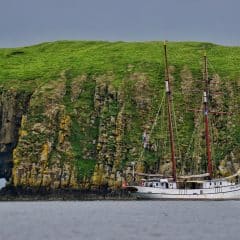
This volcanic archipelago lies off the coast of the Hebrides and consists of the islands of Hirta, Dun, Soay and Boreray. Here are some of the highest cliffs in Europe with large colonies of rare and endangered bird species such as puffins and gannets. The archipelago has been uninhabited since 1930.
For thousands of years people lived on the island of Hirta. This community eventually perished through fundamentalist pastors and epidemics. In 1930, the last inhabitants were evacuated. Today you can walk through the abandoned village and learn what life must have been like for the inhabitants. Several houses contain an exhibition about the families who lived in them.
Tobermory
On our way to Oban we shall visit Tobermory on the Isle of Mull. Picturesque Tobermory is the largest settlement on Mull. It is a charming little place with colourful houses and a range of small shops such as a chocolaterie, a bakery, a candle maker's, a silversmith's, an art gallery and a pottery, to name but a few. Tobermory is also known for its galleries and some good pubs and restaurants. And of course, on our voyage you can also visit the famous Tobermory Distillery. Around the natural bay there are some lovely walks.
Oban
We conclude our voyage in Oban, a charming fishing town picturesquely situated on a beautiful bay. This is also home to the famous Oban Distillery, which is well worth a visit.
We are happy to send further information.
Ahoy,
Karsten
Map from OpenStreetMap. When the map is displayed, data is transmitted to the provider.
More InformationMap from OpenStreetMap. When the map is displayed, data is transmitted to the provider.
More InformationLogger
120 feet
