SailingLife

The sailing blog for tips, trends and trips

Stories, tips and guides about sailing – for newcomers and old hands alike. From the finest sailing areas to technology and trends, equipment, safety and navigation.

General Beach catamarans on the beach

Hobie Cat vs. Topcat – A Comparison of Sports Catamarans

Catamaran sailing stands for speed, freedom and pure "beach life". Anyone who has experienced a beach catamaran planing will never forget that feeling. Two brands have shaped this sailing class like no others: Hobie Cat from California and Topcat from Germany. Both manufacturers have their roots in the 1970s, both offer boats for beginners, families and regatta sailors – and yet they differ in philosophy, construction and community. Hobie Cat stands for international reach and legendary models like the Hobie 16, Topcat for European quality, centreboard-less hulls and tool-free assembly. History of the brands Hobie Cat (USA) Hobart "Hobie" Alter, originally a surfboard pioneer from California, launched the first Hobie 14 in 1968…
Show more
Yacht design Comparison of cruising yachts

Dangers in cruising sailing – and how specialist yachts defy them

Cruising sailors who undertake long passages across oceans and into remote areas are exposed to a wide range of hazards. It is no surprise that safety concepts are hotly debated in sailing circles – particularly since several well-known accidents have exposed the weaknesses of conventional production yachts. This article examines the most common causes of yachts sinking and presents in detail two modern blue-water yachts that redefine safety: the Garcia Exploration 60 (an aluminium centreboard yacht) and the Kraken 58 (a GRP yacht with integral keel). We explain the special design features with which these boats address the risks. We then compare these approaches with traditional production yachts built in GRP (with bolted-on keels, unprotected rudders, etc.). Typical causes of sinking: Why yachts can sink Although modern sailing yachts today…

Show more
Sailing training Sailing boat on the horizon and ship's wheel - symbolic image for sailing licence and first independent sailing trip

From sailing licence to your first independent sailing trip

Anyone dreaming of their own trip — a weekend on the IJsselmeer, a week in the Croatian Adriatic or the big leap to the Caribbean — always faces the same question at the start: how do I get from land onto the water? The key is solid training, and that almost always begins with the right boating licence. Two licences are crucial for getting started: the SBF See for coastal and offshore waters and the SBF Binnen for rivers, canals and lakes. Anyone planning to charter later can't avoid the SBF See in any case. And how you learn the theory has changed considerably: instead of rigid classroom sessions, modern providers rely on flexible online learning that fits into everyday life.

Show more
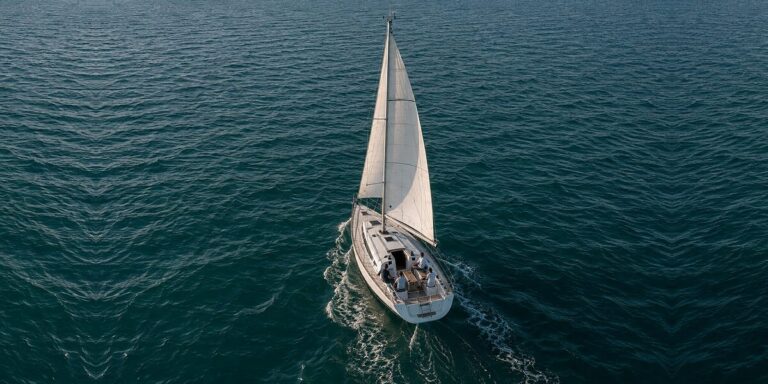
General Sailing yacht under sail from the air — trip with vacant berths for crew

Looking for crew? How to find crew for your sailing trip

The boat is ready to go, the trip is planned, two bunks are still free. And now? Anyone who has ever looked for crew knows the feeling: it rarely fails for lack of interest. It fails because the right people do not find out that you exist — and because the advert does not answer the questions they need answered in order to decide. This article shows where crew actually look for trips today, what belongs in a sailing trip advert, what the kitty realistically costs, and at what point a private trip legally becomes something else. The last point is the most frequently underestimated. Where crew actually look today Sailing crew boards and sailing portals. This is where people look who have already decided that they…

Show more
Sailing training Sail training in the cockpit: instructor explains the route, chart on the cockpit table

Sailing schools: How to get your sailing courses found online

Sailing schools live on two things: a good reputation and being found at the right moment. Reputation is built on the water. Being found is decided beforehand — usually in the evening at the kitchen table, when someone is searching for where to take their boat licence in the spring. This article shows why the designation of a course determines its visibility, what information prospective students actually need — from prerequisites to examination fees — and which mistakes lead to good courses not being booked. Why the designation determines visibility There is a gap between official language and everyday language, and it is precisely in this gap that course offerings are lost. The official sources — the waterways…

Show more
sailing knowledge The logbook for sailors

The logbook: Why it's more than just a diary

A logbook is much more than a collection of notes – it is the heart of every sailing trip, an indispensable document and a connection to the centuries-old tradition of seafaring. But why is keeping a logbook so important, what is its significance and how is it kept correctly? In this blog post we explore these questions and show why no sailing trip should be undertaken without a carefully kept logbook.   The significance of the logbook The logbook is a central element of navigation and documentation at sea. It serves not only to record events during the trip, but also fulfils numerous practical and legal functions: 1. Tradition and history The logbook…

Show more
sailing knowledge Recording nautical miles on a sea chart

The Nautical Mile: History, Meaning and Navigation

The nautical mile – this special unit of measurement that has accompanied sailors, navigators and explorers for centuries – is far more than just a technical number. It tells a story of adventures, scientific progress and the eternal fascination with the world's oceans. In this article we examine what exactly the nautical mile is, why it came into being and how it is used today. In doing so we delve deep into its historical development and discover how it has shaped our way of travelling the seas.   What is a nautical mile? A definition The nautical mile is a unit of length developed specifically for navigation, as it relates directly to the shape and size of the…

Show more
sailing knowledge Sailing plastic-free

Plastic-free at sea: How to make your sailing trip eco-friendly as a crew member

A sailing trip is a unique experience: the vastness of the sea, the tranquillity of nature and the feeling of freedom. But at the same time we bear a responsibility to protect our environment. Plastic is one of the greatest threats to our oceans. Even as a crew member you can help to avoid plastic waste and make your trip more environmentally friendly. Here you will find practical tips and ideas on how to reduce plastic on board.   The importance of plastic-free sailing Plastic is ubiquitous: around 8 million tonnes end up in the oceans every year. It threatens marine life, destroys fragile ecosystems and even ends up in our food in the form of microplastics. Particularly at sea we are often in close contact…

Show more
General Family sailing

Sailing with children – tips for a relaxed family trip

Sailing with the family can be an unforgettable experience – especially when the little sailors are on board too. For the family trip to be a complete success, good preparation and well thought-out safety measures are crucial. In this post we give you the best tips on how to ensure safety and entertainment for your children on board.   1. Safety on board: the most important rules for children Suitable lifejackets for children One of the most important safety measures is the right lifejacket. Make sure that it corresponds to your child's size and weight and is checked before every voyage. Safety netting and lifelines Install a safety net on the guardrails and use…

Show more
Sailing area info Tyrrhenian Sea

Tyrrhenian Sea: Beauties and Special Features of the Mediterranean

The Tyrrhenian Sea, part of the Mediterranean, is known for its breathtaking landscapes, historic sights and unique islands. From the magnificent coasts of Italy to the hidden bays and lively cities, the Tyrrhenian Sea offers a wealth of experiences for travellers, historians and nature lovers. In this post we will explore the main highlights of the Tyrrhenian Sea and give you tips on how to get the best out of your visit. What is the Tyrrhenian Sea? The Tyrrhenian Sea is part of the western Mediterranean, lying between the Italian peninsula and the islands of Sicily, Sardinia and Corsica. It borders the Ligurian Sea to the north and the Ionian…

Show more
sailing knowledge Knots in km/h

Converting Knots to km/h: Guide to Speeds

Speed can be stated in various units, depending on context and region. In the maritime field, speed is frequently given in knots (kn), whilst on land kilometres per hour (km/h) are often used. If you need to convert between these units, it is important to know the correct method. In this post you will learn how to convert knots into km/h and which rule of thumb will help you. What is a knot? A knot is a unit of speed used in shipping and aviation. One knot corresponds exactly to one nautical mile per hour. Since one nautical mile is approximately 1.852 kilometres, it is important to convert knots correctly into kilometres per hour (km/h), particularly…

Show more
Sailing area info

Corinth Canal: A breathtaking journey through Greece

The Corinth Canal connects the Saronic Gulf with the Gulf of Corinth and considerably shortens the shipping route around the Peloponnese peninsula. It separates the Greek mainland from the Peloponnese peninsula and thereby realises historic plans that already existed in antiquity. It is approximately 6.3 kilometres long and was built at the end of the 19th century. Today both tourist boats and smaller cargo vessels use the canal. In this article you will learn more about the history, construction and present-day use of this impressive structure. The essentials at a glance The Corinth Canal, a visionary idea since the 6th century BC, was completed in 1893 and simplifies the trade routes between the Saronic Gulf…

Show more
Travel

Naxos holidays: Discover the best beaches and sights

Naxos is the largest island in the Cyclades and offers an impressive variety of beaches, historic sights and cultural experiences. Whether you're looking for picturesque sandy beaches, mediaeval old towns or culinary delights, Naxos has something for everyone. In this article, you'll discover which beaches you should visit, which sights you mustn't miss and what adventures await you. Further information and tips about Naxos can be found on our website. Key points at a glance Naxos offers an impressive variety of beaches, ranging from picturesque sandy beaches in the south to rugged coastal stretches in the north, ideal for various leisure activities and relaxation. Naxos Town (Chora) is rich in historic and cultural sights,…

Show more
Sailing area info

The Panama Canal: History, Technology and Global Significance

The Panama Canal, one of the world's most important waterways, connects the Atlantic and Pacific oceans and revolutionises global trade by drastically reducing sea voyage times. The canal serves as a vital shortcut that significantly reduces the conventional route and offers ships a cost-effective way to avoid the dangerous Cape Horn. Discover in this article the fascinating history, impressive engineering and immense significance of this canal for the global economy. From the early visions of European explorers to modern-day management by the Panama Canal Authority – the Panama Canal has a rich and complex history. Learn more about the engineering masterpieces that made construction possible, and the challenges that…

Show more
Events

Mediterranean Highlights: Sailing Talks That Inspire!

Are you already dreaming again of peaceful, idyllic anchorages in the Mediterranean? Markus Silbergasser from UNTER SEGELN, a true Mediterranean expert, takes you on an exciting virtual voyage of discovery with beautiful impressions and clear drone footage to the Mediterranean's most unspoilt spots. The anchorage tips and special features conveyed with passion and conviction, as well as the wealth of relevant information for each region, guarantee inspiration for your next sailing trips. Let yourself be captivated by breathtaking coastal landscapes, the unique mountain scenery as well as authentic culture and cuisine, sensitively captured and prepared into a varied multimedia sailing presentation.   The next dates: • Thurs. 14.11. in Vienna – Best of Greece (already fully booked, waiting list possible) • Thurs. 21.11. in Carinthia – UNTER…

Show more
Events

What is the Vendée Globe? The World's Toughest Single-Handed Race

The Vendée Globe is one of the most prestigious and toughest sailing races in the world. It is a non-stop regatta around the world in which participants sail alone on the open sea, without outside support and without stopovers. The challenge and appeal of this race attract sailing enthusiasts from around the world. Key points at a glance The Vendée Globe is a prestigious offshore race that challenges sailors to circumnavigate the globe solo, non-stop and without outside assistance. The route of the Vendée Globe covers 24,000 nautical miles and includes extremely challenging milestones such as Cape Horn, the Cape of Good Hope and the Southern Ocean. The history of the Vendée Globe…

Show more
Sailing technique

Sustainability in boat building: Modern approaches to environmentally friendly yachts

How can boat building become more sustainable? This article shows approaches and examples for the use of environmentally friendly materials and technologies in boat building, with a focus on "sustainability in boat building". The availability of data on pollutant emissions is crucial to track progress in emission reduction and to provide other boatyards and interested parties with access to this information. The transition to sustainable boat building requires a holistic consideration of a boat's entire life cycle, from material selection through production to disposal. An important aspect is the use of renewable raw materials and recyclable materials that minimise environmental impact. Furthermore, innovative manufacturing techniques and the integration of renewable energies play a decisive role. For example…

Show more
sailing knowledge

Celestial Navigation: Simple Methods for Beginners

Astronavigation is the art of determining one's position by means of celestial bodies. Seafarers and pilots measure the altitude of the sun, moon and stars to guide their voyage. This article explains the fundamentals and shows how to use tools such as the sextant. Practice-oriented courses in astronavigation are particularly important to introduce participants to the fundamentals of this discipline and to emphasise its relevance for modern sailors. Key points at a glance The fundamentals of astronavigation are based on measuring the altitude angles of celestial bodies such as the sun, moon, planets and fixed stars above the horizon to determine position. The sextant is an essential tool in astronavigation that enables precise angle measurements to…

Show more
Travel Free travel

Travel for free: The best tips for your next trip

Would you like to know how you can travel the world without spending much money? In this article, you'll learn how you can travel for free by using alternative accommodation options, hitchhiking and taking part in various programmes. Read on to discover the best tips for your next journey. Key points at a glance Couchsurfing enables free overnight stays with locals and offers deep cultural insights as well as personal city tours and insider tips from hosts. Home exchange and housesitting are low-cost accommodation alternatives to hotels, where you either swap flats or live in unoccupied houses and look after them. With housesitting, you can live free of charge in someone else's house whilst looking after the property and…

Show more
Meteorology

The Most Important Winds in the Mediterranean: Overview and Tips

The winds in the Mediterranean region significantly shape the weather and sea conditions in this area. Which winds are the most well known here? In this article you will receive a comprehensive overview of the most important Mediterranean winds such as Bora, Scirocco, Meltemi and Mistral and their characteristic features. The essentials at a glance The article describes the most important winds in the Mediterranean region and their unique features as well as their effects on the weather and sea conditions. The Meltemi, a prevailing summer wind in the Aegean, and the Bora, a cold katabatic wind from the east/north-east, are two of the most influential winds in the Mediterranean, bringing sailing challenges and weather-related uncertainties. The article covers various wind systems in the Mediterranean region, including the…

Show more
Travel

Danish Islands: An Unforgettable Holiday – Your Perfect Escape by the Sea

The Danish islands, particularly the "Danish islands" such as Zealand, Funen and Bornholm, offer breathtaking landscapes, rich culture and diverse activities. Find out more about these beautiful places and what makes them so special. In this article you will find information and inspiration about the most beautiful islands in Denmark and specific regions in Zealand. The essentials at a glance Denmark offers a great variety of islands with unique landscapes and attractions, including Zealand with the capital Copenhagen and Funen, the "heart of Denmark", known for its charming villages and dense forests. Here are the top 10 islands in Denmark that you should visit: Zealand, Funen, Bornholm, Rømø, Fanø, Samsø, Langeland, Møn, Ærø and…

Show more
Travel

Madeira Holiday: Tips for the Perfect Trip to the Island of Flowers

A Madeira holiday is a year-round destination and offers a unique blend of stunning landscapes, mild climate and exciting activities. Whether you want to hike, love watersports or seek cultural experiences — Madeira has something for everyone. In this article you will learn everything important about travel times, getting there, accommodation, activities and useful tips for a successful holiday in Madeira. The essentials at a glance Madeira is a year-round destination with pleasant temperatures, perfect for various activities and cultural events such as the Flower Festival and the wine festivals. Getting to Madeira is easy and convenient with numerous direct flights from many major European cities or alternatively via ferries from Portimão. Madeira offers a variety…

Show more
Travel

When Is It Cheapest to Fly? 10 Top Tips for Cheap Flight Tickets

When is flying cheapest? An important aspect is knowing on which days are flights cheapest to find the best deals. Flights are usually cheaper when booked on Tuesday or Wednesday. Very early and late flights are also often cheaper. But that is only the tip of the iceberg. There are many factors that can influence the price of a flight ticket. From choosing the right booking time to flexibility with travel dates — with the right strategies and tips you can achieve considerable savings. Read on to learn more practical tips for cheap flight bookings and to plan your next trip cost-effectively. The essentials…

Show more
General

Dangerous Encounters: Orca Interactions with Sailing Boats

Why are there more and more orca interactions with sailing boats? Since 2020 there have been increasing reports of orca attacks on sailing boats, in which the killer whales, also known as orcas, ram and damage the boats. Find out in this article why this happens and which regions are most affected. The essentials at a glance The number of orca interactions and orca attacks on sailing boats has increased sharply since 2020, particularly along the Atlantic coast of Spain and Portugal as well as the Strait of Gibraltar. There are various theories about the causes of the orca interactions, including playful behaviour, traumatic experiences of individual orcas and cultural transmission of behaviour patterns within the orca population. Sailors are encouraged to take precautions and their…

Show more