This page was translated automatically from German. View the original
A jackstay, a lifebelt and a short safety line ensure that you stay on deck in heavy seas, strong winds or at night, rather than going overboard. Here you'll learn how the three parts work together, how to run a jackstay sensibly, and what to look out for with clips, line lengths and maintenance.
The essentials at a glance
- The jackstay is the line on deck that you clip onto with your safety line and which still lets you move from the cockpit to the bow.
- The lifebelt is the chest harness, often already built into the automatic lifejacket. Both harness and line should comply with ISO 12401.
- The safety line is at most 2 metres long. A line with two hooks or an intermediate hook allows both short and long attachment.
- Clip on above all when working on deck, at night and in rough weather, ideally as soon as you leave the companionway.
- Webbing ages in the sun. Check the shock absorber, line, stitching and hooks regularly and replace overloaded lines.
What is a jackline, what is a lifebelt?
The jackline is a fixed line running on deck from the cockpit forward. You clip your safety line onto it and can thus move about on deck without having to clip and unclip constantly.
Several names surround this safety system, often used interchangeably:
- Jackline, also called jackstay: the line that runs fixed along the deck.
- Safety line, usually called lifeline on board: the short line with hooks between you and the boat.
- Lifebelt or safety harness: the harness you wear on your body. It has an eye or ring at the front to which the safety line is attached.
Many automatic lifejackets have the lifebelt already built in. The marking shows whether this is the case: alongside ISO 12402 for the lifejacket, ISO 12401 for the harness must be stated. An eye alone is not sufficient indication. A lifejacket without a built-in harness does not replace a lifebelt, and a lifebelt alone gives you no buoyancy in the water. Only both together make up the usual equipment for heavy weather.
What is the purpose of clipping on aboard?
Clipping on is meant to prevent you from going overboard at all. It is preventive: jackline and short line keep you on the boat, even if you slip on wet deck.
From this follows the most important principle: the safety system must be arranged so that you stay on deck, not just that you are hanging off the boat. A line that is too long, allowing you to reach the water, is itself a risk. Therefore the routing of the jackline, line length and attachment points work together.
How do you run a jackline correctly?
The jackline should run as close to centreline as possible on deck, separately on each side, from the cockpit to the foredeck. This way you can reach all working positions on deck and will not go over the rail if you fall.
Routing on deck
Run the jackline as close to the boat's centreline as possible. This is especially important on boats with low freeboard. Lay a separate jackline on each side so you can move easily between cockpit and working positions on deck. Further advice on safety lines (in English) supplements this.
Practical tip: Tension the jackline taut so that it does not hang loose across the deck. The ends belong on solid fittings built for the purpose, not on the stanchions: their wires and posts are not designed for the loads of a safety line.
Webbing, wire or rope?
Many cruising yachts use flat webbing. A wire jackline can roll under your foot and thus itself become a tripping hazard. Webbing lies flat on deck, but ages through sun and weather.
For offshore racing, World Sailing's Offshore Special Regulations permit three materials: webbing, HMPE cordage (high-strength synthetic fibre such as Dyneema) or uncoated stainless steel wire with a minimum diameter of 5 millimetres. Breaking strength must be at least 2,040 kilograms; sheathed wire is not permitted (as of October 2026). For cruising yachts this is a good guideline.
Jackline before departure
Rig the jackline whilst still in harbour if heavy weather is forecast. On a pitching foredeck it is considerably harder. Whether it will come to that is shown by the shipping forecast; how to read it is explained in the article Reading and understanding the sea weather report.
Where are the correct clipping-on points?
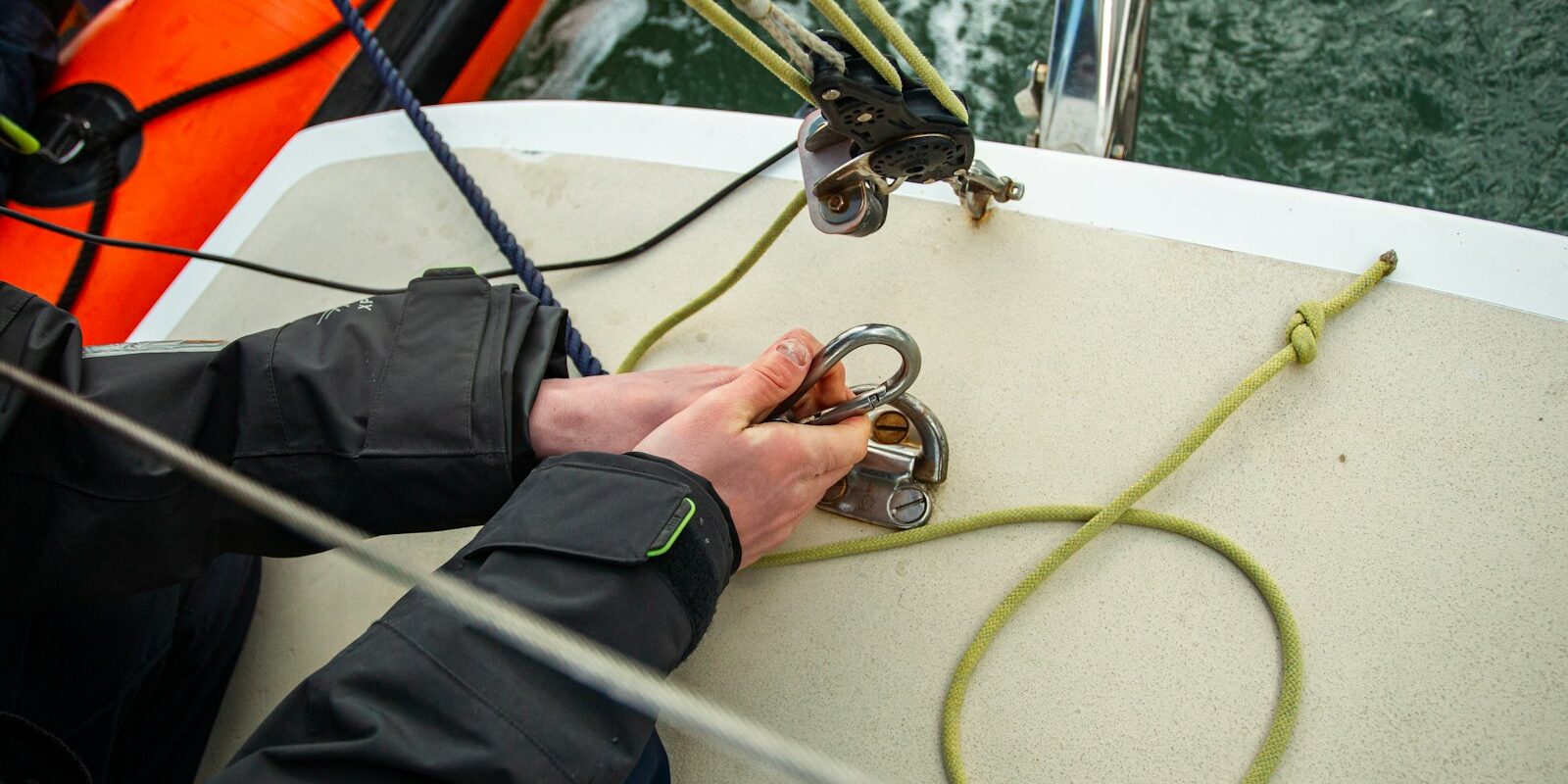
The most important clipping-on points are at the companionway, at the helm, at the winches and at the mast. Ideally you clip on before you come on deck from the companionway, and unclip only when you are below. For this you need a solid attachment point directly at the companionway.
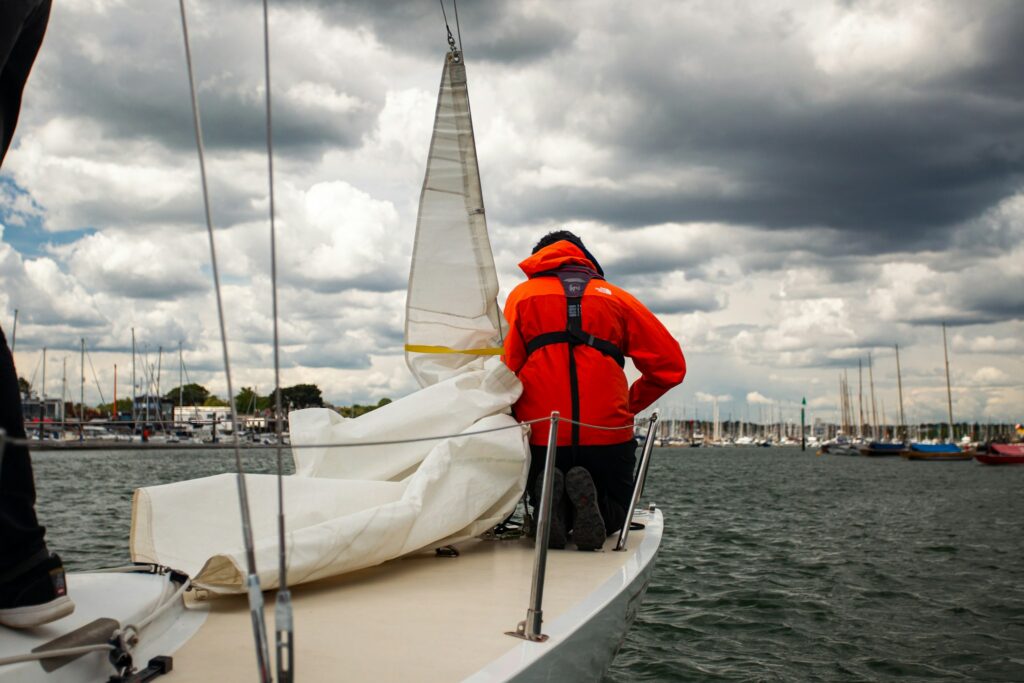
The attachment points at the helm and winches secure you whilst working in the cockpit; the point at the mast when reefing. On racing yachts, there must be enough attachment points for two-thirds of the crew to be secured simultaneously without using the jackstays. On a heeling boat, clip in on the windward side wherever possible. A fall will then take you across the deck rather than to leeward over the guardrails.
Make sure the hook cannot jam under a cleat or other fitting. If a hook is loaded sideways rather than in line, it can bend and open. The hook should therefore be able to rotate freely in the direction of load.
How long should a safety line be?
A safety line to ISO 12401 is no more than 2 metres long. For exposed positions such as the foredeck, a shorter line of about 1 metre is more sensible.
In offshore racing, either a short line up to 1 metre or a 2-metre line with an additional intermediate hook is mandatory, hooks included in the measurement. Lines with two or three hooks are common: one long leg for the cockpit, one short for working forward. With two hooks, you can also clip round an obstacle, such as the mast, without being unsecured even for a moment.
Elastic lines contract when not under load. This reduces the tripping hazard from loose line in the cockpit. When stretched, they usually reach about 2 metres, so they should be attached as close to amidships as possible.
Which hooks and karabiners are safe?
Self-closing hooks that can only be opened with a deliberate action are safe. Hooks on lines to ISO 12401 are designed and tested so that they will not open accidentally.
Many lines also have an overload indicator: a sewn-in marker that becomes visible after a hard jerk or a fall. If it has been triggered, the line is replaced. Some lines also have a hook that can be released even when the line is under load. Which features suit you depends on the boat and the use.
Do not replace the hooks with arbitrary karabiners. Under ISO 12401, the line is tested together with its hooks.
When should you clip in?
You should clip in whenever you are working on deck, at night and in rough weather. In these three situations, the risk of going overboard is particularly high.
A clear boat rule, set by the skipper before departure and applying to everyone, is sensible. Common points are:
- always clipped in on deck at night,
- in strong winds and seas from the moment you leave the companionway,
- during any work on the foredeck or at the mast, such as sail changes,
- on many yachts, also when on watch alone in the cockpit if no one else is on deck.
A fixed rule takes the decision away from you at the wrong moment. Especially on long passages with night watches, such as on a mile-building trip, clipping in becomes routine.
Which standards apply to lifebelt and lifejacket?
Lifebelt and safety line should comply with standard ISO 12401, adopted in Europe as EN ISO 12401. For lifejackets, the ISO 12402 series of standards applies.
The Standard ISO 12401 sets out requirements and test procedures for safety harnesses and safety lines on recreational craft. It distinguishes three size classes by body weight. Trapeze harnesses from dinghies and windsurfing harnesses are not covered, nor are fall arrest devices for working at height. The current version dates from 2009; a revised version is in preparation (as at October 2026). The older standard EN 1095 is obsolete.
For lifejackets with built-in lifebelt, look for both standards: ISO 12402 for the jacket and ISO 12401 for the harness. For offshore racing, an automatic jacket to ISO 12402-3 with 150 newtons of buoyancy (Level 150) is required, plus crotch or leg straps to prevent the jacket riding up in the water. The detailed rules are in the Offshore Special Regulations from World Sailing.
How do you maintain and inspect jackstay and lifeline?
Inspect jackstay, lifeline and lifebelt before each season and before each trip for chafe, loose stitching and properly closing hooks. Webbing made of synthetic fibre ages through sunlight and should not be left on deck permanently.
- Webbing and stitching: Frayed edges, faded or stiff areas and broken stitching are warning signs. When in doubt, replace.
- Hooks: They must open easily and close securely of their own accord. Replace bent hooks or hooks with play.
- Overload indicator: If it is visible, the line is worn out.
- After the trip: Rinse line and harness with fresh water (if necessary with a mild soap solution), dry thoroughly and store in a dark place.
- Used boat: Better to replace jacklines of unknown age.
Lifebelt for children: what is different?
Children need a lifebelt and a life jacket in their size. ISO 12401 provides size classes according to body weight. For small children, a short line with just one hook that remains permanently attached to the jacket is suitable.
Single-hook lines are particularly suitable for children who cannot yet clip and unclip themselves. An adult then sets the hook, at a fixed point in the cockpit. More about equipment and life on board with young crew can be found in the article Sailing with children.
Frequently asked questions
What is the nautical term for the line to hold on to in heavy weather?
The line stretched along the deck is called a Strecktau, in English a jackline. The short line between lifebelt and boat is called a safety line or lifeline.
May I clip on to the guardrail?
No. The guardrail is not built for the loads from a safety line. Clip on to the jackline or to fixed attachment points.
Is a lifebelt integrated into the life jacket just as good as a separate harness?
Yes, if it complies with ISO 12401 and the jacket is correctly adjusted. Look for the marking of both standards on the jacket.
How often should I replace a jackline made of webbing?
There is no fixed interval. The condition is what matters: sun and chafing weaken the webbing. Replace it if it shows wear, has an unknown age or has been heavily loaded.
Is a line with just one hook sufficient?
For the cockpit or for small children, yes. Anyone going forward on deck is better served with two hooks, as they can clip around obstacles without detaching themselves.
Safe on passage: trips for practising
The best way to learn how to use jacklines and lifebelts is at sea, with an experienced crew and under real conditions. On Törnfinder you will find Skipper training, in which seamanship and safety on deck are the focus, and Mile building with night passages and a watch system. Anyone who wants to experience sea conditions and wind in a challenging sailing area will also find it in Sailing in the North Sea .