Symbolic image
This page was translated automatically from German. View the original
Water ingress in the North Sea, engine out, wind up to Force 7: on Tuesday 20 October 2026, the sea rescuers of the DGzRS took a historic gaff ketch under tow around 15 nautical miles offshore and brought her safely to Cuxhaven. The operation shows what matters when delivering at the end of the season.
The essentials at a glance
- A 14.5-metre gaff ketch, built as a fishing cutter in 1938, was on delivery from Föhr to Hamburg when the engine failed completely and water began entering at around 5 p.m.
- The lifeboats HERMANN MARWEDE and ANNELIESE KRAMER brought the vessel into Cuxhaven marina with their daughter boats; the skipper remained safe and well.
- En route, two of the three bilge pumps failed; an additional pump from the sea rescuers kept the water under control.
- For owners and crews this means: check pumps including power supply, seacocks and weather conditions before every delivery, and inform the Maritime Rescue Coordination Centre early if problems arise.
What happened during the water ingress in the North Sea?
The skipper was delivering the historic cutter from the island of Föhr towards Hamburg. Around 15 nautical miles — about 28 kilometres — from the mainland, the engine failed completely at around 5 p.m. Water was also entering the hull.
The vessel had already been taking on some water earlier. The skipper had therefore been running the bilge pumps via the emergency power supply. In the afternoon he alerted the Maritime Rescue Coordination Centre, the MRCC Bremen of the German Maritime Search and Rescue Service (DGzRS).
A lifeboat was already nearby
The 46-metre HERMANN MARWEDE from Helgoland station was on the return leg of a supply run to Cuxhaven and was sailing through the sea area. She reached the casualty after about 20 minutes and established a tow. Then it was off towards Cuxhaven.
Two pumps fail under tow
After about two hours under tow, two of the three bilge pumps failed. The water rose quickly to the floorboards. The sea rescuers launched their daughter boat VERENA. She brought over a powerful bilge pump and a power cable, keeping the water level in the hull manageable. With a second line, VERENA also helped to steer the casualty.
Outside the wind was blowing up to Force 7 Beaufort, that is up to 61 kilometres per hour. The waves reached heights of three metres at times.
Handover off Cuxhaven
At around 7.20 p.m. the daughter boat of the lifeboat ANNELIESE KRAMER, stationed in Cuxhaven, took over the tow. The two daughter boats finally made the gaff ketch fast in Cuxhaven marina. Vessel and skipper arrived safe and well. The DGzRS published the full operation report in their announcement of 21 October 2026 .
Why are autumn deliveries particularly demanding?
At the end of the season many boats are on their way to winter storage or to their home harbour, whilst the days are getting shorter and the water colder. A delivery also often has a fixed deadline, such as a crane appointment, and leads across open stretches such as here off the North Sea coast.
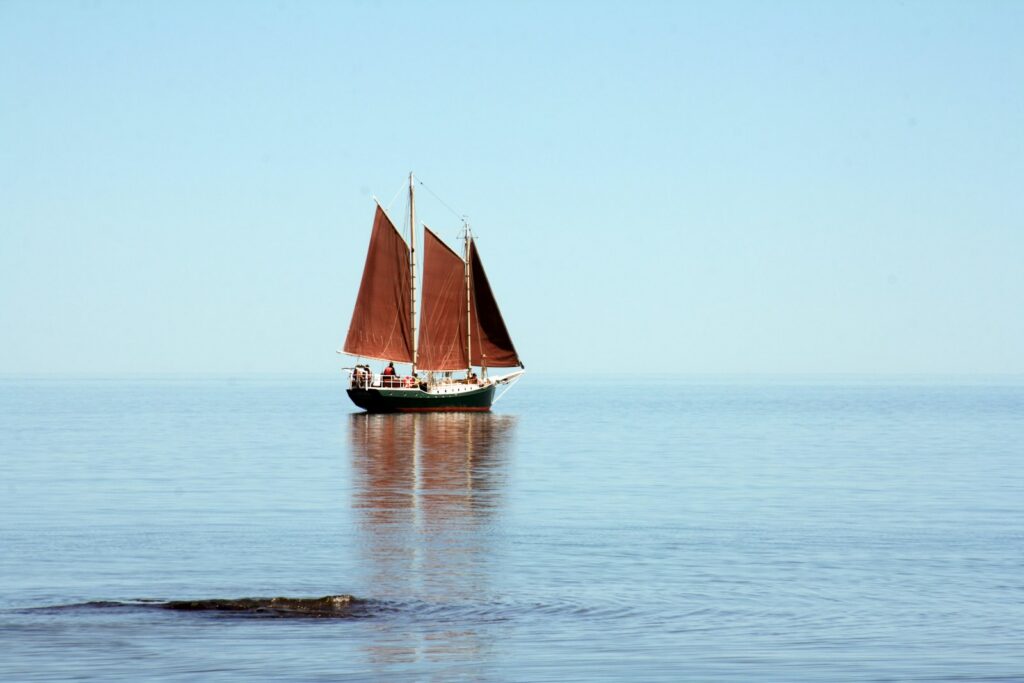
Symbolic image
What caused the engine failure and water ingress in this case is not known. Regardless of that, the same applies to every boat, whether an old wooden cutter or a modern yacht: after a long season a thorough check is worthwhile before setting off on another longer passage.
What owners and crews can take from this
The most important precaution happens in harbour: check pumps, seacocks, batteries and weather before the lines are cast off. The DGzRS provides a checklist for this on its page Safety when sailing .
Testing bilge pumps and their power supply
Before a delivery trip, switch on each electric bilge pump once and check that it actually pumps water. Also check the state of charge of the batteries and the connections, because an electric pump is only as good as its power supply. Especially if the engine fails, nothing recharges. A bilge alarm alerts you to rising water early, even when no one is below deck.
A manual bilge pump as backup
The DGzRS checklists explicitly name both: the electric and the manual bilge pump. A hand pump works without electricity and therefore remains usable when batteries are weak or cables get wet. Check that the handle is on board, that the pump draws and that the intake is clear.
Checking seacocks and stern gland
Every seacock should turn easily and close tightly. The crew should know where the seacocks are located. On boats with an inboard engine, the propeller shaft seal is part of this: check for leakage and tighten the stuffing box if necessary. A quick look in the bilge before casting off shows whether the boat is already taking on water in the harbour.
Inspecting the engine before the end-of-season trip
Engine failure often has simple causes such as empty tanks, weak batteries or damaged lines. Fuel level, filters, oil level and cooling therefore belong to every longer passage. A sufficiently long towline on board makes it easier if someone does need to help.
Taking the weather forecast seriously
Check the forecast for the entire sailing area and the planned period, not just for the departure harbour. For the North Sea and Baltic Sea, the German Weather Service issues its own shipping forecast. How to read it is explained in our article Reading and understanding the sea weather report. Better to deliver a day later than with a tight schedule against freshening wind.
Calling early rather than waiting too long
The DGzRS expressly asks you to call when a problem could become dangerous, not only when in acute danger. Anyone who gives their position early gains time, and the operations centre can dispatch the nearest available unit. When in doubt: better to call once too early.
The Maritime Rescue Coordination Centre can be reached via these emergency contact methods (as at October 2026): VHF channel 16 with the call sign "Bremen Rescue", the digital distress alert via DSC on channel 70, and round the clock by telephone on +49 421 536870. In German mobile networks, the short dial 124 124 also works at sea and near the coast. It is a service number of the network operators, not an official emergency number. The VHF radio remains the most important method. Enter departure, destination and times in the Logbuch , then you have the details quickly to hand in an emergency.
North Sea trips on Törnfinder
Anyone who would like to sail the North Sea, whether as crew or for mile building, will find suitable offers on the Sailing in the North Seapage. An overview of all sailing areas and dates is given by the trip search.
Frequently asked questions
Who is responsible for maritime emergencies in the North Sea and Baltic Sea?
The DGzRS with its Maritime Rescue Coordination Centre, MRCC Bremen. It coordinates the search and rescue service in the German areas of the North Sea and Baltic Sea and is manned round the clock.
How do I reach the sea rescuers by radio?
Via VHF channel 16, call sign "Bremen Rescue", or by DSC alert on channel 70. The coordination centre keeps a continuous listening watch on channel 16.
Does 124 124 work everywhere?
No. The short dial only works in German mobile networks and only at sea or near the coast. It does not replace a VHF radio.
Why does a manual bilge pump belong on board?
Because it works without electricity. If engine or batteries fail, it remains the backup when electric pumps no longer run.