
This page was translated automatically from German. View the original
When anchoring a sailing boat, the rule of thumb is to pay out at least three times the water depth in chain and five times in rope, and more if there is more wind or current. Whether the anchor holds then depends above all on the holding ground, on setting the anchor properly, and on a crew that keeps an eye on position and weather (as of November 2026).
The essentials at a glance
- Rule of thumb: at least 3 times the water depth in chain, at least 5 times in rope. At 5 metres, that means 15 metres of chain or 25 metres of rope.
- Good holding ground is sand, silt or soft clay. Stones, weed and very soft mud hold poorly.
- At anchor, a yacht under 50 metres shows an all-round white light at night and a black ball in the fore part of the vessel by day.
- On the Spanish Mediterranean coast and in the Balearic Islands, anchoring on seagrass meadows is prohibited in principle, and the chain must not touch the meadows either.
- The anchor is holding if the chain does not snatch and the bearings to landmarks do not change.
How much chain when anchoring? The rule of thumb
With all-chain rode, you pay out at least three times the water depth; with an anchor rope, at least five times. These values from German recreational boat training are enough for calm weather. More chain is better as long as there is enough room to swing; in British sailing training, four and six times respectively is already standard in normal conditions.
Chain is heavy and lies largely on the bottom. This makes the boat pull at a shallow angle on the anchor, so the anchor digs in rather than breaking out. A rope is light and rises more steeply to the bow, which is why it needs more length. If you use a rope, add a chain leader of 3 to 5 metres between the anchor and the rope.
If the wind picks up, pay out more chain. If there is no room for this, for example in a narrow bay, an anchor weight (kellet) helps: it is lowered down the chain or rope, pulls it towards the bottom and dampens snatching. In tidal waters, you calculate with the depth at high water. How to work out the depth at any given time is explained in the article on Tides, tidal range and water depth.
| Water depth | Chain (3x) | Rope (5x) |
|---|---|---|
| 3 m | 9 m | 15 m |
| 5 m | 15 m | 25 m |
| 8 m | 24 m | 40 m |
| 10 m | 30 m | 50 m |
| 15 m | 45 m | 75 m |
These values apply to calm conditions. In more wind, current or swell, pay out more.
Which holding ground holds well?
Sand, silt, soft clay and loam hold well with the usual lightweight anchors. Hard clay and loam are only moderately suitable; avoid stones, weed and very muddy bottoms.
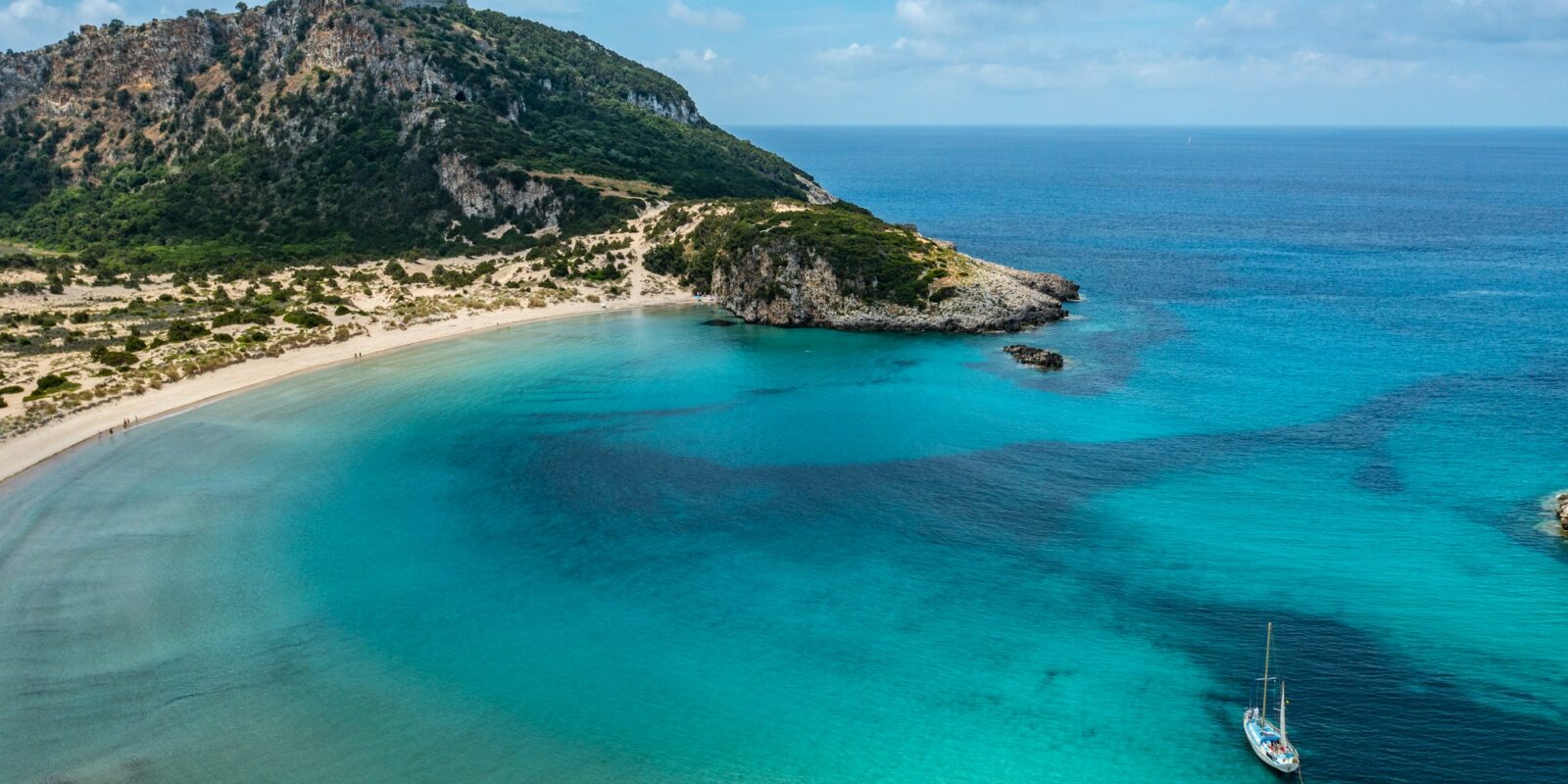
In clear water you can recognise the seabed by its colour: light water usually lies over sand, while dark patches indicate vegetation or rocks. The chart also shows the nature of the seabed, so check it when planning.
We have covered which anchor types exist and which one suits which seabed in the article Ground tackle: anchor types, chain and line .
Seagrass and Posidonia: where anchoring is prohibited
On the entire Spanish Mediterranean coast and in the Balearic Islands, anchoring on seagrass meadows is prohibited in principle. This applies to Posidonia and to the smaller seagrass Cymodocea. The meadows grow very slowly and are protected as a habitat. The ban does not apply only to the anchor: you must not anchor even on sand next to a meadow if the chain lies on the seagrass or sweeps across it as you swing. Where mooring buoy fields have been set up, you pick up the buoys or anchor only on the designated sandy areas. A map of the seagrass meadows and buoy fields in the Balearic Islands is provided by the Balearic government . Violations are punished as administrative offences.
In German federal waterways, anchoring is prohibited, among other places, in the fairway, at narrows, in front of harbour entrances and locks, and within 300 metres of wrecks, cables and pipelines.
Anchoring a sailing boat: how does the manoeuvre work?
An anchoring manoeuvre consists of planning, a slow approach into the wind or current, dropping the anchor while making gentle sternway, and checking afterwards.
- Choose the anchorage on the chart: sheltered from wind and swell, suitable depth, good holding ground and enough room to swing, that is, to turn around the anchor.
- Determine the wind and current direction, and get the ground tackle and anchor signal ready.
- Approach the anchorage at the slowest speed into the wind or current and bring the boat to a stop.
- While making gentle sternway over the ground, let the anchor go and pay out the chain.
- Hoist the anchor ball or switch on the anchor light, note your position and take bearings, that is, the compass direction to prominent landmarks.
Never throw the anchor overboard together with the line. The line can wrap around the anchor, and then it won't dig in.
Setting the anchor: how to tell that it is holding
Once the chain is out, you check by going gently astern whether the anchor digs in and the boat stays put. If you rest a hand on the chain, you will feel no jerking or vibrating when the anchor is holding. You also take bearings on two landmarks or a neighbouring boat: if the bearings stay the same, the anchor is holding.
How big is the swinging circle?
Your boat swings around the anchor, and the circle is almost as large as the length of chain paid out plus the length of the boat. With 30 metres of chain and a 12-metre boat, that is a radius of a good 40 metres.
That is why you keep your distance from other anchored boats and from the shore, including on the side towards which the wind might shift. Boats lying to a line swing differently from boats lying to a chain. An anchor buoy above the anchor shows others where your anchor is, and its trip line makes it easier to free a fouled anchor.
Anchor ball and anchor light: what is required?
By day, you show a black ball in the fore part of the boat when at anchor, and at night a white all-round light where it can best be seen. This is laid down by the international Kollisionsverhütungsregeln – the rules of the road at sea.
For yachts under 50 metres, a single white all-round light is enough. Boats under 7 metres need neither a light nor a ball, as long as they are not anchored in or near a narrow channel or a roadstead (a designated anchorage off a harbour), or where other vessels normally pass. In restricted visibility, yachts under 20 metres at anchor may, instead of ringing a bell, sound another loud signal at least every two minutes. You can find more on all lights in the article on Navigation lights at sea.
Anchor watch and anchor alarm
Anchor watch means that someone regularly checks whether the boat is still in the same place and how the wind and weather are developing. On German federal waterways, it is compulsory if you anchor near a fairway or in a roadstead. Boats under 12 metres are exempt in some designated areas.
An anchor alarm on the chartplotter or in an app can help. You save the anchor position and a radius slightly larger than the swinging circle. If the boat leaves this circle, the alarm sounds. When the wind is freshening, at night or in crowded bays, someone should still stay awake and check bearings, distances and the weather.
What do crew members do when anchoring?
It is usual on board for one person to stand at the bow and one at the helm when anchoring. The person at the front lets the anchor and chain run out, calls out the length of chain paid out and reports when the anchor is holding.
Common commands are “Let go the anchor”, “Pay out chain” and, when weighing anchor, “Anchor's aweigh”. Many crews agree hand signals beforehand, for example an outstretched arm for the direction in which the chain is lying and a clenched fist for stop. Keep hands and feet away from the running chain and the windlass. The article on Tacking, gybing and commands.
Anchoring in thunderstorms and wind shifts
If the wind shifts, the boat swings round, and a sheltered bay can suddenly become exposed. So when choosing your anchorage, allow for possible wind shifts from the outset.
If a thunderstorm is approaching, pay out more chain in good time, provided there is room, and keep up the anchor watch. How to behave on board during a thunderstorm is explained in the article on Thunderstorms on a sailing boat.
Frequently asked questions
How much chain do I need to pay out when anchoring?
Pay out at least three times the water depth in chain, or at least five times the depth if you are using an anchor rope. In more wind, current or swell, you pay out more.
How can I tell that the anchor is holding?
The chain doesn't jerk or vibrate when you rest your hand on it, and the bearings to landmarks stay the same.
When do I need an anchor ball?
Always during the day when you are at anchor. Only boats under 7 metres are exempt, provided they are lying away from narrow fairways, roadsteads and usual shipping routes.
Can you anchor on seagrass in the Balearic Islands and in Spain?
No. On the Spanish Mediterranean coast and in the Balearic Islands, anchoring on seagrass meadows is prohibited as a matter of principle, and the chain must not touch the seagrass as the boat swings either. Anchor on sand with enough distance from the meadow, or pick up an authorised buoy. In mooring fields, only the buoys and the designated sand areas may be used, and in some protected areas anchoring is banned altogether.
Learning to anchor on a sailing trip
The best way to learn anchoring is in practice, with changing bays, seabeds and weather conditions. On Törnfinder you will find Sail trainingwhere you can practise anchoring manoeuvres, anchor watch and other seamanship under guidance.