This page was translated automatically from German. View the original
Tacking and gybing when sailing are the two manoeuvres by which a yacht changes the side on which the wind is coming from: when tacking the bow goes through the wind, when gybing the stern. Both manoeuvres have fixed commands, and everyone on board has a clear task: at the helm, on the jib sheet or on the mainsheet.
The essentials at a glance
- Tacking: The bow turns through the wind, usually from a close-hauled course. Gybing: The stern turns through the wind, usually from a broad reach.
- The tacking call is "Lee-oh": The helmsperson puts the helm over with this command, after the crew has answered "Ready about" to "Ready to tack?"
- When gybing, the commands are "Ready to gybe?" – "Ready" – "Haul in mainsheet" – "Gybe-oh". The mainsheet is hauled in beforehand because the boom slams across to the other side, and is then eased out again in a controlled manner.
- An unintentional gybe is called an accidental gybe. It can damage the rig and injure people; a preventer guards against this.
- In strong winds, a tack replaces the gybe: a broad turn through the wind instead of a slamming boom.
What is the difference between tacking and gybing?
Both manoeuvres bring the yacht onto the other tack, that is from starboard tack to port tack or vice versa. The difference is the direction of turn: when tacking the boat turns with the bow through the wind, when gybing with the stern.
You normally tack from a close-hauled course. The yacht luffs up, that is turns towards the wind, stands briefly with the bow directly into the wind and falls away again on the other side.
You gybe from a broad reach, that is when the wind is coming from diagonally behind. The yacht bears away, turning away from the wind, until the wind briefly comes from directly astern, and then turns with the stern through the wind. At this moment the mainsail and boom swing from one side to the other. When tacking the boom swings across gently, when gybing it can slam across with great force if no one is controlling it.
What sails there are on board and what they are called is explained in the article about the different sails on a sailing boat. Windward is the side the wind is coming from, leeward is the side facing away from the wind. Further terms can be found in our Sailing glossary. Sheets are the lines used to adjust the sails.
What commands are there for tacking and gybing?
The helmsman gives the commands, the crew confirms. The following overview shows the usual German commands on a cruising yacht.
| Command | Manoeuvres | What it means |
|---|---|---|
| "Klar zur Wende?" | Wende | Question to the crew: Please man the stations and prepare everything. |
| "Ist klar" | Tacking and gybing | Crew's answer: Everyone is ready. |
| "Ree" | Wende | The helm is put over, the bow turns through the wind. |
| "Über die Fock" | Tacking and gybing | The headsail is brought over to the new side. |
| "Klar zur Halse?" | Halse | Question to the crew: Please man the stations and prepare everything. |
| "Hol dicht Großschot" | Halse | Mainsail and boom are brought in to the centre. |
| "Rund achtern" | Halse | The stern turns through the wind, the boom swings to the other side. |
| "Fier auf Großschot" | Halse | The mainsheet is eased out in a controlled manner on the new tack. |
What is the call for tacking when sailing?
The call for tacking when sailing is "Ree" (sometimes written "Rhe"). Beforehand the helmsman asks "Klar zur Wende?", the crew answers "Ist klar". With "Ree" he puts the helm over, the bow goes through the wind. Afterwards often follows "Über die Fock" or "Über die Segel", then the headsail is brought over to the new side.
What do you call out when gybing?
When gybing, the helmsman asks "Klar zur Halse?", the crew answers "Ist klar". With "Hol dicht Großschot" the boom is brought in to the centre. "Rund achtern" corresponds to the tacking call: the helm is put over, the stern goes through the wind. Afterwards follow "Fier auf Großschot" and bringing the headsail over.
"Klar zur Wende?" and "Klar zur Halse?" are questions, not start signals: if no one answers with "Ist klar", the manoeuvre is not carried out. The commands vary slightly from boat to boat. Anyone new on board should best go through the procedures together once before casting off.
How does a tack work on a cruising yacht?
A tack follows three steps: announce and prepare, lay the helm with "Lee-oh", sheet in the headsail on the new side. On a cruising yacht there is usually nothing to do with the mainsail sheet during this.
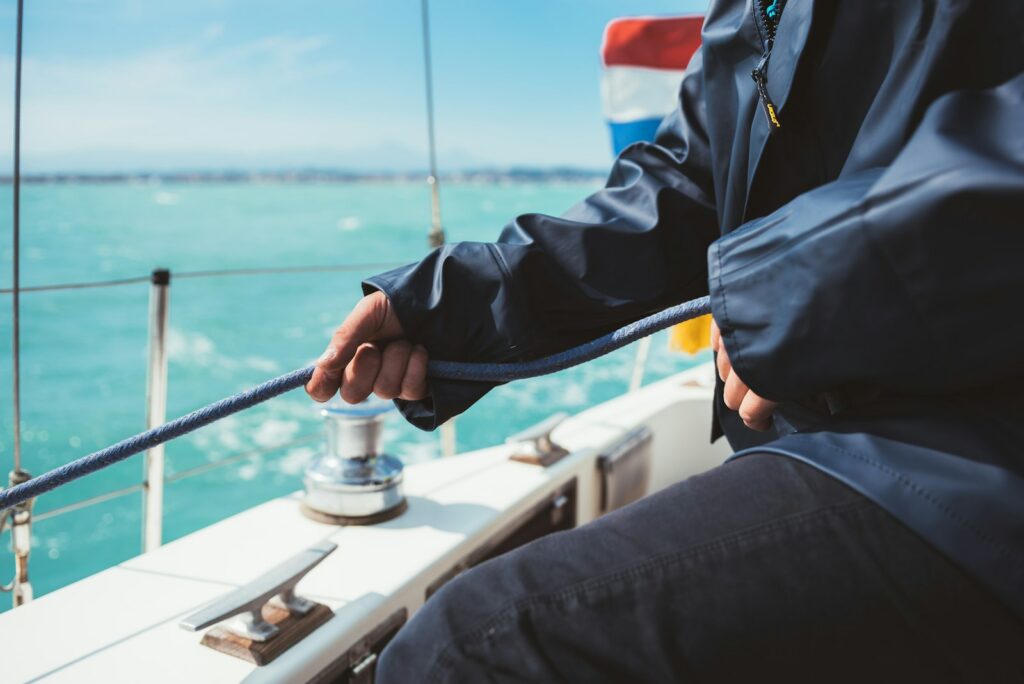
Preparing after "Ready about?"
At the jib sheet, i.e. the sheets of the jib or genoa, you prepare two things. The sheet that will be working after the tack is currently the slack sheet on the windward side. You put this round the winch two or three times clockwise and have the winch handle ready. You take the sheet that is still holding the sail now out of the cleat or off the cleat and hold it by hand on the winch. This way you can release it with one motion. Only when both are ready do you report "Ready".
After "Lee-oh"
The helmsman lays the helm, the yacht luffs up. The headsail begins to flutter, the bow goes through the wind. Now you release the old sheet and make sure it can run out freely and does not snag. On the other side you sheet in the new sheet briskly by hand whilst the sail still has little pressure. You haul in the rest with the winch handle. Anyone with nothing to do keeps their head down because the boom swings across the cockpit, and afterwards moves to the new high side.
After the tack
The yacht falls off onto the new close-hauled course. Once the headsail is trimmed, you cleat the sheet and tidy away the loose end so that nothing is in the way during the next manoeuvre.
How does a gybe work?
During a gybe the yacht bears away slowly until the wind is almost exactly from astern. Then the mainsail sheet is hauled in, with "Gybe-oh" the stern goes through the wind and the mainsail sheet is eased out again in a controlled manner on the new side. Finally the headsail is gybed over.
Preparing after "Ready to gybe?"
On a broad reach the boom stands far out. If it were to swing across from there to the other side it would have a long way to go and a lot of momentum. Therefore the crew at the mainsail sheet hauls the mainsail to the centreline after "Haul in the main" whilst the helmsman holds the course steady. Only when the boom is amidships comes "Gybe-oh".
After "Gybe-oh"
After "Gybe-oh" the boom goes to the other side. Now you ease the mainsail sheet in a controlled manner, i.e. do not simply let go, but let it run through the winch or the cleat without it surging through your hand. The helmsman applies counter-helm briefly, the so-called checking helm, so that the yacht does not round up into the wind. Head, hands and legs have no business being in the area of the boom and mainsail sheet during this phase.
After the gybe
During a gybe you only gybe the headsail over once the mainsail is set on the new side. Beforehand you keep it slightly sheeted in so that it does not wrap itself round the forestay whilst turning. Afterwards you release the old sheet and haul in the new one, as with the tack.
What is an accidental gybe and how do you avoid it?
An accidental gybe is an unintentional gybe: the stern goes through the wind without anyone having prepared for it, and the boom slams across to the other side with full force. This can damage the rig, make the yacht heel heavily and injure people on the head or legs.
An accidental gybe usually happens on a downwind course when the boat bears away too far unnoticed. Triggers are a wave that shifts the stern, a wind shift or counter-helm held too long after an intentional gybe. You can prevent this by the helmsman steering attentively on downwind courses and not sailing dead downwind but slightly higher. For everyone on board: on broad reaches do not stand or sit in the sweep of the boom.
What is a preventer?
A preventer is a line that holds the boom on its side on broad reaches so that it cannot swing over during an accidental gybe. It is attached to the boom well outboard and led forward on deck. Important for every intentional gybe: the preventer must be released beforehand, otherwise the boom cannot go to the other side.
It is not to be confused with the boom vang. That pulls the boom downwards and shapes the sail, but does not hold it laterally.
What is a chicken gybe?
A chicken gybe replaces the gybe with a tack. Instead of turning the stern through the wind, the yacht luffs up from a broad reach, tacks and bears away again on the new side.
It is sailed mainly in strong winds when a gybe would be too risky. When luffing up the sheets are hauled in, the boom is then near the centreline and goes calmly to the other side during the tack. An uncontrolled slam across as in a gybe does not occur. The price is a large arc and more time.
What mistakes happen most often during tacks and gybes?
Typical mistakes during tacks and gybes are these:
- Reporting "Ready" even though the new sheet is not yet on the winch.
- Releasing the old jib sheet too early, before the bow is through the wind. Then the yacht loses speed and stops with the bow head to wind.
- Releasing the old jib sheet too late. Then the headsail is aback, i.e. on the wrong side, and pushes the bow round.
- During a gybe not hauling in the mainsail sheet or simply letting go after "Gybe-oh".
- Putting the helm down too hard during the gybe. The yacht heels sharply and shoots into the wind.
It helps to practise the manoeuvres several times in a row in light winds until everyone knows their tasks.
Where you can practise tacking and gybing in real conditions
Tacking and gybing are best learnt on board, with a skipper who explains the procedures and lets you work at all stations. On Törnfinder you'll find sail trainingwhere manoeuvres are deliberately practised, and Skipper training for anyone who wants to give the commands themselves. For preparation at home, the magazine also offers a book with basic knowledge for sailing crew .
Frequently asked questions
Is gybing more dangerous than tacking?
Yes, because during a gybe the boom swings across the full width of the boat and has considerable force in wind. But with the mainsheet hauled in and clear commands, it's a normal manoeuvre.
What's the difference between a gybe and an accidental gybe?
A gybe is a planned manoeuvre with warning and controlled boom. An accidental gybe happens unintentionally, without preparation, and the boom swings across uncontrolled.
As crew, do I need to know the commands?
Yes, at least the most important ones: "Ready about?", "Lee-oh", "Ready to gybe?" and "Gybe-oh". Then you'll know what's happening during each manoeuvre and when you're needed on the sheet.