
Delivery Trip: North Sea Sailing Trip Scotland – Netherlands
 Seehase

This page was translated automatically from German. View the original
Delivery Trip from Edinburgh to Rotterdam (400 nm)
From Edinburgh we set a course south, along the Scottish coast and across the North Sea towards Rotterdam. Wind, weather and tides will ultimately determine our route, but we plan to complete the crossing in manageable stages. Along the way we combine beautiful coastal scenery and cosy harbours with a genuine offshore crossing. We sail day and night, gaining practical experience in navigation, tidal knowledge and handling busy shipping lanes.
Past Bass Rock and along the Scottish coast
When leaving the Firth of Forth, we will sail close past Bass Rock, provided the route and conditions allow. This striking white rock in the sea is home to thousands of gannets. It is an impressive sight to watch the birds circling above the rock and plunging into the water. A very special start to our voyage.
Depending on wind and tides, we will then look for a suitable anchorage or continue sailing along the coast. We may be able to anchor near Lindisfarne, also known as Holy Island. This special island off the coast of Northumberland is known for its historic monastery ruins and rugged coastal scenery. Lindisfarne gained a dubious reputation in 793, when the Vikings raided the island – one of the earliest documented Viking attacks on England.
Whether we can go ashore depends on the tides, the anchoring options and the time available. Currents and tides play an important role on this stretch of coast, which is why careful route planning is essential.
On the first day we do not normally sail straight through the night. This gives everyone time to get used to the yacht, the crew and life on board. Whether we can anchor or carry on sailing also depends, of course, on the weather and the options along the coast.
Whitby: a cosy English harbour town
If wind and tides play along, we sail on to Whitby, one of the prettiest harbour towns on the English east coast. The harbour, the narrow lanes and the old fishermen's houses give the town its special character. High above the town lie the ruins of Whitby Abbey, which can be reached via the famous flight of 199 steps. From the top there is a magnificent view over the harbour and the North Sea.
We plan to stay here for a day to explore the town and its surroundings, stock up on provisions and prepare for the long crossing to the Netherlands. It is a lovely opportunity to go ashore once more before we head back out onto the busy North Sea.
Across the North Sea: two nights at sea
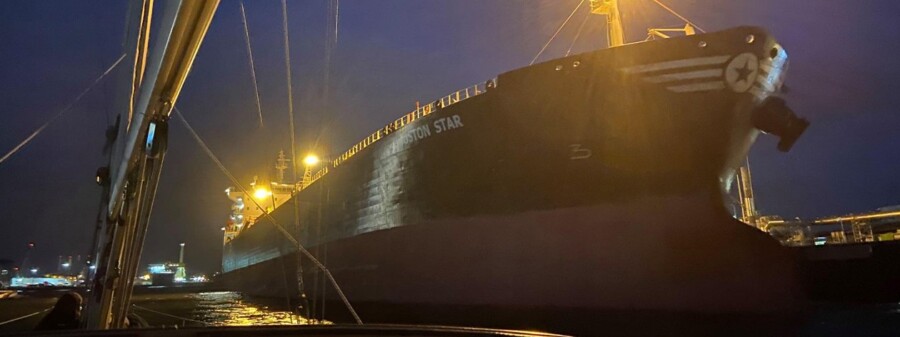
From Whitby we begin a passage of about 230 nautical miles towards the Netherlands. We sail along heavily used shipping routes, past offshore installations and wind farms. The closer we get to the Dutch coast, the denser the shipping traffic becomes. Large cargo ships, fishing vessels and other commercial vessels demand constant attention and careful navigation.
During this crossing we sail through two nights. We use a three-watch system: three hours on watch, followed by six hours of rest. This leaves enough time for sleep, and the crew is alert when the next watch begins. Especially on cold night watches, it is reassuring to know that a longer rest period follows.
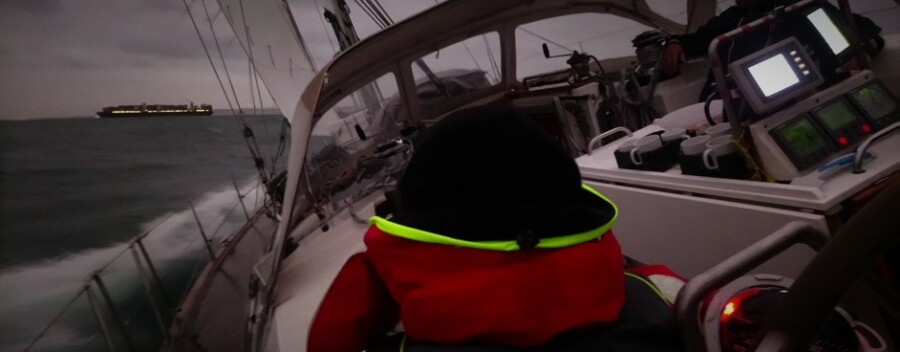
While on watch we keep a careful lookout, observe the shipping traffic and use radar and AIS to build as accurate a picture as possible of the surrounding vessels. The navigation lights also play an important role. In the dark we learn to recognise ships by their lights and to judge their direction of travel. This is valuable practical experience for anyone who wants to feel more confident when sailing offshore.
The approach to Rotterdam
The final leg takes us to the Dutch coast and finally to Rotterdam. Here the character of the voyage changes once again. The open North Sea gives way to one of the busiest shipping areas in Europe, with large seagoing vessels entering and leaving the Port of Rotterdam.
Via the approach and the Nieuwe Waterweg we sail between the commercial vessels towards the city. Shipping traffic is coordinated through various VHF traffic sectors. It is therefore important to follow the correct traffic information and to keep a close eye on your own position. Especially on a night-time approach, this is an impressive experience and valuable practice in navigation, lookout and radio communication.
Further inland, the modern skyline of Rotterdam gradually appears. We pass beneath the Erasmus Bridge and head for our home port. There we let this sailing voyage – and our season – come to a close with a relaxed dinner ashore.
This sailing voyage combines the adventure of a North Sea crossing with the charm of the Scottish and English coasts. You will experience life on board over several days at sea, learn how to deal with heavy shipping traffic and tides, and discover special places such as Bass Rock and Whitby. The impressive approach to Rotterdam is the perfect finale to this varied sailing voyage.
The route and the daily stages depend on wind, weather and tides. The itinerary is therefore a guide; if conditions require it, we may deviate from it.
Map from OpenStreetMap. When the map is displayed, data is transmitted to the provider.
More InformationMap from OpenStreetMap. When the map is displayed, data is transmitted to the provider.
More InformationBavaria one off
50 feet