This page was translated automatically from German. View the original
Rotterdam lies on the Nieuwe Maas, which flows into the North Sea at Hoek van Holland, and visiting yachts moor right in the city centre at the Veerhaven and the Haringvliet. Here you can read how to get to the start of your sailing trip, where the marinas in Rotterdam are, where to park and shop, what the sailing weather is like, which sailing destinations are nearby and what skippers need to know about harbour rules, bridges and sea weather in the Port of Rotterdam.
The essentials at a glance
- From Schiphol Airport, the Intercity direct takes 26 minutes to reach Rotterdam Centraal. From the smaller Rotterdam The Hague Airport, bus 33 gets you to the main station in about 30 minutes.
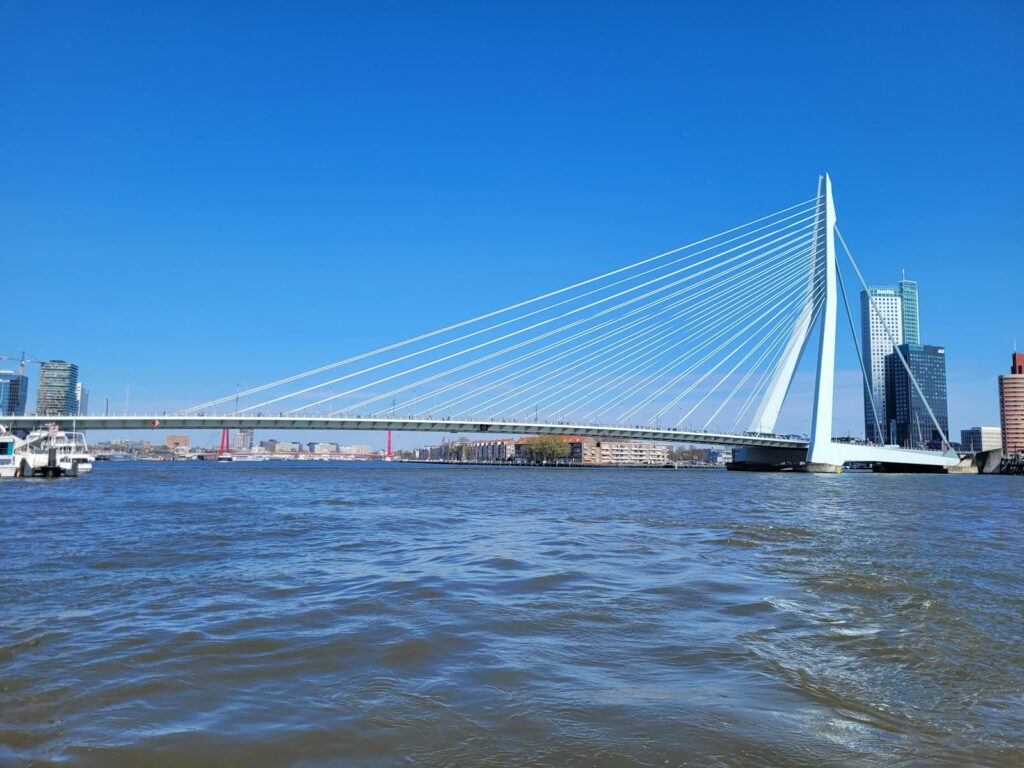
- The Veerhaven lies directly on the Nieuwe Maas in the Scheepvaartkwartier, west of the Erasmus Bridge. The Haringvliet is in the east of the city centre next to the Oude Haven and can only be reached from the Nieuwe Maas via two bridges.
- The nearest supermarket is about 250 metres from the Haringvliet and about 1 kilometre from the Veerhaven. The nearest public car park at the Veerhaven is about 800 metres away.
- The Nieuwe Maas is a tidal river with constantly changing water levels and current. Off the Veerhaven, the ebb or flood stream runs at up to 1.5 knots.
Where are the marinas in Rotterdam?
Visiting yachts moor at two places in Rotterdam: in the Veerhaven on the north bank of the Nieuwe Maas, a short distance west of the Erasmus Bridge, and in the Haringvliet, just under 2 kilometres as the crow flies further east in the old harbour district next to the Oude Haven. The Veerhaven has an open entrance directly from the river, whereas to reach the Haringvliet from the Nieuwe Maas you have to pass through the Boerengatbrug and the Oostbrug.
Map from OpenStreetMap. When the map is displayed, data is transmitted to the provider.
More Information| Feature | Veerhaven | Haringvliet |
|---|---|---|
| Location | North bank of the Nieuwe Maas, Scheepvaartkwartier | City centre east, next to the Oude Haven |
| Access | directly from the Nieuwe Maas, no bridges or locks from the sea | through Boerengatbrug and Oostbrug, 30 minutes' advance notice |
| Visitor berthing fees | €3 per metre of boat length per day | €2.50 per metre per night |
| Login | Form on the harbour website or by phone on +31 6 2435 1927 | Reservation via the harbour master, phone +31 6 5266 3289 |
| Operator | Stichting Veerhaven Rotterdam | Stichting Erfgoedhavens Rotterdam |
The other city-centre harbours between Leuvehaven and Buizengat are mainly home to historic working vessels and permanent berth holders.
Arriving for the start of your sailing trip in Rotterdam
Rotterdam has its own airport and is quickly reached by train from Schiphol. In the city, buses, trams, the metro and a fast ferry run by the RET transport company are available.
From the airport to the marinas
The main international airport is Amsterdam Schiphol. The Intercity direct runs from Schiphol Airport to Rotterdam Centraal in 26 minutes. On this route you need the Intercity direct supplement in addition to your normal ticket.
From Rotterdam The Hague Airport, RET bus 33 runs directly to the main station, Rotterdam Centraal, and you will be there in about 30 minutes. Alternatively, you can board metro line E at the Meijersplein stop. Taxis wait right next to the airport building.
From the main station, you can continue into the city centre by taxi, tram or metro. The largest taxi rank is to the left of Rotterdam Centraal station.
By car, train or bus
From The Hague, Metro line E takes you to Rotterdam Centraal in around 35 minutes. On buses, trams and the metro, you can check in and out contactlessly with a bank card, credit card or mobile phone. This payment method only applies to second class without a discount.
For your sat nav: the Veerhaven is at Veerkade 15, and the Erfgoedhavens office is at Haringvliet 68.
Parking
In Rotterdam's paid parking zones, you pay by licence plate via a parking app or at the pay machine; you do not place a ticket behind the windscreen.
The nearest public car park to the Veerhaven is on the Baden Powelllaan, about 800 metres to the west.
Showers and sanitary facilities
Both harbours have toilets, showers, and a washing machine and tumble dryer. In the Veerhaven, a hot shower costs €0.50, and a load of washing or a drying cycle costs €4.
Shopping for the trip
From the Haringvliet, it is about 250 metres to the nearest Albert Heijn, about 450 metres to a Dirk and about 500 metres to a Lidl. From the Veerhaven, it is about 1 kilometre as the crow flies to the nearest Albert Heijn and about 1.1 kilometres to a Dirk, both in the city centre north of the harbour. Other supermarkets, including a Jumbo and an Aldi, are on the south side of the Maas, about 1.3 and 1.8 kilometres away as the crow flies. The best way to get there is by car or by bike over the bridges.
Doctor, pharmacy and emergency services
The nearest pharmacy to the Veerhaven is the Apotheek Vasteland, about 500 metres away, and the GP practice Jans Huisartsen is right next door. From the Haringvliet, it is about 500 metres to the Apotheek Spanhoff and also about 500 metres to the GP practice Huisartspraktijk De Stadsdriehoek. The Erasmus MC hospital is about 700 metres north-west of the Veerhaven as the crow flies.
- 112: emergency number for ambulance, fire brigade and police.
- On the water: VHF channel 16 or DSC on channel 70, the Dutch coastguard (Kustwacht); by telephone in an emergency on +31 88 958 4040.
- For nautical problems in the port area, you can ask the traffic centres of the Havenbedrijf Rotterdam for help or a berth on VHF channel 11, or by telephone: Rotterdam Traffic Centre +31 10 252 2601 or Hoek van Holland Traffic Centre +31 10 252 2801.
Where is the Veerhaven?
The Veerhaven is on the north bank of the Nieuwe Maas in the Scheepvaartkwartier, with its museums, restaurants and terraces. The city centre is only a few minutes' walk away. Visiting yachts moor in the basin directly in front of the Bureau Veerhaven, a floating harbour office.
The harbour was dug between 1852 and 1854. From 1909, it was the marina of the Royal Rowing and Sailing Association “De Maas”, and since 1990 it has been run by the Stichting Veerhaven Rotterdam. The foundation maintains the harbour as part of the city's maritime heritage, and it is the home port of historic seagoing sailing ships. Around 1910, the Bureau Veerhaven was a watch house of the Rotterdam river police.
Facilities at the Veerhaven
Drinking water is included in the mooring fee, with taps on the pontoons. Shore power costs €4 per day at 230 volts and 16 amps, and €8 per day at 380 volts and 32 amps. The mooring fee is €3 per metre of boat length per day (as of November 2026). You pay at the harbour master's office or via the iMarina QR code next to the harbour office.
Depending on how busy the harbour is, vessels up to 20 or 25 metres in length can turn in the harbour. The harbour office is staffed daily from 9 am to 6 pm in July and August, with shorter hours in the shoulder seasons. From November to March, it opens irregularly and by arrangement.
Where is the Haringvliet?
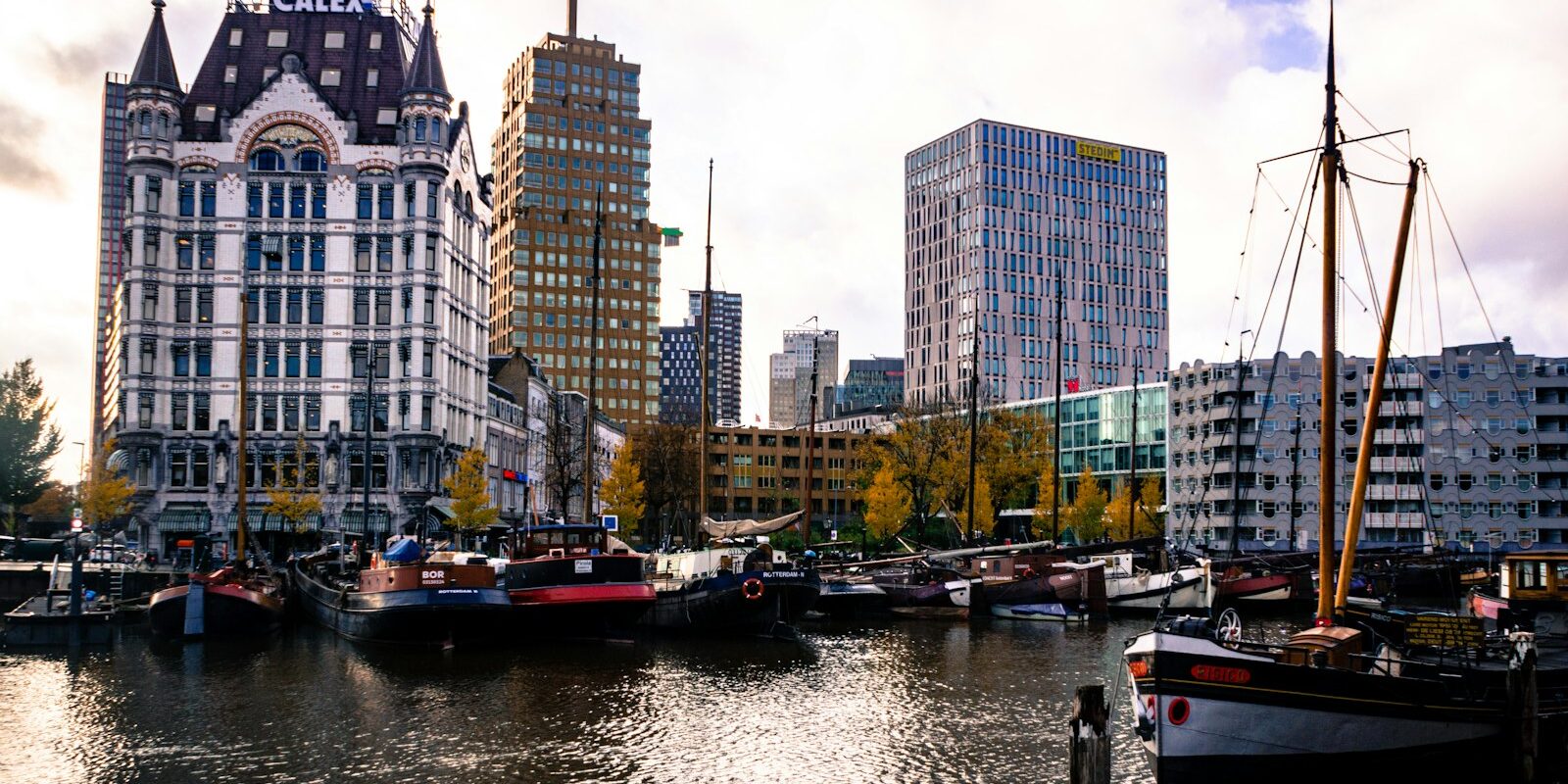
The Haringvliet is an old harbour basin in the east of the city centre, right next to the Oude Haven, Rotterdam's oldest harbour, with the Witte Huis. There are more than 20 bars and restaurants around the Oude Haven.
The Haringvliet is one of the city-centre harbours of the Stichting Erfgoedhavens Rotterdam, which stretch from the Schiedamsedijk to the Oostmaaslaan. The Haringvliet has visitor berths for leisure boats, both historic and modern. By arrangement with the harbour master, historic vessels can also get a visitor berth in the other harbours.
Facilities at the Haringvliet
The visitor berths have electricity, drinking water, Wi-Fi, showers and toilets, as well as a washing machine and tumble dryer. The mooring fee is €2.50 per metre per night (as of November 2026); separate arrangements apply for longer stays. The Erfgoedhavens office at Haringvliet 68 is staffed Monday to Friday from 9 am to 5 pm.
On the way into the Haringvliet, you pass the Boerengatbrug and the Oostbrug. Both require 30 minutes' advance notice via VHF channel 20 or by telephone on +31 10 411 3772.
What is the weather like for sailing in Rotterdam?
In the winter half of the year, from October to March, the wind in the Netherlands blows most often from the southwest.
For the Hoek van Holland coastal area off the mouth of the Maas, the Dutch weather service KNMI issues a wind warning from Beaufort 6. It reports gusts when they are at least 10 knots above the mean wind speed.
The Nieuwe Maas is a tidal river: water level and current change constantly, and all bridge heights refer to the NAP gauge. In front of the Veerhaven, the flood sets from about 2 hours before to about 1 hour after high water at Rotterdam, and there is hardly any true slack water. At the mouth of the Maas, the current can reach 4 knots.
Which sailing destinations are near Rotterdam?
From Rotterdam, you can sail downstream via the Nieuwe Waterweg to the North Sea, or upstream into the network of rivers around Dordrecht.
- Dordrecht: upstream via the Nieuwe Maas and the Noord. On the Noord, the current runs at up to 4 km/h. At Dordrecht, the Noord, Oude Maas and Beneden-Merwede meet, one of the busiest river junctions in Europe. There you listen to Sector Dordrecht on VHF channel 79. If you are coming from the north, the Rietbaan is a good alternative to the Noord for a draught of up to 2.50 metres.
- Hoek van Holland and the North Sea: downstream via the Nieuwe Waterweg to the mouth of the Maas. The Berghaven in Hoek van Holland serves as a harbour of refuge. Do not turn into the Calandkanaal, but keep the Splitsingsdam to starboard.
- Zeeland: From the sea, you reach the Oosterschelde through the Roompotsluis. Inland, the route runs via Dordrecht, the Dordtsche Kil and the Hollandsch Diep to the Volkeraksluizen near Willemstad. As things stand today (November 2026), the yacht lock at the Volkeraksluizen is closed from 1 November 2026 to 31 March 2027, and at the Krammersluizen the north chamber of the yacht lock is closed until 9 May 2027.
- Amsterdam: As things stand today (November 2026), the western and eastern standing-mast routes through North and South Holland are closed. With the mast up, you therefore head out into the North Sea and run in via IJmuiden into the North Sea Canal, provided the yacht is equipped for coastal passages. You can read about how to moor there in the profile of the Harbours in Amsterdam.
What can you do ashore in Rotterdam?
From both marinas, you can walk to the city centre. Katendrecht on the opposite bank is reached by water taxi or metro.
- Scheepvaartkwartier and Hotel New York: Around the Veerhaven you will find museums, restaurants and terraces. The water taxi to Hotel New York on the opposite bank departs from a landing stage in the Veerhaven.
- Oude Haven and Witte Huis: At the city's oldest harbour, next to the Haringvliet, stands the Witte Huis, Europe's first skyscraper.
- Leuvehaven: The Leuvehaven is home mainly to historic ships from the collection of the Maritiem Museum.
- Katendrecht: The peninsula on the south bank used to be a seafarers' quarter. Today it is home to the Museum Fenix, the former passenger ship ss Rotterdam, now a hotel and restaurant offering guided tours, and the Fenix Food Factory market hall. You can get back to the city centre by water taxi from Fenix or by metro from Wilhelminaplein or Rijnhaven.
- Historisch Delfshaven: The old harbour survived the bombing of 1940. The Gothic church of 1417 tells the story of the Pilgrim Fathers, who set off for America from here, and on the waterfront stands one of the largest windmills in the Netherlands.
For skippers: mooring, bridges and sea weather in Rotterdam
For the Veerhaven, register in advance using the form on the harbour website or by phone; on arrival, the harbour master will assign you a berth. For the Haringvliet, book by phone with the harbour master. On the Nieuwe Maas, monitor the traffic centre channel and keep to starboard.
Registration and Berthing
You can reach the Veerhaven by phone on +31 6 2435 1927. Announce your arrival at the Veerhaven to Sector Maasbruggen on VHF channel 81, especially if you are coming from the west and have to cross the river. Allow for the current before entering, and for a noticeable counter-current in the entrance. Larger vessels are best off approaching against the current, and should make a circle beforehand to do so.
On entering, watch out for departing vessels and especially for the water taxi to Hotel New York, whose landing stage is often hidden behind moored vessels. Do not pass behind the eastern green harbour light, because of the current and poor visibility. A speed of about 4 km/h applies in the harbour.
For the Haringvliet, you can reach the harbour master on +31 6 5266 3289.
Sailing area rules in the Port of Rotterdam
The Port of Rotterdam is full of seagoing and inland vessels that are larger and faster than any yacht and create suction. For recreational craft, Havenbedrijf Rotterdam lists these basic rules:
- Keep to the starboard bank.
- If you have a radio on board, you are required to monitor the designated VHF channels. Respond when you are called.
- Look astern regularly: the blind spot of an inland vessel extends 250 to 300 metres.
- Cross the fairway at a right angle wherever possible.
- The harbour basins are off limits to recreational craft, unless you are heading for a berth at a shipyard or marina. The harbours east of the Erasmusbrug and the Parkhaven are exempt.
- You may only moor and stay overnight in marinas.
On the Nieuwe Maas and in the Maas estuary you may sail, but not tack, and the engine must be ready to start immediately.
You can reach the traffic centres on VHF channel 11 (Traffic Control Rotterdam). En route, the block channels of the individual sections apply: Maasmond channel 3, Botlek channel 61, Oude Maas channel 62, Maasbruggen in the city centre channel 81.
Erasmusbrug and other bridges
Since April 2026, a separate zone has applied around the Erasmusbrug with a maximum speed of 20 km/h, and 50 km/h on the approaches, in each case measured through the water. In the zone, you keep to the starboard side of the fairway and must not turn around. Signs on the bank mark the zone and the approaches. If you are leaving the Leuvehaven, you may cross the fairway to the starboard side, as far as possible at a right angle.
Under the fixed section of the Erasmusbrug, the clearance is 12.5 metres above NAP, and under the Willemsbrug behind it 11.40 metres. The opening section of the Erasmusbrug opens at fixed times during the day, and in the evening and early morning on request with one hour's notice; between 0.30 and 5 am it opens only in special cases. Call on VHF channel 20 or by phone on +31 10 485 7900. If your yacht fits under the Erasmusbrug but not under the Willemsbrug, take the route through the Koningshaven with the Koninginnebrug (channel 20) and the De Hef lift bridge, which is almost always open at a height of 46.4 metres. As things stand today (November 2026), the Koninginnebrug opens only up to wind force 4 because of a technical problem.
The Dutch safety portal for recreational craft shows further details, including routes to follow Varen doe je Samen.
Approaching from the North Sea
The Maas estuary is the approach area for the Port of Rotterdam, and traffic is controlled by the Hoek van Holland traffic centre. Pleasure craft cross the Maasgeul only on the recommended crossing route between buoy MN-1 in the north and MV in the south. At the buoy, call Sector Maasmond on channel 3, giving your vessel name, direction of travel and position, and monitor the channel during the crossing. A radar reflector is compulsory, and anchoring is prohibited in this area.
When entering, keep to the starboard side of the Maasgeul and stay out of the leading-light line used by large ships. It is best to enter with the flood. Two to four hours before high water at Hoek van Holland, the flood stream sets small vessels strongly to the north, so keep to the south side of the Maasgeul, south of the red leading-light line on 107 degrees. Outside the buoys there are groynes, some of which are submerged.
Which marine weather forecast applies to Rotterdam?
For the coast off Rotterdam, the KNMI marine VHF weather forecast for Dutch coastal waters up to 30 nautical miles offshore applies, area Hoek van Holland. It is issued four times a day, is valid for 24 hours and includes wind warnings from Beaufort 6, as well as wind, gusts, weather and visibility. You can read the current forecast on the KNMI Marifoon page.
The Coastguard broadcasts the weather forecast on VHF channels 23 and 83 daily at 8.05, 13.05, 19.05 and 23.05 Dutch time. For sea areas further out, there is the English-language NAVTEX bulletin with wind warnings from Beaufort 7.
Sailing trips from Rotterdam on Törnfinder
You can find sailing trips on the Dutch inland waters and along the coast under Sailing in the Netherlands, and sailing trips across the open sea under Sailing in the North Sea. All sailing areas together are listed in the trip overview.
Frequently asked questions
How do I get from Schiphol Airport to Rotterdam?
Take the Intercity direct to Rotterdam Centraal in 26 minutes; this requires a supplement on top of your ticket. From the main station, continue to the marinas by taxi, tram or metro.
Where can I park at the start of my sailing trip in Rotterdam?
At Veerhaven, use the public car park on Baden Powelllaan, about 800 metres to the west. On the street, you pay by registration number via an app or a machine.
Are there showers in the marinas in Rotterdam?
Yes, both harbours have showers, toilets, and a washing machine and tumble dryer. At Veerhaven, a hot shower costs €0.50.
How high is the Erasmus Bridge for sailing boats?
Under the fixed section it is 12.5 metres above NAP. Taller yachts wait for the movable section to open, which you request on VHF channel 20. As the Nieuwe Maas is a tidal river, check the current water level beforehand.
Do I need to reserve a berth in Rotterdam?
Yes, in both harbours you need to register in advance. At Veerhaven, use the form on the harbour website or call, and the harbour master will assign you a berth on arrival. At Haringvliet, reserve by telephone with the harbour master.
Which VHF channels do I need in the Port of Rotterdam?
Channel 11 for the traffic centres, channel 81 in the city centre (Sector Maasbruggen), channel 20 for the Erasmus Bridge and the bridges to Haringvliet, and channel 3 at the Maas estuary. If you have a radio on board, listening in is compulsory.