
You're planning your next sailing trip and wondering what the 'Pyroschein' is all about? In watersports, this is the name given to the Fachkundenachweis nach Sprengstoffrecht (FKN). It entitles you to acquire, transport and possess certain pyrotechnic distress signals. Specifically, it covers signalling devices of category P2 (also subcategory T2) – such as signal rockets (red, with parachute), hand flares, smoke flares and light or smoke signals. Only with the pyrotechnic certificate may you carry these licence-required distress signals on board. Although the pyrotechnic certificate is a German legal requirement (explosives law), most charter companies, skippers and boat operators now demand it as standard. Lack of proof is already considered gross negligence on private boats.

Why the Fachkundenachweis is mandatory
Pyrotechnic distress signals can be life-saving in an emergency, but are also dangerous. Careless use can cause serious accidents – particularly in the panic of a distress situation. The law (SprengV) therefore stipulates that only skippers with proven specialist knowledge may acquire and carry pyrotechnic distress signals. In other words: you must demonstrate that you can handle them responsibly in an emergency. In Germany, virtually every charter company now requires the pyrotechnic certificate as a condition for handing over a boat. Parachute flares are almost always mandatory in charter contracts – without proof, the charter company may not release the boat to you. The authorities also check the pyrotechnic certificate during routine inspections. In short: if your boat carries parachute flares or other pyrotechnic signals on board, you need the FKN (pyrotechnic certificate) – otherwise you risk fines or confiscation of the signal set.
Requirements for your pyrotechnic certificate
To be admitted to the pyrotechnic certificate, you must be at least 16 years old and hold an official recreational craft licence (See or Binnen). Many take the FKN immediately after the Sportbootführerschein-See. You must also prove your identity (with identity card or driving licence) at the examination.
Contents of a pyrotechnic certificate course
In the preparatory course you learn everything important in theory and practice: Theory mainly means legal regulations and safety rules. Typical topics are explosives law for distress signals, basics of weapons law (e.g. what is a signalling device), correct emergency procedures and general handling of the devices. It also covers which signals you use in which situations.
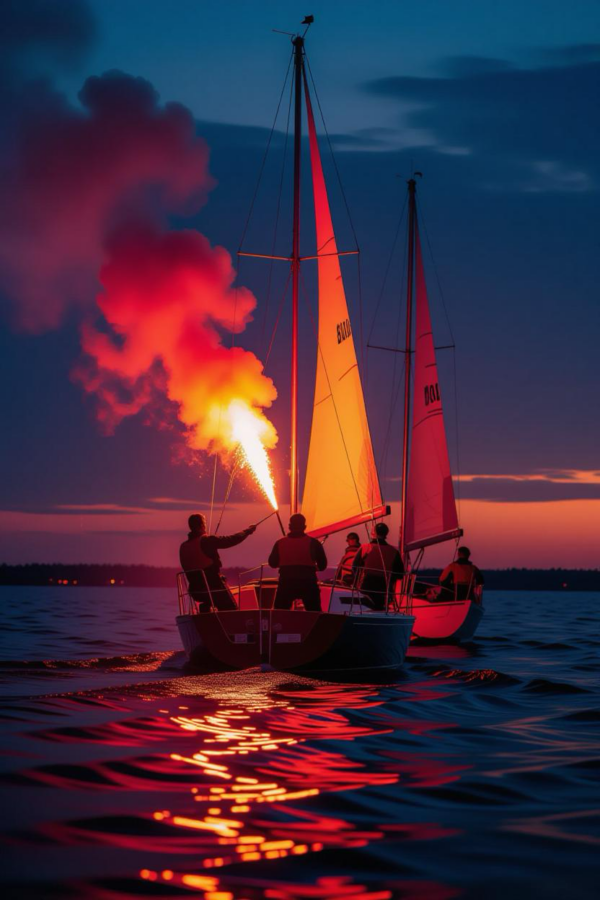
In the practical part you practise the proper handling of signalling devices. You practise, for example, preparing and igniting red parachute flares, hand flares and smoke flares, as well as handling smoke signals and drum-type signal launchers. Most courses last half a day to a full day and are offered by sailing schools, yacht schools or through associations (e.g. DMYV/DSV). (Note: There are also intensive online courses that prepare you specifically for the examination.) After the course you feel confident in handling flares and know when you may use them.
Structure and contents of the pyrotechnic certificate examination
The examination for the specialist certificate consists of two parts: written test and practical demonstration.
In the theoretical part you answer a questionnaire with 15 questions (from an official question bank of 60 questions). These are usually multiple-choice questions on explosives and weapons law as well as safety measures. You have about 30 minutes for 15 questions.
In the practical part you must then demonstrate the safe handling of the signalling devices. Typically there are three tasks, e.g. correctly firing a parachute flare, lighting a smoke or hand flare and handling a signal launcher (drum), as well as correct handling of misfires. Before the examination begins, the examiner checks your personal details.
If you pass both parts, you receive the specialist certificate (often sent by post). Failure of one part means that the entire examination must be repeated. (Important: You must take the examination within 12 months of admission, otherwise it expires.)
Validity and recognition of the pyrotechnics certificate
 Once acquired, your pyrotechnics certificate retains its validity permanently. The certificate of competence for distress signal devices is valid indefinitely – it does not expire and does not need to be renewed. Older certificates (e.g. a previous stamp in the SBF See up to 2006) also remain legally valid. Important: The FKN is valid only for the specified pyrotechnic distress signal devices. You may not acquire or carry a signal pistol in calibre 4 with it – a separate weapons permit is required for this. In practice, the German certificate of competence is recognised by German associations (DSV, DMYV) and authorities. If you are often abroad, it can be sensible to have the document with you when chartering – many charter companies also accept it internationally as proof of your training.
Selected pyrotechnics certificate courses
You will soon find courses from sailing schools in your region here. In the meantime, it is worth taking a look at our current sail training trips – checking back regularly is worthwhile.
SKS sail training along the unexpected beauties of Mallorca

SKS sail training along the unexpected beauties of Mallorca
SKS practical training from Breege on Rügen
4-day SKS sail training skipper training in Travemünde
SKS practical training from Breege on Rügen
Learn to sail in the island world of the Kornati Islands. In a small group with max. 4 participants.

Finding suitable courses – how Törnfinder helps you
On toernfinder.de you can quickly and impartially find an overview of pyrotechnics certificate courses in your area. Various training providers advertise their FKN courses. You can filter the offers by region, date, duration and price and thus easily compare them.
If a course is of interest, you can contact the provider directly via a contact form or via a link to their website. Törnfinder itself does not arrange or book courses, but is purely a comparison and information portal. Final registration and payment always take place directly with the sailing school or association of your choice. This way you keep an overview and can choose the best course for you in a relaxed manner, without having to search through hundreds of websites.
Conclusion: If you want to carry distress signal devices on board, the pyrotechnics certificate is essential. The examiner often refers to the "certificate of competence under explosives law" – you must have it ready at the latest before your next charter trip. Now you know what content to expect in the course and how the examination works. Visit toernfinder.de, find the right FKN course and secure your authorisation for an emergency. Fair winds and always a hand's breadth of water under the keel!