
SSS Online Webinar (Live) 5 Weekends
 Greubel Yachtsport
 This page was translated automatically from German. View the original
The Sportseeschifferschein (SSS) is required by law under § 15 of the SeeSportbootVO for skippers of a commercially operated sports boat (e.g. training or similar sporting and leisure purposes), and for skippers of traditional or museum vessels (from 15 to 25 metres in length).
Its scope of validity comprises the coast up to a distance of 30 nautical miles from shore, as well as the sea areas of the North Sea and Baltic Sea, the English Channel, the Bristol Channel, the Irish and Scottish Seas, and the Mediterranean and Black Seas.
It is the logical continuation of the competence you have acquired through the Sportbootführerschein-See or SKS, and qualifies you as a skipper in coastal waters up to 30 nautical miles offshore.
Even if you do not plan to work as a skipper in this area, acquiring the SSS is recommended for every skipper. On the one hand, preparing for the theory and practical examinations "forces" you to engage intensively with seamanship, maritime law, navigation, meteorology and practical boat handling. Without the prospect of the exam, you would probably not do so as thoroughly. On the other hand, holding the SSS allows you to demonstrate your competence and experience to others (for example, to a crew who have never sailed with you before).
Course structure
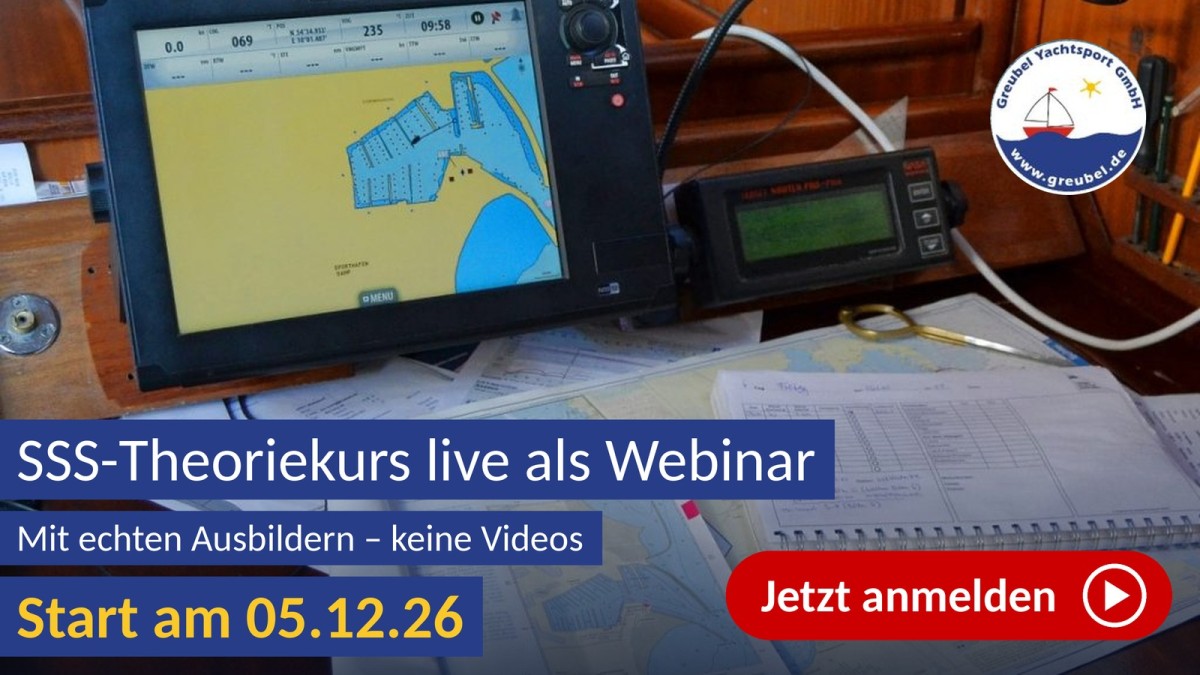
Our SSS seminar takes place over just five weekends as a live webinar. The lessons are supplemented by extensive homework, exercises and past exam papers. Course participants are permanently supported by a telephone hotline and by an internal SSS website (with a question-and-answer forum, download area, etc.).
The course takes place as a real-time webinar via the Internet. We use the same PowerPoint presentations as in our face-to-face lessons. Interaction is ensured through loudspeakers, microphone, webcam, chat function, visualiser, digital whiteboard, etc.
Taking part is very simple: you need a PC (laptop or tablet) with an Internet connection and a current browser, as well as loudspeakers and a microphone (or headset). A webcam would be ideal, but is not essential.
The great advantage of this seminar concept is geographical independence (participation is possible from anywhere the necessary technical requirements are met), as well as time flexibility in preparing for the exam. A large part of the navigation training, exercises and course material can be completed comfortably at home with individual time planning.
Course content
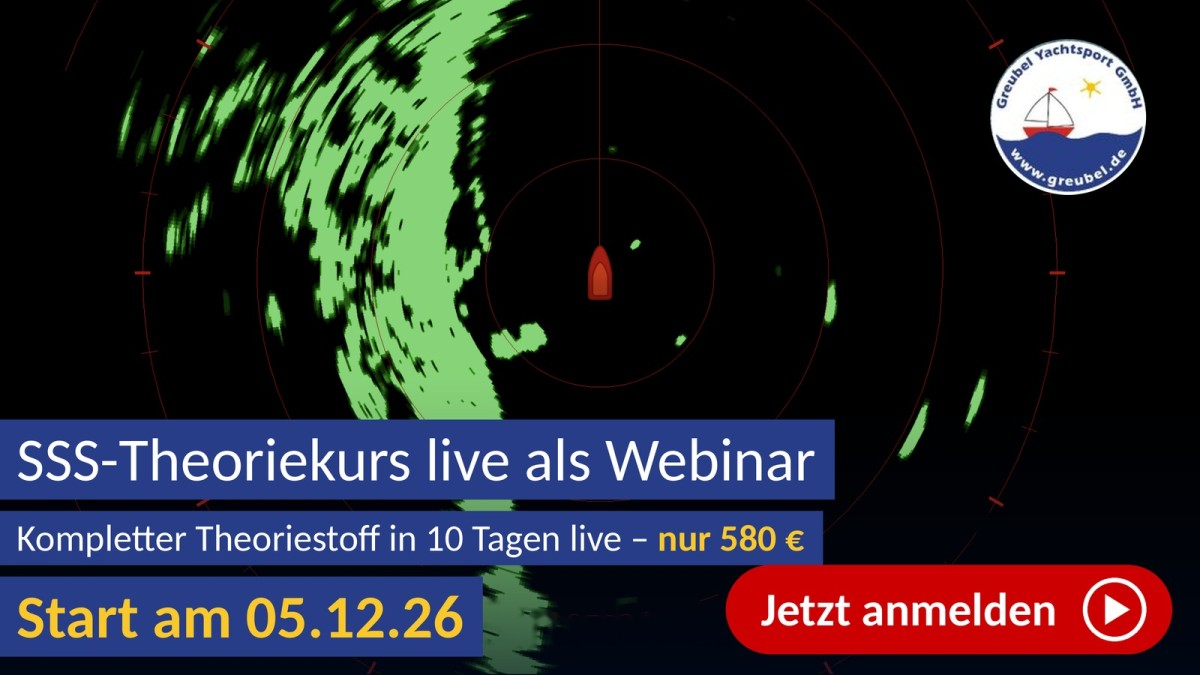
Navigation: Revision of terrestrial navigation, dead reckoning, set and drift, correction for wind and current, vertical angle measurement, current and intercept problems, tidal calculation using ATT, tidal streams, compass checking, drawing up a deviation table, position fixing (compass bearing, relative bearing, radar bearing, running fix, light on the horizon), radar theory, satellite navigation (GPS), electronic navigation, AIS.
Maritime law: KVR, SeeSchStrO, application of the rules to concrete situations, responsibility of the skipper, customs, rights and duties in foreign harbours, safety equipment, manning regulations, marine casualty investigation, environmental protection, distress and safety radio service, radar plotting.
Seamanship: Stability, safety equipment, seaworthiness, conduct in emergencies and collisions, distress at sea, man overboard, sailing in heavy weather, manoeuvring behaviour of seagoing vessels, anchoring, first aid on board.
Weather: Fundamentals of meteorology, clouds and fog, pressure systems, regional weather phenomena, weather rules, sea state, marine weather information, processing marine weather reports, meteorological instruments.
Content of practical training: See training trip with our partner Yachtsport Greubel & Morys
Requirements
Minimum age 16 years.
Possession of the Sportbootführerschein-See.
Proof of 1,000 nautical miles since SBF-See, on yachts in sea areas, of which at least 500 nautical miles before the first part of the examination.
Holders of the SKS (or the earlier BR-Schein) may begin the theory examination without having to provide evidence of 500 nautical miles.
The course builds on the knowledge of the Sportküstenschifferschein (SKS), therefore we require possession of this licence or comparable knowledge. If you do not hold the SKS or no longer have the knowledge at hand, we recommend attending current SKS courses in full or in part, or taking part in one of our sail training trips beforehand.
examination
The training concludes with a theoretical and a practical examination before an examining board authorised by the Federal Ministry of Transport. The theory examination should be taken first. A maximum of three years may elapse before the practical examination. In the theory examination (duration 4½ hours) the subjects of navigation, maritime law, seamanship and meteorology are tested in writing and orally. You may also take each of these four examination subjects as a partial examination within a period of two years.
The practical examination on board a yacht (duration 1 to 1½ hours) requires knowledge in seamanship, navigation, meteorology as well as engine and yacht technology.
For the SSS practical examination we offer, with our partner "Yachtsport Greubel & Morys GmbH", special sail training trips with subsequent examination.
Course dates
Our SSS seminar takes place over ten days, spread across five weekends.
Sat, 05.12.26; Sun, 06.12.26;
Sat, 19.12.26; Sun, 20.12.26;
Sat, 16.01.27; Sun, 17.01.27;
Sat, 20.02.27; Sun, 21.02.27;
Sat, 13.03.27; Sun, 14.03.27;
from 10.00 to 17.00 each day
Further information at:
https://greubel.de/segelschule/sss.html