
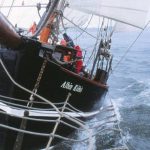
Albin Köbis Segeln
This page was translated automatically from German. View the original
The history of the Albin Köbis
FIRST LIFE – AS FISHING CUTTER KARL KRULL
Today's ALBIN KÖBIS first saw the light of day in 1948 as a fishing cutter in Barth on the Darß peninsula. The cutter was part of the first series of twelve vessels in a cutter-building programme that began in eastern Germany that year and was unprecedented in its scale. The vessel was based on the 17m cutter "Type D", developed as early as 1936. The corresponding pattern was designed by Maierform in Bremen and classified by Germanischer Lloyd. Both the designers and the builders twelve years later certainly had extensive experience in building sailing vessels – this is the only explanation for the cutter's wonderful sailing characteristics. The oak timber for the shipbuilding came from Sweden – and was certainly not a gift after the war. The vessel then went to the Volkswerft in Stralsund for final fitting out: there the engine was installed on board, along with the fishing gear and everything else needed for fishing. Two masts were also fitted, for the aerials and of course for sails: altogether the cutter had a good 60m² of sail area, distributed across three sails. The fishing cutter's main propulsion was the engine, but the sails ensured she lay more quietly in a seaway. In February 1949 our vessel began her life as a fishing cutter – christened at the time with the name KARL KRULL. For around 30 years the cutter fished herring, cod and mackerel from the Baltic. First from Sassnitz under the fishing mark SAS 86 and later from Wismar under WIS 109, always with four to five crew on board – haul after haul until the hold was full. Then the time came: the old wooden cutters were replaced by larger steel ones. KARL KRULL too had had her day and went for scrapping.
SECOND LIFE – UNDER PEACE FLAG IN THE WESTERN BALTIC SEA
Unexpectedly rescued from the scrapyard, the ship's life took a different course. The cutter set off again, but this time not for fishing. She sailed from Wismar to Kiel – from East to West, unusual at that time. In 1979 the Sozialistische Deutsche Arbeiterjugend bought the vessel for project work within the association. For several years the cutter sailed under a peace flag in the western Baltic, but mostly she lay moored at the pier. And there time took its toll. Not good for a ship.
THIRD LIFE – AS TRADITIONAL SAILING VESSEL ALBIN KÖBIS
Fortunately, a new chapter in our ship's life began in 1985. Four friends shared a common idea: 'We want to experience sailing as it was a hundred years ago and lend a hand ourselves! The cutter has sharp and therefore very favourable lines for sailing – we'll convert her so that a fast traditional sailing ship emerges.'
Seven long years of work until the idea became reality. Then the third life of our ship began: as the traditional sailing vessel ALBIN KÖBIS, the former fishing cutter set off on a great voyage in 1991. Since then, it has now been nearly three decades that our ship has been sailing the Baltic Sea.
Sonja and Werner were the ones who started it; the two of them ran the ship until the spark passed to a young boatswain. His name was Lutz and he came at the right time, because Sonja and Werner had plans to build a new traditional sailing vessel based on a Danish model. So Lutz took over the Albin Köbis in the early 2000s, cared for and maintained her, and with great dedication succeeded in keeping the ship in good trim and underway for the last 18 years.
Now there is another change of generation: Christian is taking over the Albin Köbis in October 2020. Here too it is a boatswain – who has already sailed on the Albin Köbis – who is assuming responsibility.
Over 80,000 km – more than twice around the Earth at the equator – she has covered in that time. Many people have trodden her planks and let the wind blow round their faces. Thousands of hours of work are invested in the ship and are constantly needed so that she can and will continue to cut a fine figure on her rounds.