Symbolic image
This page was translated automatically from German. View the original
Securing a boat in harbour in a storm means above all one thing: act in good time, whilst it is still calm ashore. The wind and storm surge warnings from DWD and BSH tell you when to act. The key measures are doubled mooring lines, enough fenders and a line length that suits the highest water level (warning threshold levels as of October 2026).
The essentials at a glance
- Rig every line doubled, with a snubber or elastic mooring line, and fit chafe protection wherever it runs over an edge.
- The line length depends on the highest expected water level: at a fixed quay you need considerably more slack than at a floating pontoon.
- Sails, bimini and loose covers must come off or be securely lashed before the storm, because every surface strains the lines.
- On the coast, DWD issues a wind warning from 6 Beaufort onwards and a storm warning from 8 Beaufort onwards. BSH declares a storm surge on the North Sea from 1.5 m above mean high water, and on the Baltic Sea from 1 m above normal mean water level.
- People come first: in a storm surge do not go onto pontoons, and during the storm stay away from the boat.
How do you recognise that a storm or storm surge is coming?
Reliable advance warning is provided by two official services: the Deutscher Wetterdienst (DWD) for wind and the Bundesamt für Seeschifffahrt und Hydrographie (BSH) for water level.
Wind: the coastal warnings from DWD
DWD issues coastal warnings for the German North Sea and Baltic Sea coasts around the clock. A wind warning applies from 6 Beaufort mean wind, a storm warning from 8 Beaufort. If the mean wind is below 6 Beaufort but gusts reach 7 Beaufort, there is a separate gust warning. For your lines in harbour, gusts are what matter most, so watch for their value in the warning. You will find the warnings on the DWD coastal warnings page and in the WarnWetter app. How to read the sea weather report overall is explained in our article Reading and understanding the sea weather report.
Water: the water level forecast from BSH
On the North Sea, BSH's water level forecasting service publishes a forecast four times a day for the next four high and low waters at 16 locations, given as a deviation from mean high water. A storm surge there begins at 1.5 m above mean high water, a severe storm surge at 2.5 m, a very severe one at 3.5 m. On the Baltic Sea there is no significant tide. BSH forecasts the water level there twice daily for five areas from Kiel Bay to the Kleines Haff. From 1 m above mean water level (normal mean water level) it is termed a storm surge, from 1.25 m a medium storm surge, from 1.5 m a severe storm surge, from 2 m a very severe one. Conversely, an offshore storm can lower the level by a metre or more, so-called storm low water.
BSH explains the storm surge categories on its storm surge page, where you will also find the current forecasts. Storm surge warnings are also broadcast on the radio and via DWD's WarnWetter app.
How do you secure a boat properly in harbour in a storm?
With doubled lines, snubbers, springs and chafe protection. The boat should be able to move without any single line carrying the whole load.
Mooring lines doubled and sufficiently strong
Rig a second line at both bow and stern, each made fast to its own cleat or bollard independently of the first. If one line parts, the second holds. The lines must suit the boat size. Replace any faded, stiff or chafed mooring lines before autumn. Some harbour regulations prohibit chains, wire ropes and shackles as mooring lines. They do not stretch and transmit load peaks undamped to cleat and pontoon.
Snubbers against load peaks
In gusts and swell the boat snatches the lines. A rubber or spring-steel snubber absorbs these peaks and protects line, cleat and pontoon. Important: the snubber does not replace the second line. Rig the back-up line so that it only takes load when the snubber is fully stretched or fails. Some harbour regulations explicitly require snubbers or elastic lines for heavier boats on permanent berths.
Springs hold the boat in position
Alongside the pontoon, springs prevent the boat from surging fore and aft and scraping past the fenders. A fore spring runs from the bow aft to the pontoon, a back spring from the stern forwards. In a storm you rig both, as long as possible, so that their angle changes little with rising or falling water. In a box berth between piles, cross-rigged stern lines perform a similar task.
Chafe protection at every edge
A line that works for hours over an edge will chafe through, even if it was strong enough. Critical points are fairleads, toerails, pontoon edges and pile heads. A length of hose or a purpose-made fabric chafe guard over the line spreads the friction. Secure it so that it does not slip off.
How much slack do the lines need for rising water?
On a floating pontoon, hardly any additional slack is needed; on a fixed quay, enough slack so the boat can rise with the highest expected water level. If the lines are too short, the boat will hang in the lines as the water rises, heel over or tear out fittings.
On a floating pontoon
Floating pontoons rise and fall with the water, so the line length remains suitable. The limit lies with the guide piles: if the water rises higher than the piles reach, the pontoon can float up. Stern lines to fixed bollards need slack even on a floating pontoon, because the bollard stays where it is.
On a fixed quay and in tidal harbours
Here you must plan for the entire water level range. In tidal harbours, the storm surge supplement from the BSH forecast is added to the normal tidal range. Long, shallow-led lines are better than short, steep ones: a line that runs diagonally to a more distant bollard changes its effective length far less as the water rises.
And at low water?
The opposite can also occur: in the Baltic, an offshore storm can lower the water level considerably. On a fixed quay, the boat then hangs on lines that are too short. Therefore, plan the slack for both directions.
Which fenders provide the best protection in a storm?
Many large fenders and, on piles or rough quay walls, a fender board.
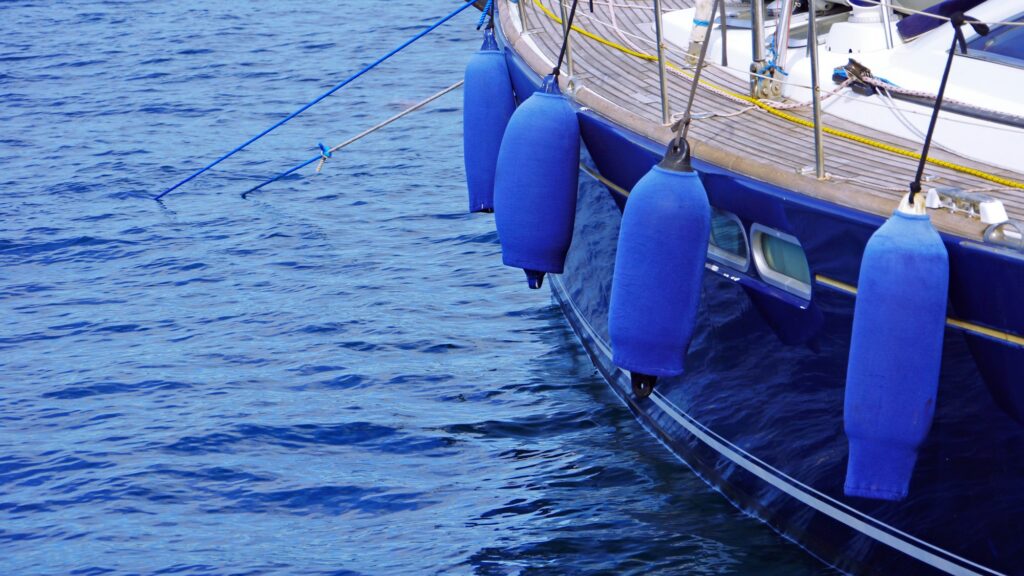
Hang the fenders at the height where the boat can touch the pontoon or neighbouring boat, and consider the rising water level: what fits at normal water level will slide over the edge of the pontoon during a storm surge. A ball fender at the bow or stern protects corners where normal fenders roll off. On individual piles or on a quay wall with projections, fenders roll away sideways. A fender board hanging outside in front of two fenders rests against the pile and holds the fenders in place. Some harbours require at least two fenders of adequate size on each side.
How do you reduce the windage?
Everything the wind can catch comes off or is firmly lashed. Every square metre of canvas increases the load on the lines and can tear loose.
- Lower the sails: In a storm, the mainsail is best stowed below deck. If it stays on the boom, lash it with several sail ties and a firm cover.
- Secure the roller genoa: best lowered; if it stays up, roll it up tight and additionally cleat the reefing line.
- Bimini, sprayhood and covers: Remove the bimini and cockpit tent. Secure a sprayhood that is to remain, and all covers, with additional lines so they don't flap.
- Halyards and small items: Lead halyards away from the mast so they don't slap. Dinghy, jerry cans, cushions and flags belong ashore or below deck.
What tears loose often damages not only one's own boat. Some harbour regulations therefore explicitly require that boats are moored in such a way that no damage occurs to neighbouring boats during a storm.
What applies when the storm arrives?
Then your own safety comes before the boat. Everything that can be prepared is completed before the storm. During the storm, you stay off the boat, and during a storm surge you do not set foot on pontoons, not even floating pontoons.
Inspection rounds before and after
Plan a thorough inspection round before the wind increases: lines, shock absorbers, chafe protection, fenders, covers, bilge pump and battery. Report a loose line or flapping sail on a neighbouring boat to the harbour office. After the storm, a second inspection round follows as soon as the water level has dropped and the pontoons are safely accessible again. Look for chafed lines, displaced fenders and water in the bilge.
If you are not on site
Those who live far from their berth fit the storm-proof equipment as early as autumn: doubled lines, shock absorbers, chafe protection and enough fenders to remain throughout the winter. Some harbour regulations explicitly oblige owners to check regularly whether their boat is securely moored for storms, and to pay particular attention during autumn and winter.
How do you secure a boat ashore and in winter storage?
Storms can also cause damage ashore: a boat on a cradle presents a large surface to the wind, and even a slipped support can cause it to tip over. The deciding factors are a suitable cradle, firmly tightened supports and a cover that doesn't flap.
- Cradle and supports: The cradle must suit the hull shape and weight. The supports rest on solid hull sections and stand on load-bearing ground. Chains or cross-braces between the supports prevent individual supports from sliding away.
- Inspection after storms and frost: After strong winds and after freeze-thaw cycles, you check that all supports are still firmly in place and have not sunk in.
- Mast and rig: A lowered mast considerably reduces windage. If the mast remains standing, all halyards must be led away and all sails removed.
- Winter cover: Well tensioned and with enough attachment points so it doesn't flap.
- Flooding ashore: Those stored outdoors near the shore follow the water level forecast in winter too. During severe storm surges, storage areas near the shore can be flooded.
Frequently asked questions
From what wind strength should I secure my boat in the harbour with extra care?
At the latest when the DWD issues a storm warning, meaning from Force 8 average wind. With a wind warning from Force 6 and strong gusts, it is worthwhile reinforcing lines and fenders, especially if the wind is blowing onto the berth.
What is the difference between a storm surge in the North Sea and the Baltic Sea?
In the North Sea, the storm surge is measured against mean high water and begins at 1.5 m above it. In the Baltic Sea, with no significant tide, a storm surge applies from 1 m above normal mean water level.
Is a snubber enough instead of a second line?
No. The snubber absorbs peak loads, but does not prevent a line from chafing through or a cleat from pulling out. The second, independently secured line is the actual safeguard.
May I still check on my boat during a storm?
Not during the storm and storm surge. Pontoons are then flooded or moving heavily. Check the boat thoroughly beforehand and only again when wind and water level permit.
More on Törnfinder
Anyone who would like to practise harbour manoeuvres and mooring in strong winds with experienced guidance will find offers for a Skipper trainingon Törnfinder. Trips on the coast can be found under Sailing in the North Sea and Sailing in the Baltic Sea.