

This page was translated automatically from German. View the original
After the sinking of the Jambo and my rescue in the South Atlantic, Anke and I give a great deal of thought to how we should continue. Perhaps we should carry on our travels in a motorhome. That definitely has its appeal too and offers completely different possibilities. Olli from the Pandora took this path after his Hanse sank in the North Atlantic (2019) and with his "Beast", as the motorhome was called, always found himself by the water again. After that he switched back to a sailing boat. We would be the same, that becomes very clear early on, because we are drawn to the water.
What we experienced in the South Atlantic and having been in distress at sea is of course still very fresh at first. It could have ended differently, I am aware of that. But as an optimistic and positive person who looks more forwards than backwards, I deal with what happened quickly and well. Nevertheless, even I am influenced by risk aversion, fears and doubts. The risk of crossing an ocean alone is something you have to know, and I was of course always aware of what I was letting myself in for. The emergency was correspondingly well prepared for. Fears never help me, but I can usually block them out; particularly in critical situations I become especially calm, focus on the task at hand and block out the rest. Doubters have actually unsettled me badly once or twice in the past, but never stopped me from my plans. If I had always listened to them, I would probably still be sailing in the Netherlands today, which is of course beautiful in summer but was already not enough for me back then.
In October, shortly after my rescue, on the voyage with the cargo ship Alanis to South Africa, Anke and I are already considering what kind of boat we want to buy. We had not given the subject any thought beforehand and we do not have a "dream boat" in mind. Whether I will cross oceans again, I am leaving open at that point. But whether the boat sinks in the South Atlantic or 20 nautical miles off a coast in the Mediterranean makes no great difference; you just get rescued more quickly. I definitely do not want to have to climb into a life raft a second time, that much is certain. So the new boat should be significantly more robust, larger, with a skeg-hung rudder and ideally two heads, so we can also sail longer passages with crew. She should be about 40 to 45 feet long.
Back in Germany we focus on aluminium and steel boats and find quite a few vessels on offer on the relevant search platforms. I telephone many friends and seek advice. Anke and I initially like Ovnis, but very many are not on the market and often they are far away. At first we limit our search radius so that the boats are reachable by car. A few possibly suitable yachts are quickly found.
In November last year our first car journey takes us to the Netherlands. A 13-metre steel boat lies there. The anticipation of seeing her is great. The broker shows her to us. But as soon as we step below deck it smells of diesel. That settles the matter for me straight away. The broker suggests that could be sorted out. But I think if the diesel leak were easy to fix, the owner would have done it himself already. Also, the condition of the boat does not at all match the photos and the broker admits that the photos are already 2 years old. He also shows us a Perry 45, about 35 years old, a very nice boat but not spacious enough and she has only one head.
Although it was clear beforehand, we are shown here that older boats, compared to newer ones, do indeed require considerably more length to offer the same amount of space as a smaller modern yacht, due to their classic and narrow hull shapes. So we change the length search parameter to 45 to 50 feet quite early on during our boat search. Our next car journey takes us back to the Netherlands, where we viewed a Cheoy Lee 47, a GRP boat built in Taiwan and China in the 1980s. In the meantime, we had also included GRP boats, as the older ones in particular have a significantly thicker laminate than many of the boats built nowadays. Boat builder Kai was an intensive and very valuable adviser during this time. Many thanks for that! Much could be written about the various materials such as aluminium, steel and GRP; all three have their advantages and disadvantages.
I had been really looking forward to this Cheoy Lee, had already bought her in my mind and planned my refit. However, we have just got on board when the broker tells us that she has osmosis. Brilliant, I think, he could have mentioned that on the phone. Anke doesn't like the boat at all; it's too dark and shabby for her. The broker then shows us an Irwin. It looks quite good in terms of space, as the boat has been extended by 1 metre to 49 feet at the stern by the owners, which has also been done quite well. When I ask whether the sail area has been adjusted accordingly, the broker looks at me somewhat taken aback and says probably not. Anke doesn't like this boat either, as it's too neglected. For me it's also out.
After that there are many more internet searches. The boats I have in mind are more like metal expedition vessels, which Anke cannot warm to at all. They are too clunky for her and she does want a boat with 'yacht character'. Of course I could override that, but I definitely want to buy one that we both like and on which we both feel comfortable. Later in January at the boat show in Düsseldorf we meet Carsten Rettig from Yachtall and I tell him how our boat search is going. Then he takes me aside and says: 'Martin, it's always the women who buy the boats!' We laugh heartily! But there seems to be some truth in that!
We are still in November time-wise. Anke sees a great video on YouTube about an Amel Santorin belonging to a British couple who are currently in New Zealand, and suggests this boat type. Amels had also interested us already, but so far had not been that much in focus. A year ago I was on board our friend Helmut's Super Maramu Red Line, a wonderful vessel. An Amel would suit me too. There seems to be a large overlap here between Anke and me. So we concentrate on Santorins, which are however somewhat further away, and we have to fly to Hyères in the South of France and Málaga in Spain. For me it is also a welcome short break, as after a few weeks at home the ceiling is already falling on my head, having previously been on the boat for 9 months.
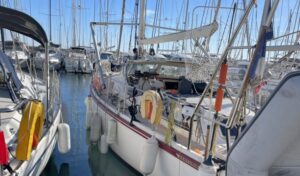
Amel Santorin in Hyères
We fly to the South of France and whilst driving to the hotel we telephone the broker to confirm the exact time for the next day. He already admits that the boat is not so tidy, as the owner is still living on it. We don't give it much thought. To measure the moisture content of the hull, I have acquired a moisture meter. When the boat is in the water, I can at least measure from the inside with it and of course also on deck. There are two settings, 10 mm and 25 mm measuring depth. Normal hull moisture is 3.5%, as I research on the internet, naturally measured from the outside. Measured from the inside it should be less, as the moisture penetrates from the outside.
We now arrive at this Amel Santorin in Hyères, built in the early 1990s, centre cockpit, sloop (1 mast), 46 feet, asking price 130k euros, in the water. The owner and the broker greet us. I ask when she was last out of the water to dry the hull. The answer is that the current owner had never taken her out of the water for longer, only ever briefly for new antifouling. Amels don't get osmosis, the owner adds. Unfortunately I can cite two examples of Amels with osmosis, whereupon owner and broker just stare at me. The hull moisture measured from inside is over 4% in some places. From my point of view that is too high.
Below deck the boat is untidy, dirty and shabby, mould in the fridge and it smells unpleasant. We just want to get out and go on deck. To give us a further incentive, the owner also says he would even leave everything on board. That finishes Anke and me off. We quickly say thank you and leave the boat almost in flight. I call the broker again in the afternoon and tell him that this Santorin is not an option for us.
After this experience we stroll through the marina at Hyères and keep an eye out for boats that might be for sale. In fact, there is an Amel Mango lying there, centre cockpit, ketch (2 masts), 52 feet. I had not yet looked at this type and in my internet search they had not turned up, as I had entered the length up to 50 feet. A French telephone number is on a sign at the stern. Fortunately Anke speaks French and we call spontaneously. The owner answers, is currently in the Caribbean and will not be back for 3 weeks. As our flight to Spain is the next day, he wants to send a friend over to show us the boat. It is supposed to cost 175k euros, which is above our budget. But having a look costs nothing.
We have been constantly increasing our budget over the last few weeks. We started at 120k euros. But there is nothing available for that which meets our expectations. When I calculate, I always work out the total project costs, i.e. purchase price and refit requirement. The insurance money for the Jambo is of course not enough, so I want to draw down reserves in order to make it financially viable.
Whilst we are waiting for the owner's friend, a friendly Frenchman comes by and we get chatting. He has an Amel 54 on the same pontoon. She is even a bit bigger than the Mango we are standing in front of. Anke finds the Mango quite large and she asks him how much crew he needs to sail his 54-footer. He says he usually sails her alone, everything is handled from the centre cockpit and the sails can be operated partly electrically. That reassures Anke somewhat, but of course berthing with a big boat remains an issue nonetheless. I did not find the Mango too big, because you can learn everything and you grow into the tasks. I actually imagine sailing this ketch would not be that difficult either, because the sails are split across three and are therefore somewhat smaller than on a sloop. Here too the lines run back to the cockpit. So whilst sailing you only rarely have to go out of the safe cockpit onto the deck.
The owner's friend arrives and shows us the boat. When you stand on board, she feels even a bit bigger. Below deck everything looks very well maintained, in complete contrast to the Santorin just a few hours earlier. Despite her age (built in the eighties), she is not so worn and the woodwork is still beautiful. The galley and the centre cockpit are larger than on the Santorin and below deck there is of course more space too. I think she is great and Anke also feels comfortable on board. The hull moisture measured from inside is just under 5% in places.
A survey was also carried out on the boat a few months ago, which we receive. It is in French. We thank them for the tour. At the hotel we use the Google Translate app and look through the 60 pages. There are quite a few defects and on one of the pages it says the hull is blistering in places and she has osmosis. The surveyor recommends a complete hull restoration. So at this price she is of course ruled out.
We fly to Spain and a few days later we view the next Santorin with a Spanish broker, asking price 145k euros, sloop, afloat. Here too the hull appears somewhat damp, I measure over 4%. But below deck she looks quite alright, though not very generously equipped. When I inspect the engine room, the engine is already warm. So the broker has had it running beforehand. I would have preferred to see a cold start. The broker starts it up, the hours are already quite high, I believe around 5000 hours. Blue smoke comes out of the exhaust and an oil film forms on the water surface. We thank him and later let him know by email that we are no longer interested. We fly home, having by now seen 7 boats and not even been able to make an offer, because something serious has always been wrong.
It is still early December and the search continues. At least we now know what we want. Amels are in focus, but I also like Moody and Westerly. There are not many of the latter two in the size we are looking for on the market. The Scandinavian boats are unfortunately ruled out because of the significantly higher price. I naturally include Mangos in the search focus, which means we are abandoning our 50-foot upper limit. The budget is also raised once more, the maximum all-in is now 180k euros. Super Maramus from the nineties are also available in that price range if you deduct a negotiating margin from the asking price. So I include them as well. The Super Maramu is essentially the successor model to the Mango, built from 1990 or 1989 I believe, and also around 53 feet long.
The asking prices for the few Mangos in December and January are between 150k and actually well over 200k euros, despite their great age, 35 to 40 years. One is in Canada and is the most expensive, one in France and one on the Baltic Sea. I ring the broker on the Baltic and he is really very competent. I arrange to meet him between Christmas and New Year. Our friend Helmut has a friend on the coast who is an Amel expert, Wolfgang. Wolfgang, a nice and knowledgeable person, luckily has time. We meet the evening before the viewing for a beer and have a chat about the boat. Wolfgang even knows this particular boat and a bit about its history as well. A great deal has been done to it, some things are good, but other things not so good.
We meet at the boat the next day with the broker. The Mango is ashore and we can also inspect the underwater hull. As was already visible in photographs, there is a gap between the GRP part of the keel and the bolted-on iron keel. So the iron keel has dropped. What the restoration effort would be there, a surveyor would have to say. The hull moisture measured from outside is very high, 3% to 7%, but there are no blisters to be seen. Reference values on neighbouring boats show significantly lower moisture readings. Below deck it smells of diesel. Nevertheless we look at every detail. I learn a great deal from Wolfgang about this type of boat and what to look out for. After 3 hours we say goodbye and the next day I tell the broker we are no longer interested because of the diesel smell.
Once again, it's time to tick it off and focus on the next boats. There's another Mango on the French Atlantic coast. I find that one interesting too, but in the meantime the advert has been updated and now she has osmosis, which would be treated, however. I arrange an appointment for early January. So as not to drive 900 km there and back just for this one boat, I check which other boats nearby might be suitable. There's also a Moody 46 and a Super Maramu. Fortunately I can fit all three appointments under one hat.
I drive to France and meet the owner the evening before the actual appointment at his Mango, which he's currently sanding down because of the osmosis. He's already done a third of it. He's very nice, speaks quite good English and tells me that she's actually already sold, as a couple came the day before and they want to take the Mango. Fair enough, I think, he could have told me before my journey that the boat was under offer. Nevertheless, I don't want to leave having achieved nothing. So we meet the next morning and when I ask whether the couple had decided to buy it, he says no, he hadn't meant this boat yesterday but another one. He has two boats. It was a misunderstanding and his English isn't that good. His Mango is still for sale. To this day I don't know what to make of this story.
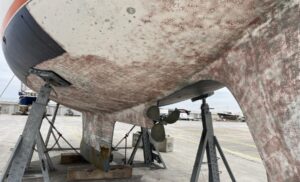
Amel Mango with osmosis
I inspect the boat, yes she has osmosis, which will be treated. He's doing the preparatory work himself and then a company is supposed to take over the rest, which will then sandblast the hull and rebuild it afterwards. I look at everything and am fairly satisfied. I make a verbal offer with the corresponding inventory list. I'd rather have the osmosis treated myself and share the costs with him. I estimate them roughly at 20k euros. I would sail the boat to Germany and have it done there. I have Wrede in mind and want to call them if we reach an agreement. I take my leave with quite a good feeling and let him know that I'll write him an email. Finally I can make an offer for once. Things are moving forward!
I drive on and look at the Moody, 46 feet, sloop, nineties, in the water. I can't remember the asking price exactly, I think it was around 120k euros. The broker is also very competent. The Moody looks good, but despite her size offers very little storage space for me. The owners have stored all their things in the third cabin, because there's no space at all under the saloon benches. It's a shame and I decline on the spot. On to the next boat, the Super Maramu, asking price 175k euros, ketch, nineties, in the water. Here too the broker, whom I meet the next morning, is very helpful. The visit is brief, as the first thing I do is measure the hull moisture. It's 4 to 5% forward. Amidships I can't measure at all because we can't lift the floorboards as they're jammed. I break off, thank him and take my leave after only 30 minutes and drive my 900 km back home.
After my return to Germany I write my email to the owner of the Mango and make him the proposal I'd already made verbally, attaching the inventory list I'd downloaded at the end of December, so only two weeks earlier. But in his reply it turns out that he's removed the dinghy and the outboard motor worth 4,500 euros. I still had the old list. We can't come to an agreement, which in hindsight is good. Because the costs and time required for osmosis treatment aren't necessarily fully foreseeable in advance.
Then there's also a Santorin in Indonesia, but the risk is too high for me and the journey too expensive. I feel similarly about the Amels in Papeete and the Caribbean that would also be possibilities. For now I've had enough of boat hunting and need a break. I'm no longer looking so intensively.
At the end of January the Santorin belonging to a friend of a friend becomes interesting. The boat has stood on land for a long time and should therefore be dry. She's supposed to be relaunched in February and could be viewed in Martinique in March. But after the telephone conversation with the owner it falls through, as he then wants to sail his Santorin to Europe after all and she won't be available until summer. So this boat is also ticked off. That same evening Anke discovers a post on social media that a Mango will soon be offered for sale, berth Turkey. Rather listlessly I agree to write a message. We receive a brochure and some photos. That looks quite good, refit done, very well equipped, the rig was renewed in 2023, navigation electronics from Raymarine 2023, but mixed with old B&G, EU VAT paid etc. The asking price is over 200k euros, which is too high for us, but perhaps we can reach an agreement. She's 35 years old and based on my experience of recent months I suspect that the hull, as with the other old boats, could probably be damp again. Nevertheless we decide to fly there. If it comes to nothing, then we'll have a few nice days in Turkey.
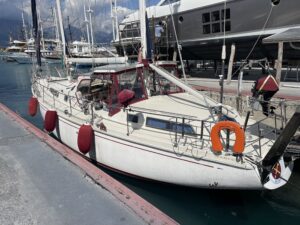
The new yacht is an Amel Mango
A few days later we're there and meet the owner couple. They're very nice people and the chemistry is right straight away, also for the first time. Unfortunately they have to sell their Mango for family reasons. They bought the boat from their father two years ago, did a refit and equipped her lovingly to go on a long voyage themselves.
Without high expectations, naturally I first measure the hull moisture, and the readings are surprisingly good: 1 to 1.5%, with a few isolated spots at 2%. That looks really good, as does the rest. However, a small refit would be necessary: new cushions, the forward heads need doing, and the navigation electronics need updating to remove the B&G part. We reach an agreement that same day. A week later, when we're back in Germany, the purchase contract is signed in writing. At the beginning of March, we fly over with our surveyor Helmut. Everything is in order. In the crane, we measure 2% to 3% hull moisture on the spots that have dried in the sun. I breathe a sigh of relief. So my method of measuring from the inside was apparently not so bad after all and at least gave an indication. But the laminate thickness in the hull area on the boats surveyed was usually at least 25 mm anyway. A few days later, we take delivery of the boat.
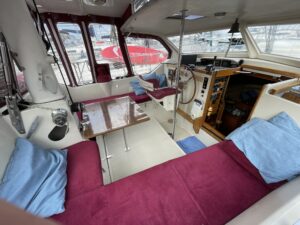
The cockpit of the Amel Mango
So we found her, after a long search, ultimately rather by chance. The months-long search wasn't straightforward. But during that time, Anke and I found the type of boat that we both like. I preferred the Mango from the first viewing in Hyères over the Santorin, and with Anke it was rather the other way round at first. In the end, this Mango is what we both want and where we both feel at home. She's our new baby.
Does she have everything I was originally looking for? Yes, because the original search parameters were: significantly more robust and larger than the Jambo, with a skeg-mounted rudder and ideally two heads. She has all of that. She offers a homely ambience and significantly more space than the Jambo. At first, I'll probably catch myself comparing our Mango with the sunken Jambo from time to time. But that's OK for me.
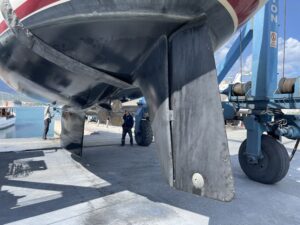
Amel Mango with skeg-mounted rudder
Additionally, this Mango has separate sections that are watertight from one another: anchor locker and forward deck lockers, forward cabin with forward heads (bulkhead with a rubber seal on the door, which can be fixed firmly against the seal with 2 beams and turnbuckles, so it holds even with internal pressure), saloon and aft cabin (the largest area, no bulkhead on the aft cabin door), engine room and aft deck locker.
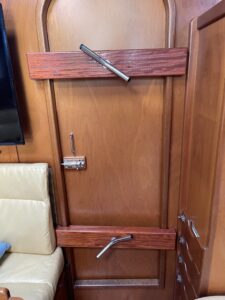
Separate sections on the Amel Mango
That means, even in the worst case, if there were a hole in the saloon, the boat wouldn't sink, as the other areas provide buoyancy. That leaves time to take countermeasures, at least in straightforward conditions. All in all, she's a safe bluewater boat and has even exceeded my original search parameters.
She is to be called Comeback and will be christened with that name in the coming weeks. Compared with her predecessor, I can also sail things with her that I perhaps wouldn't have dared with the Jambo, so she fits our sailing plans very well. For now, we're staying in Turkey. Here we want to have the cushions and heads done. Then we'd like to sail in Greece in summer, where Tobias Lepper from Lepper Marine and I want to update the navigation electronics. After that it's off to Spain, the Caribbean, the Panama Canal, the Pacific. I haven't taken up the original plan to sail through the South Atlantic via Cape Town to Australia again, as I don't yet know Comeback that well and therefore I'm choosing the rather easier route to Australia, where there are also Amel support bases (Martinique and Tahiti), in case something needs repairing and I need spare parts.
We're looking forward to everything that's coming! 😀⛵️⛵️


Hello, may I ask which moisture meter was used during the yacht search?
Kind regards, Roger
Hello Martin and Anke,
I've been following your interesting trip reports irregularly for several years. I'm 61, will retire in two years and am now putting out feelers for my own yacht for the coming years. Without knowing a reason, a long-keeler yacht such as a ketch from HR is very appealing to me for bluewater sailing. Your report has drawn my attention to the Amel and I'd now like to know whether she has met your expectations. Since my wife doesn't want to go on long voyages but prefers to fly to the destination (where on earth does she get that from?:-)), I'd like to know whether the boat can be handled single-handed. Is there a sailing portal somewhere where one can apply for a long-term charter for, say, 1–2 months?
Best regards
Volker
Hello Volker,
Many thanks for your comment and your interest in our blog and portal! I'm pleased to hear that our reports inspire you and that you're considering the Amel – an exciting choice, especially if you're interested in long voyages.
Regarding your specific question about long-term charter or the possibility of joining an Amel: currently, to our knowledge, there is unfortunately no specialised platform that specifically offers long-term charter or cabin charter on yachts such as the Amel. This type of enquiry is indeed quite specialised. Bluewater sailors generally seldom take strangers aboard, as long voyages are very personal undertakings and require a great deal of trust between crew members.
Even with an Amel, it becomes additionally difficult, as it's a comparatively specialised and not very widespread boat. Most Amel owners use their yachts exclusively for their own long voyages and do not make them available for charter or for cabin charter opportunities.
What you could do, however, is search specifically for such opportunities in sailing forums such as Segeln-Forum.de or CruisersForum and make contact with other bluewater sailors there. From time to time an owner can be found there who is looking for crew members or offers cabin charter opportunities – even though this is rather rare on an Amel.
Best wishes and good luck with your plans,
Marcel from Törnfinder
Hi Martin and Anke,
We have watched pretty much all the videos from recent years with your Jambo on YouTube. The Bavaria was a very beautiful boat. The dismasting was certainly annoying, though compared to a total loss on the high seas probably only a lesser evil, but troublesome all the same. Browsing now I come across this more recent report and, to my surprise, the purchase of an Amel vessel is complete. A little about myself: last month I celebrated my 80th birthday, obtained my licences in 1983, owned motorboats and later a 24" Nautika (easily trailerable thanks to a lifting keel, several times from Hanover to Croatia). My wife Uschi, also proud of her motorboat and sailing boat licences, has always enjoyed being on the water. Then in 1989 the purchase of an Amel-Sharki built in 1982 for 200,000 DM. Found in Yacht magazine, drove by car to St. Laurent du Var near Nice, owner a Frenchman who spoke good English, boat craned out and purchased. After a few years sold again with little loss. Subsequently also chartered boats several times in the Caribbean, including an Amel-Mango with a trip from Trinidad to the ABC Islands. Since 2019 we have come to know and love the sailing areas in Holland. Just the two of us with Uschi, we spend 3 or 4 weeks each year in one stretch on a so-called Doerak, depending on availability 9.0 or 10m to 11.5m long, from Sneek. The canal routes from Groningen right down to Zwolle are very beautiful, you as Holland connoisseurs can surely confirm that. These vessels have a great deal of comfort: bow and stern thrusters, 400 litres of water, the larger ones also with 800 litres, waste water tank of course correspondingly sized. Free moorings (Marrekriete) about 3000!! in Friesland. I am writing to you because as an ex-Amel owner it would understandably be very interesting to be able to accompany you online on your next trips aboard your Mango – I assume, at least, and we are looking forward to it. Mid-2024 we will be cruising again for 4 weeks through North Holland and hope for some lovely clips from you. With best regards from Hanover.
Best
Have watched many films of yours and the Jambo with great fascination; although I'm not a sailor, I was particularly thrilled by the Atlantic crossing.
Wishing you the best of luck with the new yacht.
Best regards
Gerd Schneidee
A very, very interesting article that I really enjoyed! 😊 A boat search with a happy ending.
Many years ago we were keen sailors and for family reasons were no longer able to pursue this wonderful hobby, and we wish you the best of luck 🍀👍🏼