This page was translated automatically from German. View the original
Bastia lies on the northeast coast of Corsica, at the foot of Cap Corse, and has two harbours for sailing boats: the Vieux-Port right by the old town and the Port de Toga to the north of the city. Here you can read how to get to Bastia for your trip departure, which harbour is where, where to park and provision, what the sailing weather in the area is like, which destinations are nearby and what skippers should know about mooring.
The essentials at a glance
- Bastia-Poretta airport lies about 16 kilometres south of the city. A shuttle bus runs in about 25 minutes to Bastia railway station, from where both harbours are roughly 800 metres as the crow flies.
- Ferries from Livorno, Marseille and Toulon arrive daily in Bastia all year round, plus connections from Genoa, Savona, Nice and in summer from Piombino.
- The quays around the Vieux-Port have been a pedestrian zone since 2025; there is no longer any harbour parking there. At Port de Toga you park free on the landward side.
- At Port de Toga the pontoons have been off-limits since 2022 due to risk of collapse, but mooring is permitted. A lifting of the ban has not been announced as of the current date (October 2026).
- The southwesterly wind Libeccio blows particularly fiercely in Bastia. In Libeccio conditions the entrance to the Vieux-Port is difficult; Port de Toga is better sheltered.
Which harbours are there in Bastia?
On the map you will find two harbours: the Vieux-Port de Bastia to the south, directly below the old town Terra Vecchia, and about a kilometre and a half further north the Port de Toga. Between the two lies the commercial harbour in the Bassin Saint-Nicolas, where the ferries and cargo ships berth. The Vieux-Port is the smaller, older harbour in the heart of the city; the Port de Toga is the larger marina on the border with the neighbouring commune of Ville-di-Pietrabugno.
Map from OpenStreetMap. When the map is displayed, data is transmitted to the provider.
More InformationThe commercial harbour is not a destination for sailing boats. Anyone running to the Vieux-Port from the north does, however, pass its entrance.
| Feature | Vieux-Port de Bastia | Port de Toga |
|---|---|---|
| Location | Old town, below Terra Vecchia and the citadel | North of the town, north of the commercial harbour |
| Operator | Town of Bastia | Port authority of the municipalities of Bastia and Ville-di-Pietrabugno |
| Berths | 267, of which 20 for visitors | 357, of which 60 for visitors |
| Boat length visitor berths | up to 12 m at the pontoons, in the summer basin up to 30 m | up to approximately 25 to 30 m |
| Water depth in harbour | 2 to 5 m | 2.2 to 3.5 m, entrance dredged to 4 m |
| VHF channel | 9 | 9 |
| Equipment | Water, electricity, fuel berth, showers, Wi-Fi | Water, electricity, fuel berth, showers, laundry, Wi-Fi, slipway |
| Shelter | not sheltered against mistral and other winds, often strong swell in the outer harbour | well sheltered against wind and swell |
| Current situation | – | Pontoons closed to pedestrians since 2022, mooring permitted |
Information correct as at: October 2026.
Getting to Bastia for trip departure
You can reach Bastia by air, by ferry or by the island railway. Both harbours are close to the centre, and the walk from the railway station or ferry terminal is short.
From Bastia-Poretta Airport to town
Bastia-Poretta Airport (BIA) lies in the plain south of the town, around 16 kilometres as the crow flies from the Vieux-Port. A shuttle bus connects the terminal with Bastia railway station; the journey takes about 25 minutes and costs around €10 (guide price, as at October 2026). From the railway station it is around 800 metres as the crow flies to both the Vieux-Port and Port de Toga. With luggage, a taxi from the airport is more convenient — it takes you directly to the harbour.
By ferry, train or car
Ferries from Livorno, Marseille and Toulon arrive daily year-round. From Savona and Nice they run two to three times a week, from Genoa twice daily from May to October, and from Piombino twice a week from June to September (as of October 2026). The ferries dock at the commercial harbour, near Place Saint-Nicolas. From there you can reach the Vieux-Port to the south and Port de Toga to the north.
If you are already on Corsica, take the island railway to Bastia. The main line connects Ajaccio via Corte with Bastia; from Calvi and L'Île-Rousse you change at Ponte-Leccia. The station is in the centre, around 800 metres as the crow flies from both harbours.
Which harbour is mine?
Vieux-Port and Port de Toga are around one and a half kilometres apart, with the commercial harbour and ferry terminal in between. Give the taxi driver the full name: "Vieux-Port, Quai de la Madonetta" for the harbour by the old town, or "Port de Toga" for the marina to the north. At the Vieux-Port you will recognise from a distance the two bell towers of the church of Saint-Jean-Baptiste above the harbour basin; at Port de Toga, the white square tower of the Capitainerie with the inscription "Port Toga".
Parking
At Port de Toga you can park free of charge on the landward side of the harbour. At the Vieux-Port there is no longer a harbour car park: when it was redeveloped as a pedestrian zone, completed in June 2025, the former car park with around 70 spaces on the quay was removed.
Showers and sanitary facilities
Both harbours have showers. At the Vieux-Port, two of the four showers are accessible; there is a launderette in Rue Luce de Casabianca. Port de Toga also has its own launderette.
Shopping for the trip
At Port de Toga there is a supermarket directly opposite the harbour, plus restaurants, bars and shops. From the Vieux-Port you can walk in a few minutes to Place de l'Hôtel de Ville (Place du Marché): there is a market every Saturday and Sunday morning with fruit, cheese, charcuterie, olive oil, honey and fish from the island. In the lanes of Terra Vecchia, such as Rue Pino and Rue des Oliviers, you will find fishmongers and grocers.
Hospital and emergency numbers
The city hospital, the Centre hospitalier de Bastia in Résidence Paese Novu, has an accident and emergency department open round the clock. In France the following emergency numbers apply, all free of charge:
- 112: European emergency number
- 15: ambulance service (SAMU), 17: police, 18: fire brigade
- 196: Sea rescue by telephone from the coast; at sea use VHF channel 16 first
Vieux-Port de Bastia: berths and facilities
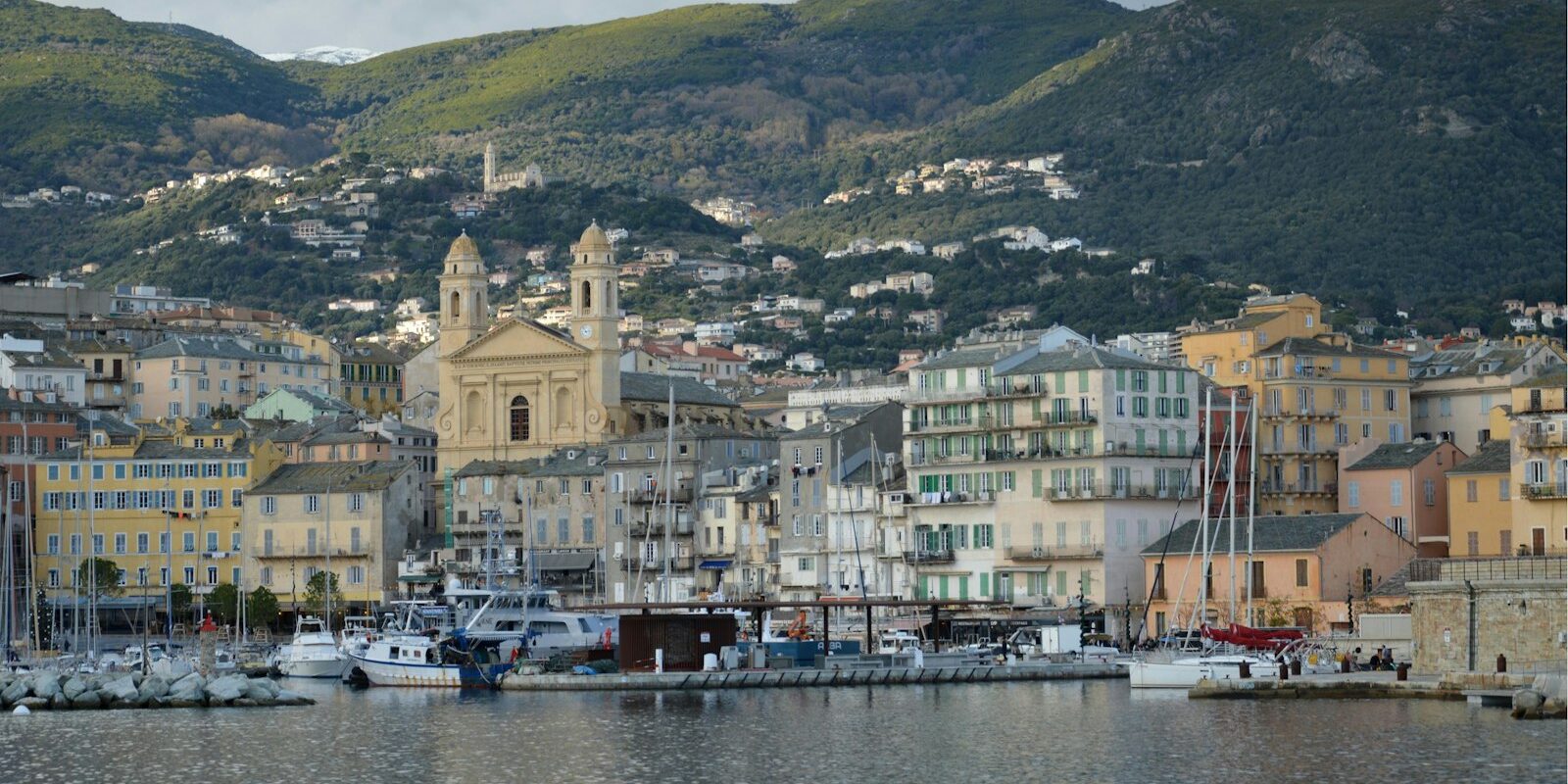
The Vieux-Port is in the heart of the old town. Tall, colourful houses stand around the basin, with the church of Saint-Jean-Baptiste and its two bell towers above; to the south rises the citadel. Cafés and restaurants line the quays.
The harbour has 267 berths on floating pontoons, 20 of them for visitors. Boats up to 12 metres lie at the pontoons, larger yachts up to 30 metres in the summer basin. The basin is 2 to 5 metres deep. Water and electricity are available on the quay, and opposite the Capitainerie there is a fuel station with petrol and diesel, open during office hours, plus free Wi-Fi. The Capitainerie is on Quai de la Madonetta.
Between 2022 and 2025 the city renovated the quays. Where cars once drove and parked, there is now a promenade with light-coloured stone paving and green spaces running from Quai des Martyrs in the north to the southern quay.
Port de Toga: berths and current situation
Port de Toga is on the northern edge of the city, north of the commercial harbour. The marina was built from 1988. It is operated by a harbour authority of the communes of Bastia and Ville-di-Pietrabugno; the harbour site lies within the territory of both communes.
With 357 berths, 60 of them for visitors, it is larger than the Vieux-Port and well sheltered from wind and swell. The boats lie at concrete pontoons. There is water and electricity at the berths, ice, a fuel station near the Capitainerie, showers, a launderette, free Wi-Fi, a slipway, an area for working on underwater hull surfaces and a chandlery nearby.
Since May 2022 the pontoons may not be entered due to risk of collapse. Mooring has been permitted again since July 2022 following an emergency repair. In November 2025 the city of Bastia extended the access ban until 20 May 2026 and additionally prohibited living aboard boats at the pontoons. The municipal council stated in December 2025 that the ban would remain in force until the pontoons are permanently repaired. At the end of March 2026 part of a pontoon sank during the night; no one was injured. As of today (October 2026), neither a lifting of the ban nor any separate rule for crew access has been announced.
What is the weather like in Bastia for sailing?
The prevailing wind in Bastia comes from the west. The Libeccio from southwest to west falls as a katabatic wind over the mountains of Cap Corse and therefore blows particularly strongly in Bastia. In summer it usually remains dry; in winter it brings rain and thunderstorms. The Mistral reaches Corsica as a westerly, strongest in winter and spring. The easterly Levante (French Levant) blows moderate to strong and humid, most frequently from late autumn to spring; Bastia on the east coast is exposed to it. Météo-France issues a strong wind warning for the coast from 7 Beaufort, and a gale warning from 8 Beaufort.
Tides play hardly any role in the Mediterranean. Low atmospheric pressure and onshore winds can, however, raise the water level.
Which destinations are near Bastia?
From Bastia you can head north up the east coast of Cap Corse, or east across to the islands of the Tuscan Archipelago. For the west side of Corsica the route leads once around Cap Corse.
The distances are rounded over-water distances on the usual course from the Vieux-Port; consult the chart for precise planning. From Port de Toga it is just under one nautical mile less to the north.
- Macinaggio at the northeast tip of Cap Corse: around 17 nm
- Capraia (Italy): around 27 nm
- Centuri on the west side of Cap Corse: around 28 nm, around the northern tip
- Portoferraio on Elba (Italy): around 40 nm
- Saint-Florent: around 46 nm, once around Cap Corse
From Macinaggio to Capraia it is around 18 nautical miles. Between Macinaggio and Centuri the Customs Officers' Path runs along the coast on land. On the other side of Cap Corse lies Saint-Florent in the Gulf of Saint-Florent, surrounded by the Nebbiu wine-growing region with Patrimonio.
What can you do on a harbour day in Bastia?
From the Vieux-Port you can reach the old town and the citadel on foot; from Port de Toga you walk along a continuous pedestrian and cycle path by the water via Place Saint-Nicolas into the centre. The path continues to the beach at Arinella.
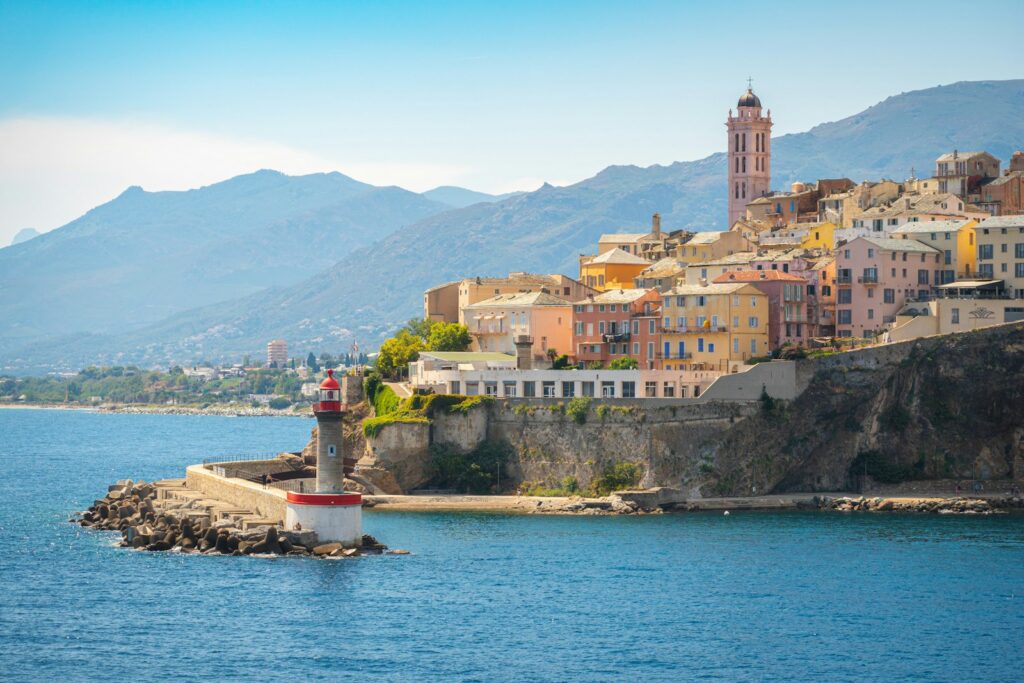
- Terra Vecchia: The old quarter around the Vieux-Port with narrow streets, fishmongers and food shops. Here stands the Church of Saint-Jean-Baptiste, one of the largest churches in Corsica, with a Baroque façade. The Oratoire Sainte-Croix is known for its black Christ.
- Citadel Terra Nova: Via the Jardin Romieu, a 19th-century garden, you climb up from the Vieux-Port by a staircase. At the top stand Genoese houses and the Governor's Palace with the Museum of Bastia.
- Place Saint-Nicolas: The large square with palm trees lies at the ferry port between both harbours. Here stands a statue of Napoleon, and you will also find the tourist office there.
- Erbalunga: The village with a Genoese tower lies around ten minutes' drive to the north at Cap Corse. In summer there are jazz concerts there.
- Beach at Arinella: A long sandy beach in the south of the city, behind which lie salt marshes with migratory birds.
For skippers: Berthing and sea weather in Bastia
You can reach both harbours on VHF channel 9.
Registration and Berthing
- Vieux-Port: Harbour office at Quai de la Madonetta, VHF channel 9, telephone +33 4 95 31 31 10, e-mail vieuxport@bastia.corsica. During the season it is manned from 8 to 12 and from 14 to 20; outside the season from 8:30 to 11:30 and from 14 to 16:30. If it is closed at lunchtime, you wait at the fuel berth. In the low season there is no one on site at weekends. In high season you reserve by telephone or e-mail. You make fast at the floating pontoons with a mooring line assigned to you by the harbour office.
- Port de Toga: Harbour office in the white tower, VHF channel 9, telephone +33 4 95 34 90 70. In July and August it is manned from 8 to 20; otherwise Monday to Friday from 8 to 12 and from 14 to 18, Saturdays from 8 to 12. You cannot reserve; the harbour office will tell you about free visitor berths by telephone or VHF; a harbour boat escorts visitors to their berth. It is not always immediately reachable by radio.
Area rules off the coast
In the 300-metre-wide strip off the French Mediterranean coast, including the whole of Corsica, you travel at no more than 5 knots, even where there are no buoys. This is regulated by an ordinance of the Préfecture maritime de la Méditerranée. Anchoring is prohibited in the outer harbour of the Vieux-Port.
Approach
As a landmark for both harbours, use the Serra di Pigno, a 961-metre-high mountain around 2 nautical miles west of the city with a red-and-white transmitter mast.
You enter the Vieux-Port from the north-east. Those coming from the north pass the entrance to the commercial harbour and watch for departing ferries. In Libeccio conditions the entrance is difficult. In the outer harbour and at the visitors' quay there is often strong swell. You approach Port de Toga only by day and reach it from south-southwest through a 30-metre-wide entrance, of which around 25 metres are usable, dredged to 4 metres depth. The harbour can be identified by the white tower of the harbour office with the red band.
Which sea weather forecast applies to Bastia?
The coastal weather forecast from Météo-France for the area "Côte de Corse" applies. The maritime rescue coordination centre CROSS MED broadcasts it in Corsica on VHF channel 79, for Bastia via the relay station Serra di Pigno. The broadcasts are announced on channel 16.
Strong wind warnings from force 7 onwards are broadcast hourly at ten minutes past the hour. Via NAVTEX you receive the forecast in English from the station La Garde, identifier W, on 518 kHz. All broadcast channels are explained in the Marine weather guide from Météo-France.
Trips from Bastia on Törnfinder
In October 2026 there are 12 trip dates on Törnfinder in the next twelve months starting from or arriving in Bastia. Most start in May, August and September; typically 8 days.
All current offers are in the trip overview. An overview of the whole island is given on the page Cabin Charter in Corsica; trips on all French coasts can be found under Sailing in France. Two harbours on the French mainland coast are presented in the profiles of Vieux-Port of Marseille and for Port Saint-Laurent-du-Var near Nice .
Frequently asked questions
How do I get from Bastia airport to the harbour?
By taxi direct to the harbour or by shuttle bus to Bastia railway station. The bus takes about 25 minutes; from the station it is around 800 metres as the crow flies to both harbours.
Do the ferries arrive at the Vieux-Port?
No, the ferries berth at the commercial harbour at Place Saint-Nicolas. It lies between the Vieux-Port to the south and Port de Toga to the north.
Where do I park at trip start in Bastia?
At Port de Toga free of charge on the landside of the harbour. At Vieux-Port there is no harbour car park any more since the quays were rebuilt as a pedestrian zone.
Are there showers in the harbours of Bastia?
Yes, both harbours have showers. Port de Toga also has a launderette; from Vieux-Port there is a launderette in Rue Luce de Casabianca.
Where do I shop for the trip in Bastia?
At Port de Toga in the supermarket directly opposite the harbour. From Vieux-Port you can walk in a few minutes to the weekend market on Place du Marché and to the food shops in Terra Vecchia.
Which VHF channel applies in the harbours of Bastia?
Channel 9, in both Vieux-Port and Port de Toga. Channel 16 is the distress and calling channel at sea.