
This page was translated automatically from German. View the original
The Beaufort scale divides wind into 13 levels, from 0 (calm) to 12 (hurricane). To put it into perspective: 4 Beaufort is 11 to 16 knots or 20 to 28 km/h, and 6 Beaufort is 22 to 27 knots or 39 to 49 km/h.
The essentials at a glance
- Each Beaufort level (abbreviated Bft) stands for a fixed range of mean wind speed, measured at a height of 10 metres.
- The marine weather forecast from the Deutscher Wetterdienst (DWD) gives the wind in Beaufort, for example “Northwest 3 to 4”.
- For the German coast, the DWD warns of strong wind from 6 Bft and of storm from 8 Bft mean wind, and of gusts from 7 Bft (as of November 2026).
- Rule of thumb for 3 to 8 Bft: Beaufort times 5 minus 5 gives roughly the speed in knots.
- Gusts can be considerably stronger than the mean wind that the Beaufort number describes.
Beaufort scale as a table: wind forces in knots, km/h and m/s
The table shows all levels with the German descriptions used by the DWD. The values are internationally defined and have applied since 1 January 1949.
| Bft | Description | Knoten | km/h | m/s |
|---|---|---|---|---|
| 0 | Calm | under 1 | under 1 | 0–0,2 |
| 1 | Light air | 1–3 | 1–5 | 0,3–1,5 |
| 2 | Light breeze | 4–6 | 6–11 | 1,6–3,3 |
| 3 | Gentle breeze | 7–10 | 12–19 | 3,4–5,4 |
| 4 | Moderate breeze | 11–16 | 20–28 | 5,5–7,9 |
| 5 | fresh breeze | 17–21 | 29–38 | 8,0–10,7 |
| 6 | strong breeze | 22–27 | 39–49 | 10,8–13,8 |
| 7 | near gale | 28–33 | 50–61 | 13,9–17,1 |
| 8 | gale | 34–40 | 62–74 | 17,2–20,7 |
| 9 | Gale | 41–47 | 75–88 | 20,8–24,4 |
| 10 | storm | 48–55 | 89–102 | 24,5–28,4 |
| 11 | violent storm | 56–63 | 103–117 | 28,5–32,6 |
| 12 | Orkan | 64 and over | 118 and over | 32.7 and over |
All values refer to the mean wind speed at 10 metres above open terrain or open sea. A handy printable version is available as the official Beaufort table from MeteoSchweiz (PDF).
How do you convert Beaufort to knots and km/h?
The most accurate way is to read the value from the table. When you're out on the water, a rule of thumb will do: Beaufort times 5 minus 5 gives you roughly the speed in knots.
An example: 5 Bft times 5 is 25, minus 5 gives 20 knots. The range in the table is 17 to 21 knots. Between 3 and 8 Bft, the rule is at most around 2 knots off the middle of the respective range. Below and above that, it becomes inaccurate.
To convert from knots to other units:
- Knots times 1.852 gives km/h. In your head: double the knots and subtract about 7 per cent. So 20 knots is roughly 37 km/h.
- Knots times 0.514 gives metres per second. In your head: halve the knots.
A knot is one nautical mile per hour. You'll find more worked examples and a dedicated conversion table in the article Converting knots to km/h.
How can you tell the wind force at sea?
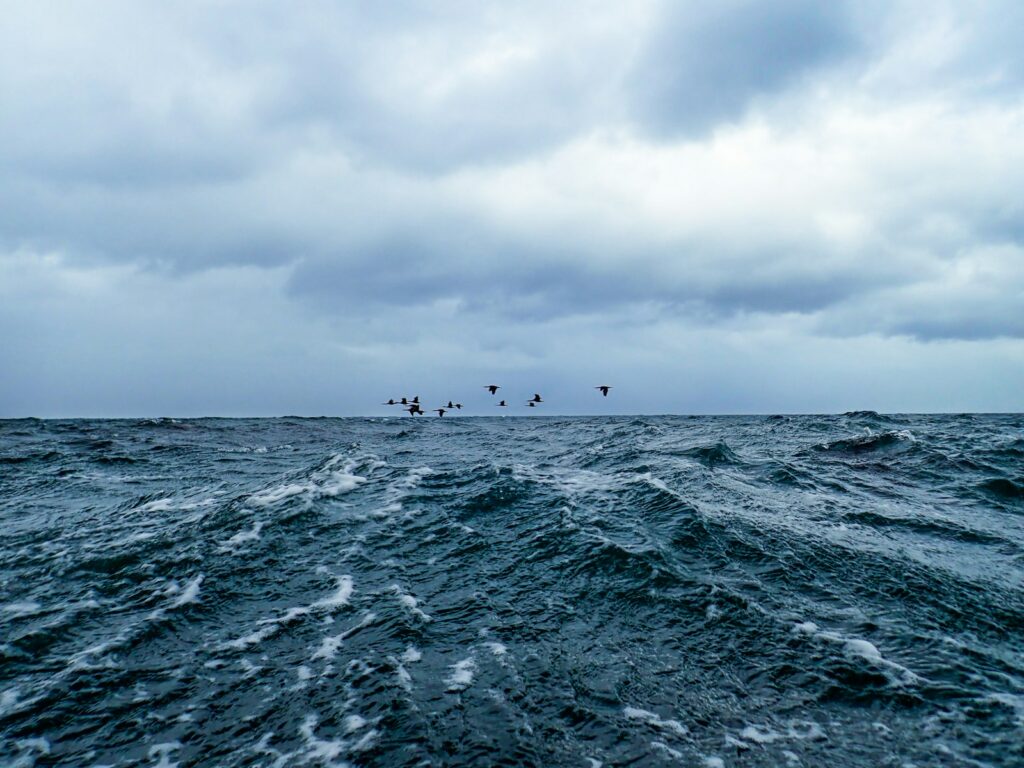
Without an anemometer, you can estimate the Beaufort force from the water itself: from the shape of the waves, from whitecaps and from streaks of foam. The table shows what the sea typically looks like at each force.
| Bft | What the sea looks like | Probable wave height in open sea |
|---|---|---|
| 0 | mirror-smooth | – |
| 1 | fine ripples without foam | 0,1 m |
| 2 | small, short wavelets, crests glassy and unbroken | 0,2 m |
| 3 | crests begin to break, first whitecaps | 0,6 m |
| 4 | longer waves, white horses widespread | 1 m |
| 5 | moderate, distinctly longer waves, white horses everywhere, some spray | 2 m |
| 6 | large waves, extensive white foam crests, spray | 3 m |
| 7 | the sea heaps up, foam lies in streaks along the wind direction | 4 m |
| 8 | higher wave heaps, spray blowing from the crests, distinct foam streaks | 5,5 m |
| 9 | high wave heaps, dense foam streaks, spray reduces visibility | 7 m |
| 10 | very high waves with long, breaking crests, the sea looks white | 9 m |
| 11 | exceptionally high waves, the sea is covered in foam | 11,5 m |
| 12 | air full of foam and spray, sea completely white, hardly any visibility | over 14 m |
The wave heights apply to fully developed wind seas on the open sea. In the lee of the land, on inland waters and in small bays, the waves stay lower because the wind has less fetch there.
Important for your assessment: the sea lags behind the wind. If the wind picks up, the waves keep growing for a while. If it eases, an old swell that no longer matches the current wind often remains.
What does wind force 6 mean for sailing?
Wind force 6 means a mean wind of 22 to 27 knots, large waves and white foam crests everywhere. From this level upwards, the German Weather Service (DWD) issues a strong wind warning for the North Sea and Baltic Sea.
There is no fixed limit beyond which you no longer sail. It depends on the boat, the sail area, the sea state in the sailing area and the experience of the crew. As a rough guide, expressly without any guarantee of safety:
- 2 to 4 Bft: steady wind and small waves. Good for learning, for manoeuvres and for first sailing trips.
- 5 Bft: white horses everywhere, the boat heels noticeably. Many yachts now sail with reduced sail area, in other words reefed.
- 6 to 7 Bft: strong wind. Feasible for well-rehearsed crews on seagoing yachts, but tiring and demanding for beginners.
- From 8 Bft: gale and storm. Here the aim is to get through the weather safely (riding it out), and it is no longer about recreational sailing.
A seamanship rule of thumb is: reef early. If you put in the first reef while the wind is still increasing, you have less work than someone who has to do it with the sail under full load.
Why the wind feels stronger on board
On board you always feel the apparent wind, that is, the true wind and the wind generated by your own speed combined. On a close-hauled course it is therefore stronger than the true wind. The display in the cockpit usually shows this apparent wind. The Beaufort number in the weather forecast, on the other hand, refers to the true wind.
Height also plays a part. The wind increases with height: over land, at a height of 4 metres it is around 20 per cent weaker than at the standard 10 metres, and at 30 metres about 20 per cent stronger. On the water the difference is smaller, but here too the wind sensor at the masthead measures more than a handheld anemometer in the cockpit.
Gusts or mean wind: what does the Beaufort number indicate?
The Beaufort number describes the mean wind, that is, the average over roughly ten minutes. Gusts are brief wind peaks and can be considerably higher.
That is why the DWD issues separate gust warnings on the coast: a gust warning is issued when gusts of 7 Bft or more are expected, even if the mean wind stays below 6 Bft. The criteria can be found on the page for the DWD coastal warnings.
In practice this means: with a forecast of 4 Bft with gusts of 6, you will sail most of the time in a moderate breeze, but must expect moments when the boat suddenly heels sharply. You should set your sail area according to the gusts rather than the mean wind.
Why does the shipping forecast use Beaufort rather than knots?
In the shipping forecast, the DWD gives wind direction and strength in Beaufort, for example “West to Northwest 3 to 4”. For sailors this has one advantage: each level can be estimated from the sea state even without a measuring instrument.
The difference between a designation and a warning is important. Force 8 is called "stormy wind", and the name "storm" only begins at 9. However, the DWD's storm warning already applies from 8 Bft. How to read the report section by section and where to receive it is explained in the article Reading and understanding the sea weather report.
How strong the Mistral, Bora or Meltemi can get is described in the article on Good months for a trip through the region are April, May, September and October. The weather is mild, it's less crowded ashore and the midsummer heat is absent. You can read how the winds in Greece work in our article about.
Who invented the Beaufort scale?
The scale goes back to Francis Beaufort, an Irish-born officer in the British Royal Navy. He noted it down in his journal in 1806 as commander of HMS Woolwich. 1805 is also often given as the year of origin.
Originally, the scale did not describe speeds but how the wind affected a sailing warship, a Royal Navy frigate. It was officially introduced in the 1830s, when Beaufort was Hydrographer of the Navy. Among the first ships to use it was HMS Beagle under Robert FitzRoy.
The speed ranges in use today have been internationally defined since 1 January 1949. Since then, they have been based on a measuring height of 10 metres. The levels are not equally wide: Force 2 spans 3 knots, while Force 10 already spans 8 knots. This is because the scale arose from observation and the numbers were only assigned later.
Learning to estimate wind strengths
Knowing the wind by the numbers is one thing. Recognising it on the water and setting up the boat accordingly is best learned out on the water with experienced sailors. On Törnfinder you will find offers for this, such as Skipper training, where reefing, sailing in stronger winds and reading the weather and sea state are on the programme.
Frequently asked questions
How many km/h is 6 Beaufort?
6 Beaufort corresponds to 39 to 49 km/h. That is 22 to 27 knots or 10.8 to 13.8 metres per second.
How many knots is 4 Beaufort?
4 Beaufort is 11 to 16 knots. This level is called "moderate breeze" and brings widespread white horses.
From what wind strength do we speak of a storm?
Force 9, i.e. 41 to 47 knots, is referred to as "storm". However, the DWD's storm warning for the coast already applies from 8 Bft mean wind.
What does the abbreviation Bft mean?
Bft stands for Beaufort. "5 Bft" means Force 5 on the Beaufort scale, i.e. 17 to 21 knots.
Does the Beaufort number refer to gusts?
No, it describes the mean wind over roughly ten minutes. Gusts are mentioned separately in the weather forecast and in warnings, and can be considerably stronger.