This page was translated automatically from German. View the original
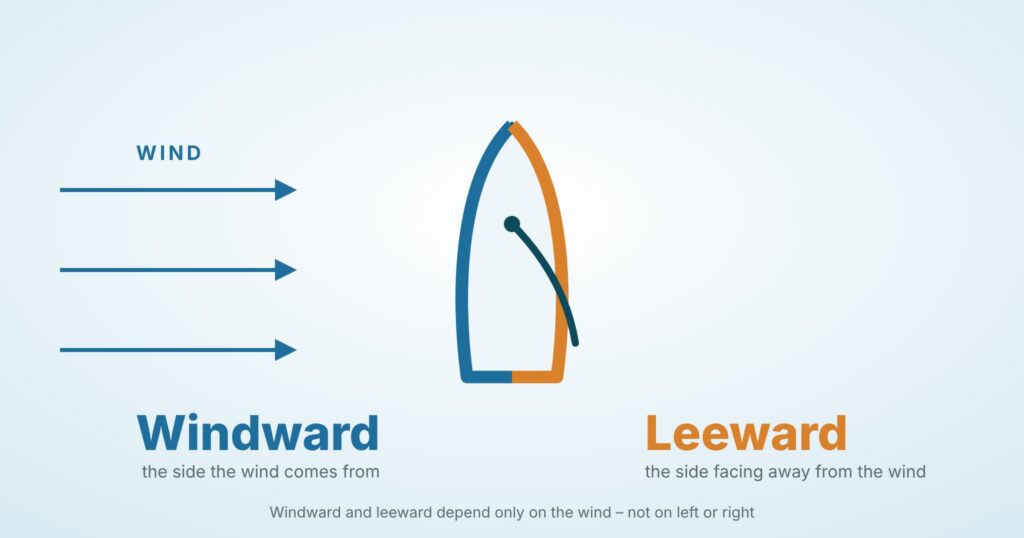
Windward is the side the wind comes from, leeward the side it blows towards. Unlike starboard and port, windward and leeward are not fixed sides of the boat: they depend on the wind and swap places with every tack and gybe.
The essentials at a glance
- Windward is the side facing the wind, leeward the side facing away from it. This applies to a boat just as much as to an island or a mountain range.
- Memory aid (in German): Aus Luv kommt die Luft, in Lee ist es leer vom Wind – the air comes from windward (Luv), and to leeward (Lee) it is empty of wind.
- If two sailing boats have the wind on the same side, the windward boat must give way to the leeward boat (“Lee vor Luv”, leeward before windward).
- Luffing up means turning closer to the wind. Bearing away means turning away from the wind.
- The mainsail is always on the leeward side. When the wind comes from the side, the boat heels to leeward.
What do windward and leeward mean?
Windward is the side facing the wind, leeward the side facing away from it. This applies to any obstacle in the wind: a ship, an island, a building or a mountain.
“To windward” means towards the wind, “to leeward” means away with the wind. If you anchor “in the lee of the island”, the island lies between you and the wind, so you are sheltered from it.
Because the wind shifts and the boat changes course, windward and leeward are relative terms. Starboard always stays on the right. The windward side, by contrast, changes as soon as the wind comes onto the other side of the boat. What the fixed sides are called is explained in the article Starboard and port.
How can you remember windward and leeward?
The easiest way is by sound, in German: Aus Luv kommt die Luft, in Lee ist es leer vom Wind (air comes from windward, and leeward is empty of wind). The boat itself also shows you the sides.
- The flag and the burgee (the small wind indicator at the masthead) stream out to leeward.
- When the wind comes from the side, the boat heels over to leeward. The high side is windward, the low side is leeward.
- The mainsail and the boom are on the leeward side.
- Tip things out, rinse or spit only to leeward. Anyone who tries it to windward gets it all back.
| windward | Lee | |
|---|---|---|
| Wind | wind comes from here | blows this way |
| On the boat | high side when heeling | low side, the mainsail is on this side |
| Change of course in that direction | head up | bear away |
| Two boats, wind from the same side | must give way | holds course |
| Coast | Land to windward offers shelter | A lee shore is dangerous |
| Mountains | Orographic lift, clouds, rain | Foehn, clouds dissolve |
What are the windward side and the leeward side of a boat?
The windward side is the side of the boat the wind hits, and the leeward side is the opposite one. For the rules on giving way this is precisely defined: the windward side is the side opposite the mainsail that is set.
This definition helps above all when running downwind. If the wind comes exactly from astern, you can hardly tell from the wind alone which side is windward. Then the mainsail decides: if it is on the port side, starboard is the windward side.
On board, each side has its own tasks. When sailing close-hauled, the crew sits on the windward side and keeps the boat more upright with its weight. The working jib sheet is on the leeward side, and the slack sheet lies to windward.
Leeward before windward: who has to give way?
If two sailing boats have the wind on the same side, the boat to windward must give way to the boat to leeward. This is laid down by the Kollisionsverhütungsregeln (KVR, as of: November 2026), which apply at sea.
The order in which you check is important:
- If the boats have the wind on different sides, the boat with the wind on the port side gives way. Leeward before windward then plays no role.
- If both have the wind on the same side, the boat to windward gives way to the boat to leeward.
- If you have the wind on the port side, see a boat to windward and cannot tell for certain which side it has the wind on, you give way.
The give-way vessel acts early and decisively so that its intention is clear to everyone. The other boat is the stand-on vessel and maintains its course and speed. The windward boat can, for example, bear away and pass astern of the other boat.
In harbours, on rivers, lakes and some fairways, separate rules may apply. The COLREGs expressly permit such special rules set by the authorities.
What do luffing up and bearing away mean?
Luffing up means changing course so that the bow turns closer to the wind. Bearing away is the opposite: you turn away from the wind, and the wind fills the sail more from behind. The article explains what the individual points of sail are called: Points of sail.
When you luff up, you sheet the sails in. When you bear away, you ease them out. When tacking, the boat luffs up until the bow passes through the wind, and then bears away again on the other side. The procedure and commands are covered in the article on Tacking and gybing.
You will hear two related terms when trimming sails: a boat with weather helm turns into the wind by itself, while a boat with lee helm turns away from the wind.
What is a lee shore?
Sailors call a coast a lee shore when the wind blows onto it from the sea, so that it lies to leeward of the boat. Anyone who is “on a lee shore” is pushed so close to the coast that there is a risk of running aground.
If the wind blows towards the land, any boat without power drifts onto the coast. That is why you keep a generous distance from a lee shore. When choosing anchorages, do the opposite: pick them so that the land lies to windward in the forecast wind direction and shelters you.
What do windward and leeward mean when berthing?
When berthing, the wind determines whether the pontoon lies to windward or to leeward of your boat. This determines whether the wind pushes you onto the pontoon or drifts you away from it.
- Berth on the lee side (the wind is blowing towards the pontoon): The boat is pushed onto the pontoon. Mooring is easy, as the wind carries you in for the last few metres. The fenders hang on the leeward side. Casting off is more difficult because the wind pushes you back onto the pontoon.
- Berth to windward (the wind blows away from the berth): The boat drifts off. You approach at a steeper angle, and the first line has to be secured quickly. Leaving the berth is easy in return, as the wind pushes you clear.
The same principle applies in box berths and on mooring lines: the windward line is made fast first, because it holds the boat against the wind.
Where do the words windward and leeward come from?
Both words entered nautical language via Low German. Luv (windward) goes back to the Dutch “loef”, a short form of “loefzijde”, the windward side. The word stem actually refers to the steering-oar side and is related to an Old High German word for the rudder blade.
Lee (leeward) comes from the Middle Low German “lē” and originally referred to the sheltered, windless side. It is related to “lau” (lukewarm). The lee shore (Legerwall) is also Low German: “lēge” means low, and “Wall” in nautical language stands for the mainland.
Windward and leeward in the mountains: orographic lift and the foehn
In weather reports and geography, too, the windward side of a mountain range is the side facing the airflow, and the leeward side is the side facing away. On the windward side the air rises, cools and often forms clouds and precipitation. On the leeward side it descends, warms up, and the clouds dissolve.
This warm, dry downslope wind on the leeward side is called the foehn (Föhn). For sailors, this means that behind a high island the wind can be considerably weaker. But it can also come tumbling down the slopes in strong gusts. In the lee of high islands, expect both.
Frequently asked questions
What are windward and leeward?
Windward is the side the wind comes from. Leeward is the side the wind blows towards.
Who has right of way, windward or leeward?
The boat to leeward, if both sailing boats have the wind on the same side. If the wind comes from different sides on the two boats, the boat with the wind on the port side gives way.
How can you tell where windward is when sailing downwind?
By the mainsail. The windward side is the side opposite the mainsail. If the boom is on the port side, starboard is windward.
What does “anluven” (to luff up) mean?
To luff up means to turn the bow closer to the wind. The opposite, turning away from the wind, is called bearing away.
Is it der, die or das Luv?
On board it is usually used without an article: “in Luv”, “nach Lee”. With an article, it is die Luv, in geography also das Luv, and die or das Lee.
Practising windward and leeward on board
The best way to notice how quickly windward and leeward switch is to feel it yourself at the tiller or the wheel. On a Sail training you sail with an instructor on board and practise courses, manoeuvres and avoiding situations. If you want to specifically train docking and undocking in a crosswind, you will find offers on Törnfinder for a Skipper training. Further technical terms are explained by the Sailing glossary.