
This page was translated automatically from German. View the original
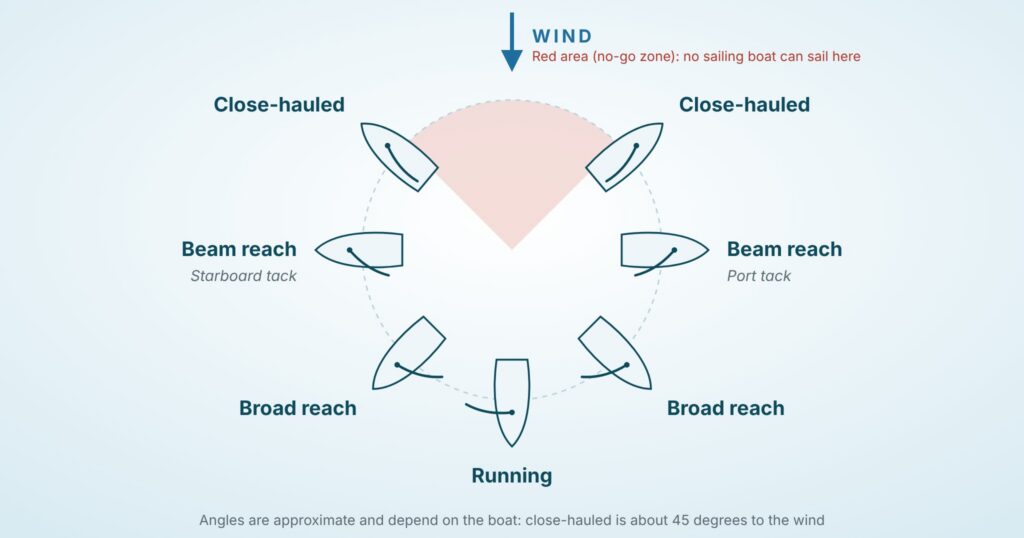
The points of sail describe the direction from which the wind meets a sailing boat: close-hauled, it comes obliquely from ahead; on a beam reach, from directly abeam; on a broad reach, obliquely from behind; and when running, from dead astern, i.e. from behind. No sailing boat can sail directly into the wind; this no-go zone extends roughly 45 degrees to either side.
The essentials at a glance
- There are four basic points of sail: close-hauled, beam reach, broad reach and running.
- What is measured is the angle between the centreline and the direction the wind is coming from: close-hauled about 45 degrees, beam reach 90 degrees, running 180 degrees.
- The further forward the wind comes from, the tighter the sails are sheeted in. The further aft it comes from, the more the sails are eased out.
- If your destination lies directly upwind, you can only make progress by zigzagging (tacking). On every tack the bow passes through the wind; on a gybe it is the stern.
- Port tack means: the wind comes from port and the mainsail is on the starboard side.
What points of sail are there in sailing?
In sailing there are four points of sail relative to the wind, plus the zone in which no sailing is possible. The table shows them from “wind from ahead” to “wind from behind”.
The angles are approximate values for a cruising yacht. How close to the wind a boat can sail depends on the hull, keel, sails and wind strength.
| Kurs | Angle to the wind (approximate) | Sail position | Feel on board |
|---|---|---|---|
| Head to wind (no-go zone) | 0 to around 45 degrees | Sails flap (luff) | The boat loses speed and comes to a halt |
| Close-hauled | around 45 degrees | Sails sheeted in fully | Pronounced heel, wind feels stronger, boat pitches into the waves |
| Close-hauled | between around 45 and 90 degrees | Sails eased slightly | Less heel, more speed |
| Beam reach | 90 degrees | Sails about half open | Wind exactly from the side, course easy to hold |
| Broad reach | between 90 and 180 degrees | Sails eased well out | Boat comes upright, wind feels weaker |
| Running | 180 degrees | Mainsail fully eased, headsail often on the other side | Hardly any heel, boat rolls in the waves, wind feels weakest |
You need two words for every change of course: heading up means turning the bow towards the wind. Bearing away means turning the bow away from the wind. If you head up from a beam reach, you come close to the wind. If you bear away, you are sailing a broad reach.
What is a close-hauled course and what does “close-hauled” mean?
You sail upwind when the wind comes from diagonally ahead. Close-hauled (also hard on the wind) is the course right at the edge of the no-go zone, roughly 45 degrees to the wind.
Close-hauled, you sheet in the mainsail and headsail as tightly as possible. If you bear away a little, you ease the sheets slightly. On this course the boat heels noticeably and takes the waves diagonally from ahead.
Close-hauled, the wind feels stronger than it actually is. The reason is the apparent wind: it is made up of the true wind and the wind generated by your own boat speed. When the true wind comes from diagonally ahead, the two add together. That is why you often reef earlier when close-hauled than a boat coming towards you with the wind further aft.
What is a beam reach?
On a beam reach, the wind comes from exactly the side, at a right angle. The sails are set about halfway out.
Beginners often practise on a beam reach first. A typical mistake is trimming the mainsail in too tightly: the heel increases and the speed drops. Ease the sheet until the sail just begins to collapse along the luff, the front edge, and then trim it in a little again.
What is a broad reach?
On a broad reach, the wind comes from diagonally behind, somewhere between abeam (exactly from the side) and dead astern. The sails are well out and the sheets are eased a long way (hence “free”).
On this course the boat stands upright and it becomes calmer on board. The apparent wind is now weaker than the true wind because the wind generated by your own speed works against it. To stop the boom from rising and twisting the sail, you set the kicker (boom vang) according to the wind strength.
What is a run?
Running downwind, the wind comes from exactly astern. On this course the true and apparent wind point in the same direction, and the wind on board is weaker by the amount of your own boat speed.
The mainsail is eased out fully. The headsail gets hardly any wind behind the mainsail, so it is often set on the other side. This sail setting is called wing-on-wing (“butterfly”). Which headsails are suitable for this is explained in the article on the different sails on a sailing boat.
Running downwind feels calm, but it is not harmless. If the wind shifts slightly or the boat yaws in the swell, so that the bow swings back and forth, the wind can suddenly catch the mainsail from the other side. The boom then swings across unintentionally – an accidental gybe. It can injure people and damage the rig. In a swell, a slightly broad reaching course is therefore often more relaxed than sailing dead downwind. On a dinghy, you raise the centreboard on this course: this reduces drag and the risk of capsizing in an accidental gybe.
Why can't you sail directly into the wind?
Because a sail only generates drive when the wind strikes the cloth at an angle. If it comes from dead ahead, the sail flaps like a flag and the boat comes to a standstill.
This area is called the no-go zone or the wind from ahead. It covers roughly 90 degrees in total, so about 45 degrees on each side. If your destination lies directly to windward, that is, on the side the wind is coming from, you have to tack.
How tacking works
You sail close-hauled at an angle to the destination on one side, tack, and carry on sailing on the other side. With each tack the boat turns through roughly 90 degrees, from close-hauled on one tack to close-hauled on the other. This creates a zigzag course towards windward.
This costs distance. At around 45 degrees to the wind, you sail a good 40 per cent further than the direct line to your destination, not yet counting leeway and current. Whether you sail many short legs or a few long ones makes hardly any difference to the distance, but every tack costs you some speed.
One advantage of tacking: when a gust hits, the apparent wind moves aft slightly for a moment. You can then luff up with it and gain height.
Tacking or gybing: how do you change tack?
When tacking, you turn the bow through the wind; when gybing, you turn the stern through it. Both manoeuvres bring the wind onto the other side of the boat.
You tack from a close-hauled course. The boat luffs up, stands briefly with her bow in the wind and falls off on the other side. You gybe from a broad reach or when running downwind. Here the boom swings across to the other side with force, which is why the crew sheets in the mainsheet beforehand. In strong winds, many skippers replace the gybe with a Q-turn, a large arc through the wind. The procedure and commands are covered in the article Tacking and gybing when sailing.
Starboard tack and port tack: what does it mean?
In English, the tack is named after the side the wind comes from. On port tack the wind comes from port and the mainsail is on the starboard side. On starboard tack it is the other way round: wind from starboard, mainsail to port.
The easiest way to read the tack is from the mainsail: the windward side is always the side opposite the mainsail. This is also how the collision regulations define it. This works on any course, even when running downwind, if the wind is coming exactly from astern.
The tack decides who has to give way. At sea the following applies (as of November 2026): if two sailing boats have the wind on different sides, the boat with the wind on the port side, i.e. sailing on port tack, gives way. If both have the wind on the same side, the windward boat gives way to the leeward boat, i.e. the boat on the side away from the wind. The full rule can be found in Rule 12 of the collision regulations. Why starboard is right and port is left is explained in the article Starboard and port.
Frequently asked questions
How many degrees can a sailing boat sail into the wind?
A cruising yacht can point roughly 45 degrees off the true wind. Exactly how close depends on the boat, the sails and the wind strength.
What does a “free wind” mean?
A free wind is wind that comes from further aft than abeam. A free course is therefore any course between a beam reach and running downwind. “The wind is veering aft” means that it is shifting further towards the stern.
What is the difference between true and apparent wind?
The true wind blows across the water, while you feel the apparent wind on board. It is created by the true wind and the wind generated by the boat's own movement: on close-hauled courses it is stronger than the true wind, while on a broad reach and when running downwind it is weaker.
Are points of sail covered in the Sportbootführerschein exam?
Yes. The official question catalogue for the Sportbootführerschein Binnen under sail contains several questions on close-hauled, beam reach, broad reach and running courses, as well as on the apparent wind.
Practise points of sail on board
Points of sail stick fastest when you steer them yourself and trim the sails accordingly. On Törnfinder you will find Sail training, where sail trim and manoeuvres are part of the programme, and Skipper training for anyone who wants to tack, gybe and beat confidently as skipper.