This page was translated automatically from German. View the original
You can't sail directly into the wind, only at an angle to it: a cruising yacht can get to around 45 degrees off the wind. The sail works like a wing, the keel keeps the boat on course, and you reach a destination straight upwind by zigzagging, known as tacking.
The essentials at a glance
- No sailing boat can sail dead into the wind. The zone on either side of the wind direction in which the sails don't draw is called the no-go zone.
- A sail that is sheeted in tightly deflects the air and so generates lift. Part of this force points forwards and drives the boat along.
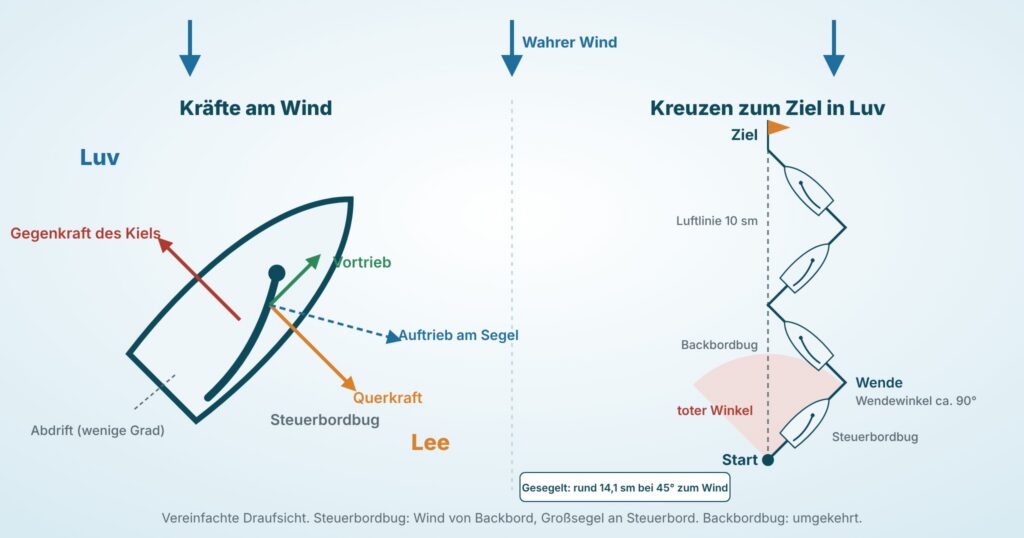
- The larger part of the force pushes the boat sideways. The keel or daggerboard counters it with an opposing force from the water.
- On a cruising yacht the tacking angle is around 90 degrees; racing yachts sail slightly closer to the wind.
- Tacking costs distance: at 45 degrees to the wind you sail a good 40 per cent further than on a direct route.
Why can a sailing boat sail against the wind?
Because the sail isn't just pushed by the wind but also deflects the air. This creates a force across the flow, and with the keel underwater it turns into forward motion.
If you sheet in the sail and steer at an angle to the wind, the air flows along both sides of the curved cloth and is deflected. On the windward side, the side facing the wind, the pressure rises. On the leeward side, the side facing away from the wind, it falls. How to remember the two terms reliably is explained in the article on Windward and leeward.
How is lift created on a sail?
Lift is created when a body deflects a flow. The force acts perpendicular to the oncoming air, in the direction opposite to the one in which the air is deflected.
On an aeroplane, lift points upwards; with a sail, the wing stands on edge. The force therefore points horizontally, diagonally forwards and sideways. Added to this is drag, which pulls backwards in the direction of the oncoming wind. Together they make up the total force on the sail.
How much force is produced depends on the angle of attack, that is, how obliquely the sail sits in the wind. If it is sheeted in too tightly, the flow on the leeward side breaks away: the sail delivers much less lift and more drag. Tall, narrow sails and deep, narrow keels work particularly effectively close-hauled, that is, on courses at an angle into the wind, because less energy is lost in vortices at their tips.
How does the force on the sail become forward drive?
The total force on the sail can be split into two parts: forward drive in the direction of travel and side force across it. Close-hauled, the side force is the larger part, and the closer to the wind you sail, the more the force points sideways.
The side force would push the boat sideways to leeward and heels it over. The forward drive, on the other hand, accelerates the boat until the resistance from hull and waves is equally great.
Why does the boat need a keel or a daggerboard?
Without a keel, the side force would simply push the boat sideways. The keel or daggerboard generates an opposing force underwater that cancels out the side force.
This also works like a wing: the boat slides slightly sideways, which is called leeway. As a result, the water flows onto the keel at an angle, and lift is created underwater, towards windward. Leeway is usually only a few degrees, around 5 degrees. The entire lateral underwater area made up of hull, keel and rudder is called the lateral plane.
What role does the apparent wind play?
The sail doesn't feel the true wind but the apparent wind. It is made up of the true wind and the wind created by the boat's own motion, and when close-hauled it comes from further ahead and is stronger than the true wind.
An example: in a true wind of 12 knots, a yacht sails at 6 knots at an angle of 45 degrees to the wind. On board you then measure around 17 knots of apparent wind from about 30 degrees. That is why the wind feels stronger when close-hauled than it really is, and the sail is trimmed to the apparent wind.
How close to the wind can a sailing boat sail? The tacking angle
A cruising yacht gets to around 45 degrees off the true wind, so it turns through about 90 degrees when tacking. High-performance racing yachts sail closer to the wind, at around 40 degrees to the wind with a tacking angle of about 80 degrees.
The tacking angle is the angle between the two close-hauled courses, that is, as close to the wind as the boat still sails well: once with the wind from port (starboard tack), once with the wind from starboard (port tack). What the other points of sail are called is explained in the article on Points of sail with angles in degrees.
| Boat type | Angle to the true wind (approximate) | Tacking angle (approximate) |
|---|---|---|
| Cruising yacht | around 45 degrees | around 90 degrees |
| High-performance racing yacht | around 40 degrees | around 80 degrees |
The values refer to the direction in which the bow is pointing. Because of leeway, the actual course through the water is a few degrees shallower, and current alters the course over the ground further.
How much extra distance does beating cost?
Beating means working your way to a destination to windward in a zigzag, tacking in between. At 45 degrees to the wind, you sail around 1.4 times as far as you would on a direct route.
An example: your destination is exactly 10 nautical miles to windward. At this angle, you cover around 14.1 nautical miles across both tacks combined. At a boat speed of 6 knots, that is just under two and a half hours. You only make progress towards the destination at around 4.2 knots.
| Angle to the true wind | Distance sailed for 10 nm to windward | Extra distance |
|---|---|---|
| 40 degrees | approx. 13.1 nm | approx. 31% |
| 45 degrees | approx. 14.1 nm | approx. 41% |
| 50 degrees (45 degrees plus 5 degrees of leeway) | approx. 15.6 nm | approx. 56% |
How often you tack makes no difference to the distance, as long as the wind stays the same. However, every tack costs a little boat speed. How a tack works and which commands go with it is explained in the article on Tacking, gybing and the tacking call “Ree”.
Myth: is the sail simply pushed by the wind?
No. If the wind merely pushed the sail, a boat could never sail any higher than a beam reach. When sailing close-hauled, the drive comes from lift, that is, from the deflected airflow.
Next time you are a passenger in a car, hold your flat hand out of the window: when it is horizontal, you feel only resistance. If you tilt the leading edge up slightly, the hand is pulled upwards. That is exactly what happens on a sail, only sideways. Pure pushing only occurs when running downwind: there, the drag of the sail drives the boat.
The explanation that the air has to flow faster on the lee side in order to arrive at the trailing edge of the sail at the same time as the air on the windward side is not correct either. In reality, it flows considerably faster still on the lee side. Pressure difference and deflection of the air are two sides of the same coin.
Putting sailing knowledge to the test on the water
The best way to feel how close to the wind a yacht can sail is to try it yourself on the tiller or at the wheel. On Törnfinder you will find Sail training, where beating and tacking are part of the daily routine, and an overview of courses and licences at Learn to sail.
Frequently asked questions
Can a sailing boat sail straight into the wind?
No. If the bow points into the wind, the sails flap and the boat comes to a stop. Only from about 45 degrees to the wind does the sail start to draw again on a cruising yacht.
Why does a sailing boat heel when sailing close-hauled?
Because the lateral force acts on the sail high above the water, while the opposing force acts on the keel below. Together they tip the boat onto its side, and the ballast in the keel rights it again.
What is a good tacking angle?
For a cruising yacht, about 90 degrees is usual, while high-performance racing yachts tack through about 80 degrees. Because of leeway, the angle actually sailed is somewhat larger.
Why is beating slower than a course with the wind abeam?
Close-hauled, the larger part of the sail force acts sideways and the smaller part forwards. On top of that comes a detour of a good 40 per cent when sailing at 45 degrees to the wind.